NOTICE OF A COUNCIL MEETING ON 29 JULY 2025 AT 11:00
Notice is hereby given that a COUNCIL MEETING of the Garden Route District Municipality will be held at the CA Robertson Council Chambers and via Zoom, 54 York Street, George, on 29 July 2025 at 11:00.
Media Release: Climate experts agree that red lights are flashing
For immediate release 09 July 2025
“Experts presenting at the 2025 GREF Climate Change Indaba in collaboration with Nelson Mandela University did not paint a rosy picture”, says Cobus Meiring of the Garden Route Environmental Forum (GREF).
At this point in time scientific data used to monitor climate change indicate that the meeting of targets and time frames to avert global catastrophe are unlikely to be achieved.
Already South Africa is feeling the pain as fire, torrential rain and angry seas hammer coastal provinces with increasing regularity causing death and destruction.
What is reported in mainstream media does not always portray wider implications. One example is local rural roads and infrastructure which are repeatedly damaged and not rehabilitated given slow economic growth and capacity. In many places the damage caused by floods to access roads and infrastructure isolate rural communities from the outside world and negatively affect mobility, trade, service delivery, economic prosperity and rural productivity.
The take- home massage for South Africa is that the country will have to get its act together and do so very fast. There is simply no more room for wasting sparse resources, counter- productive policies and tolerating predatory entities hampering vital maintenance, construction, service delivery and development.
The development of resilient infrastructure and responsible environmental management must be escalated from “nice to have” to essential. Fire, floods and drought are real and present dangers. The state of South African water quality, rivers and catchments is dire and deteriorating fast. These systems are vital not only for the sake of bio- diversity conservation, but for ensuring water security going forward.
All is not lost just yet and there are promising signs that the reaching of some climate tipping points might just be averted, but nothing can be left to chance in a fast changing natural world and failure to plan ahead will no doubt have severe implications.
Media Release: 900 Additional Smoke Alarms Now Installed by Garden Route District Municipality and Stakeholders
8 July 2025
The Garden Route District Municipality (GRDM) continues with its 10-year battery-life smoke alarm system installations within high fire risk informal settlements. This project was launched in the Garden Route during 2021. It has been a collaborative effort between the GRDM and local municipalities’ Fire Services, who identified areas based on historical call-out data, population density, access, and distances to fire stations.
Mayor Stroebel (front) with representatives from GRDM, Knysna Municipality and Asivikelani Development Action Group, shortly before their walk-about started.
Elroy Dirk (Knysna Municipality Snr. Firefighter), Mayor Andrew Stroebel and Heinrich Leslie (GRDM Station Officer).
According to Deon Stoffels, GRDM Fire Chief, “900 devices were recently installed in Smutsville within the Knysna municipal area (Lank Gewag, Skool Gaatjie, Beverly Hills, Makhaphela, Slangepark, Sukhumzamo, Onderste Gaatjie and Corona Valley). In 2024, 480 alarms were installed in Rheenendal and before that, in Kannaland too”.
Tydens ‘n besoek aan die Smutsville gemeenskap het Uitvoerende Burgemeester Andrew Stroebel met verskeie inwoners van Smutsville gesels. Magdalena Twick is een van die inwoners van Smutsville wat al drie keer haar huis verloor het. “Die laaste keer wat my woning afgebrand het is in 2023 en ek woon tans in ‘n tydelike woning wat deur Knysna Munisipaliteit opgerig is. Ek is dankbaar vir die brandalarmstelsel wat nou in my plekkie geïnstalleer is, want dit kan my enige tyd van die dag of nag waarsku teen ‘n moontlike brand”.
Burgemeester Stroebel ontmoet Magdalena Twick, wat al meer as 20 jaar in Smutsville woon.
Inside Magdalena’s temporary home is Heinrich Leslie (Station Officer), manually activates the fire alarm and explains the positioning of it to Mayor Stroebel.
Executive Mayor Andrew Stroebel, expressed his appreciation by saying: “We are deeply grateful to the Western Cape Provincial Government (WCG) Department of Local Government, under the leadership of Minister Anton Bredell, for funding this initiative with half a million Rand. It proves to the public that the WCG lends a helping hand when communities call for support. WCG also co-funded the Region’s Fire Station in 2024, supplementing the project with a R3 million shortfall, showing their further commitment to regional fire safety”.
“I’d also like to thank my MMC for Community Services, Cllr Jobieth Hoogbaard, our Fire Chief Deon Stoffels and his team, Gerhard Otto, Manager for Disaster Management and his team, for making this project a reality on the ground with external stakeholders,” said Stroebel.
MMC Hoogbaard also visited Smutsville when the devices were installed in June. ”We know that fires can strike at any moment. This happens often with little to no warning, and these impacts can be deadly. In communities, where many homes are constructed from highly flammable materials and are densely placed, a single spark can become a disaster within minutes. Imagine losing crucial documents like ID documents, birth certificates, and other important records in a fire? This is why early detection is not just important, but lifesaving as well.”
Informal houses were marked with red spraypaint, indicating which ones received a smoke detector.
Smoke detectors emit a noise ≥85dB/3m.
Knysna Municipality’s Chief Fire Officer, Ian Bezuidenhout confirmed that all areas covered, historically receive a high number of fire-related callouts. The alarms are always installed in a central area of a structure, ideally located to detect smoke from all areas within a home. As soon as it detects smoke, it emits a loud sound to alert occupants of a potential fire and provides residents time to act for a quick and safe escape. It prevents the loss of life, assets and critical belongings. Residents are also educated to then contact their Firefighters for immediate assistance.
According to project leaders Heinrich Leslie, GRDM Station Commander and Lee-Ann Joubert, GRDM Disaster Management Coordinator, residents become instantly more alert, engaging, and receptive in terms of fire prevention, which contribute greatly to a culture of safety. “Fire alarms are not only installed at homes, but homeowners are also given valuable tips on how to prevent fires.”
In order for the implementation of the project to be successful, various role-players and individual efforts are necessary and are acknowledged. They are as follows.
GRDM Fire & Rescue Services and Reserve (Volunteer) Firefighters;
GRDM Disaster Management Unit;
Working of Fire Personnel;
Asivikelani Development Action Group (Vermisha Galant, Fregan Galant, and Keanan Lamienie);
Knysna Municipality Integrated Human Settlements representative Eunis Vena; and
The Western Cape Local Government Directorate Fire & Rescue Services and Disaster Management.
Editors’ note:
In 2016 a Smoke Alarm Project was launched by Mr Anton Bredell, Western Cape Minister for Local Government, Environmental Affairs and Development Planning, developed by the Western Cape Fire and Rescue Services Directorate.
We urge the business community to support and fund similar initiatives as Local Government unfortunately cannot fill all the gaps simultaneously, and naturally, due to the economic climate, communities resort to lower cost housing, and most often, informal housing expand, which naturally are susceptible to these fire related risks. For this purpose, please reach out to GRDM Chief Fire Officer, Deon Stoffels at deon@gardenroute.gov.za.
The smoke alarms work with a DC3V lithium manganese battery. It is also recommended for the smoke detectors to be installed in corridors and starways, or in a unit outside a cluster of bedrooms.
Feature image: Junice Vene (Ward Committee Member), Mayor Andrew Stroebel, Vermisha Galant (Asivikelani Development Action Group) and Lee-Ann Joubert (GRDM Disaster Management Officer), during the walk-about.
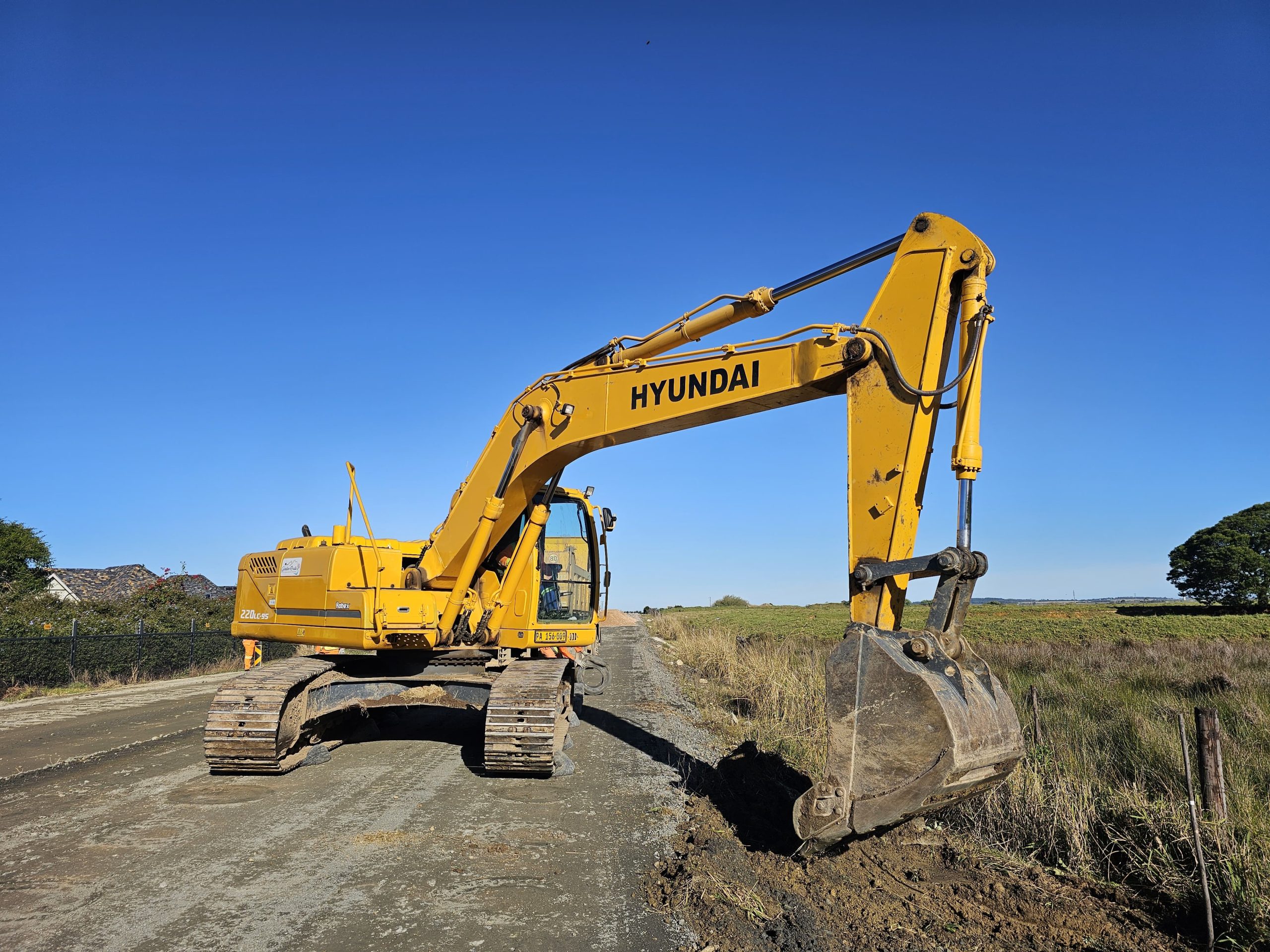
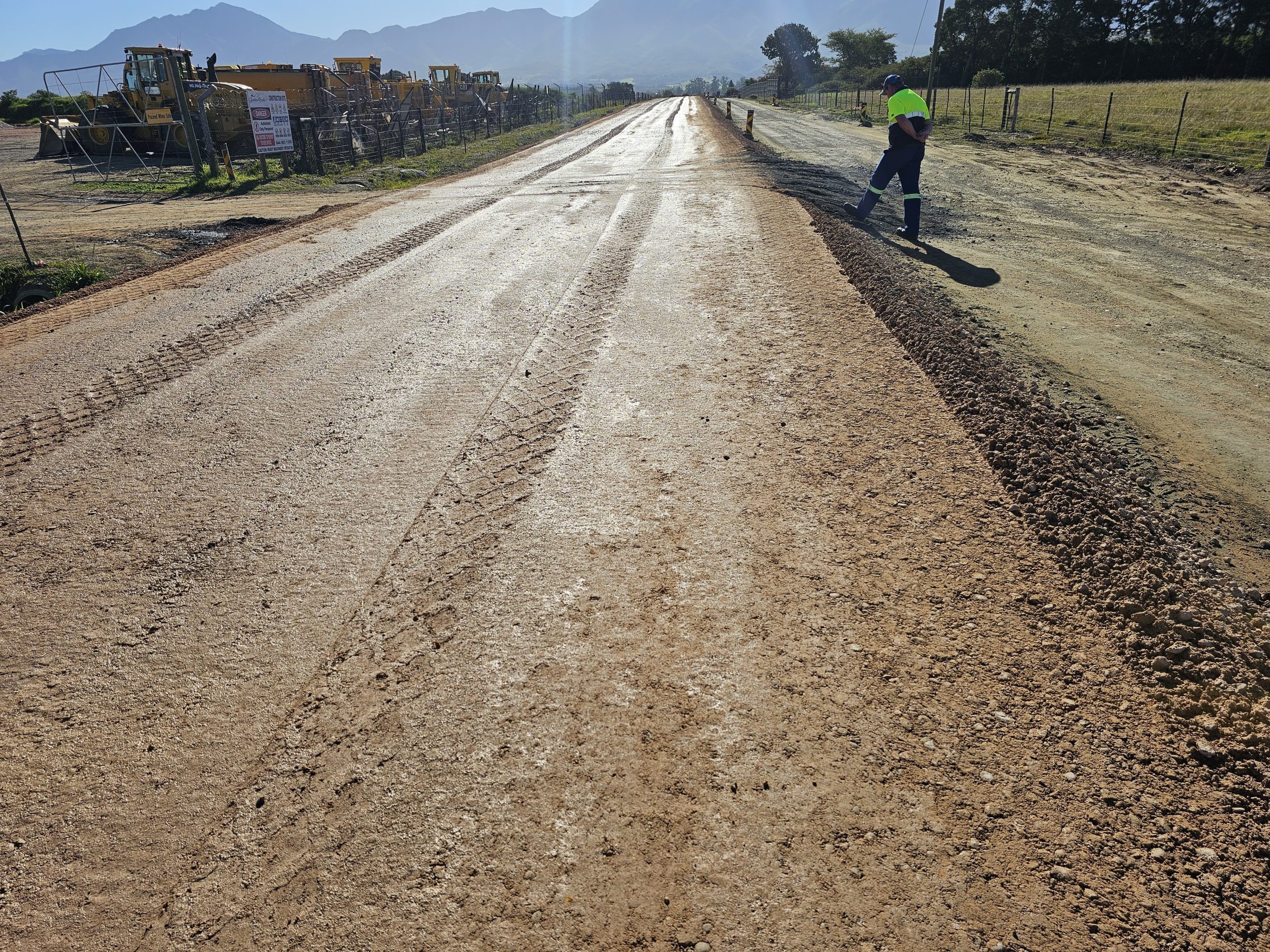
The GRDM construction team has continued with the upgrading of the Gwaiing road – nearing the completion of the placement of the final gravel layer on the right hand side lane for the full length of the project. Once this layer has cured and the final test results have been issued, the layer will then be sealed with a temporary bituminous seal.
As we are currently in the winter season, the intention is to seal the layer during the month of July with a protective armor seal, which would allow for the residential traffic to be diverted onto the right hand side lane. This would then enable the team to construct the remaining layers of the left hand side.
The project has reached 83% completion and the focus now remains on the improvement of the stormwater drainage network and the completion of the concrete headwall structures. The intended completion date for this part of the project 18 September 2025.
The final anticipated completed date for the project is 31 January 2026.
Public Notice: Access Control Measures for motorists using DR1618 – Gwaiing Road
Notice Number: 67/2025
Notice is hereby given that the Garden Route District Municipality will only permit access to residents residing along DR1618 to utilise the road which is under construction. Due to operational intensity and hazards/risks associated, only card holders and their Stakeholders will be considered. One way traffic flow with speed limit of 40km/h is enforced.
All questions and recommendations must be directed to the Site Safety Officer, Stenly Zambezi, at tel: 044-803 1414/ 078 981 0566 / Email: stenly@gardenroute.gov.za.
Nthabeleng Raisa-Mlandu Acting Municipal Manager 54 York Street
PO Box 12 GEORGE 6530 Tel: 044 803 1300
Media Release: Final GRDM Community Safety Forum Meeting for 2024/2025 Financial Year Focuses on Funding, Accountability, and Community Impact
4 July 2025
Yesterday, 3 July 2025, the final quarterly Garden Route District Community Safety Forum (CSF) Meeting for the 2024/2025 financial year took place at Garden Route District Municipality’s (GRDM) Joint Operation Centre. Stakeholders in attendance, some online, included GRDM Executive Mayor Andrew Stroebel; Portfolio Chairperson for Community Services, Cllr Jobieth Hoogbaard; the Acting Municipal Manager and Executive Manager of Community Services, Nthabeleng Raisa-Mlandu; and political and administrative representatives from the seven B-municipalities, South African Police Services (SAPS), the Western Cape Provincial (WCG) Department Social Services, and the WCG Department of Police Oversight and Community Safety (POCS).
Acting Municipal Manager officially welcome all present at the quarterly meeting and thanked them for prioritising community safety in the district. This was followed by the main discussion of the meeting, led by Vuyani Mbaqa from WCG POCS, which focused on the approval process for the 2025/2025 annual funding business plan. Feedback was provided on the six criteria that will be used as a tool to monitor and measure the effectiveness of Community Safety Forums (CSF) in local municipalities. Mbaqa during his discussion emphasized the importance of ringfencing and streamlining funding, noting that grant allocations be made based on the six criteria outcomes, making sure that local municipalities used the fund strictly for the purposes identified in their respective business plans.
Local municipalities present were given the opportunity to provide feedback on the status of their Local Safety Forums, the scheduled dates of their next CSF meetings, and the progress made on projects and objectives identified in their previous business plans.
In conclusion, GRDM Executive Mayor Andrew Stroebel delivered a word of support. “Safety is not just about statistics or patrols; it’s about people feeling secure in their homes, children walking to school without fear, and families building their futures with peace of mind. It’s about love – love for our communities, our neighbours, and the places we call home,” Stroebel said. He went on to thank all stakeholders, “From the SAPS officers to municipal officials, forum members, and community representatives. Your commitment, even when the work is tough, is truly inspiring”.
Following the formal programme, the GRDM Executive Mayor, the MMC for Community Services, and the Acting Municipal Manager handed over safety equipment and PPE to local municipal officials for use by their CSF members. The forum meeting was chaired by Cllr Jobieth Hoogbaard, with Gail Bekeer serving as secretariat.
Featured image and above: GRDM team with representatives from Hessequa Municipality.
Media Release: Public-Private EV Charging Partnership Launched in Garden Route
For immediate release 03 July 2025
The Garden Route’s green mobility future is charging forward with the confirmation of a landmark public-private pledge signed this afternoon at the François Ferreira Academy. The initiative commits land and infrastructure for the establishment of a new Electric Vehicle (EV) charging station in George – one of the first of its kind in the region.
As part of this pioneering initiative, the François Ferreira Academy has donated the site for the first EV charging station to be installed by Solar Energy Africa, a leading national provider of solar power solutions. The pledge signed by Mayor Stroebel and stakeholders includes the Garden Route District Municipality (GRDM) and Africa Skills Private Training, both instrumental in the region’s economic and skills development.
This collaboration marks the first step in a broader rollout of EV charging stations strategically located along the N2 and in rural tourism nodes from Cape Town International Airport to Plettenberg Bay. The goal is to future-proof mobility in the Garden Route and beyond—supporting the transition to electric transport and enabling infrastructure for both locals and visitors.
This collaboration follows the Garden Route EV Seminar, hosted last week at Africa Skills GeorgeTech, where the growing demand for skilled artisans to support the EV sector took centre stage. The seminar explored South Africa’s evolving EV market and its impact on training, artisan development, and job creation.
The EV pledge was formally signed by:
Executive Mayor of GRDM, Alderman Andrew Stroebel
Jessica van der Merwe, Managing Director of Solar Energy Africa
Phillip Harmse, Director: New Business Development of UXi Artisan Development
The Western Cape Government is actively transitioning its public transport and fleet vehicles to electric alternatives. In alignment with this, Africa Skills has already introduced EV-relevant artisan training through its work-integrated learning model and accredited electrical apprenticeships.
“This shift to electric mobility is more than just an infrastructure change – it’s a skills revolution,” said Phillip Harmse. “From battery technology and EV maintenance to solar integration and charging installation, Africa Skills is equipping young artisans to meet this fast-growing demand.”
Speaking at the seminar, Anthonie Janse van Rensburg, Acting Chief Director of the Western Cape Department of Mobility, confirmed the rollout of new EV infrastructure. “Our vision is to establish fast, efficient EV charging hubs across the N2 corridor and urban centres. This is part of our broader EV fleet migration strategy for provincial and local government.”
Executive Mayor Andrew Stroebel reaffirmed the municipality’s vision: “As a global tourism hub, the Garden Route must be EV-ready. We’re embracing innovation and partnerships to make this happen.”
As demand for EV adoption increases and the national government explores limitations on internal combustion imports, the Garden Route stands poised to become a leading green mobility destination – powered by solar, driven by skilled artisans, and supported through strong public-private collaboration.
Issued by UXi Artisan Development
Enquiries Images, Soundbites or Interviews: Jan Greyling – 082 556 8778, jan@uxi-ad.co.za
Feature Image:
FLTR: Alex Engelke (Corporate Services: UXi Artisan Development & Africa Skills, Phillip Harmse (New Business Development: UXi Artisan Development), Jessica van der Merwe (CEO: Solar Energy Africa), Andrew Stroebel (Executive Mayor: Garden Route District Municipality), Johan du Plooy (Operations Manager: François Ferreira Academy & Apprentice) and Lizelle Wessels (Corporate Services: UXi Artisan Development).
Public Notice: Garden Route & Klein Karoo (GR&KK) Tourism Strategy is open for public perusal and comment
Notice Number: 65/2025
Notice is hereby given that the Garden Route & Klein Karoo Tourism Strategy is available for public perusal and comments for 14 days closing on 10 July 2025.
All questions and recommendations can be directed to Raylene Meyer at tel: 044-803 1405 / E-mail: raylene@edendm.co.za.
Click here to download the Tourism Strategy
Nthabeleng Raisa-Mlandu Acting Municipal Manager 54 York Street
PO Box 12
GEORGE
6530
Tel: 044 803 1300
Notice number: 65/2025
Notice is hereby given that the Garden Route District Municipal Council’s Third Adjustments Budget for the period 2024/2025-2026/2027, was compiled in accordance with the Local Government: Municipal Finance Management Act 2003 (Act 56 of 2003).
This document was approved by the Garden Route District Municipality at a District Council meeting held on Thursday, 26 June 2025.
This document will be available for public inspection and comments on the GRDM municipal website www.gardenroute.gov.za from 27 June 2025.
Members of the public are invited to submit written comments or representations to the municipality in respect of this document. All comments and inputs must be directed to: The Acting The Municipal Manager Garden Route District Municipality 54 York Street George 6530
Please contact the Budget Manager (Ms Louise Hoek) at 044 803 1300 with any enquiries.
N Raisa-Mlandu
Acting Municipal Manager
Garden Route District Municipality
APPROVED SERVICE DELIVERY AND BUDGET IMPLEMENTATION PLAN (SDBIP) 2025/2026
NOTICE NR 64/2025
Notice is hereby given in terms of the Municipal Finance Management Act (56 of 2003), Section 69(3) and 53(1)(c)(ii), (iii) and MFMA Circular No.13 that the Service Delivery and Budget Implementation Plan (SDBIP) for 2025/26 was approved by the Garden Route District Municipality’s Executive Mayor on 22 June 2025.
Full details regarding the approved SDBIP is available on the municipal website www.gardenroute.gov.za under the heading: Documents/Performance Management.
For more information, please contact the GRDM Manager: Performance Management, Ms Ilse Saaiman, at: Tel: 044-803 1300 / E-mail: pms@gardenroute.gov.za.
Nthabeleng Raisa-Mlandu Acting Municipal Manager 54 York Street PO Box 12 GEORGE 6530




 As part of this pioneering initiative, the