Media Release: Waste Management Licence for construction of the GRDM Regional Waste Management Facility extended with 10 years
For immediate release 17 March 2023
An Environmental Impact Assessment (EIA) with regards to the process of establishing a Regional Waste Management Facility for the Garden Route District Municipality (GRDM) was completed during 2012.
Following the finalization of the EIA process, the GRDM was issued with an Environmental Authorisation by the Department of Environmental Affairs & Development Planning (DEA&DP) and a Waste Management Licence (WML) (no. 12/9/11/L1395/9). This was issued by the Department of Forestry, Fisheries & the Environment (DFFE). The licence was issued to GRDM (Eden DM at the time) on 05 February 2014.
A condition of the WML is that the activity i.e., construction of the Regional Waste Management Facility, is to commence within a period of two (2) years from the date of issue of the WML. Due to the various delays in the establishment of the facility, including the inconclusive Public Private Partnership process that did not come to fruition largely because of the Covid-19 pandemic, GRDM had to apply to DFFE for an extension of the commencement date on a bi-annual basis. The last approved extension of the commencement date was to expire on 24 May 2023, and another application for an extension of the commencement date was submitted on 07 December 2022.
The WML is only valid for a period of ten (10) years from the date of issue (05 February 2014); meaning the validity period of the WML was to expire on 05 February 2024. Therefore, together with the application for an extension of the commencement date, GRDM further applied for an extension of the validity period of the WML.
Approval of the commencement date was granted for a further two years, and an extension of the validity period of the WML was extended with ten (10) years. The extension was issued by the DFFE on 06 March 2023.
Media Release: First phase of the Regional Waste Management Facility scheduled to conclude by 30 June 2023
For Immediate Release 22 June 2022
Garden Route District Municipality (GRDM) appointed Zutari (Pty) Ltd to design and draft tender documentation and contract supervision for the Garden Route Regional Waste Management facility and associated infrastructure on Farm 419 in Mossel Bay. The design drawings and report have already been submitted on 6 May 2022 to the Department of Forestry, Fisheries and the Environment (DFFE) for statutory approval.
COST OF THE NEW SITE
The final cost of the site can only be determined once the loan tender, construction tender and the operations & maintenance tender have been concluded. The loan tender will require funding institutions to provide 10-, 15- and 20-year loan funding options. The costs will include the construction of the landfill and associated infrastructure, the loan repayment and associated interest rates, operation costs including plant and equipment, rehabilitation costs etc.
WHAT WILL THE SITE INCLUDE?
The Regional Waste Management Facility will include a domestic waste cell (Class B) and a separate hazardous waste cell (Class A) to accommodate hazardous waste with low and medium hazard ratings. Other infrastructure includes roads, stormwater pipelines, a leachate storage dams, a stormwater dam for contaminated liquids, offices, a laboratory, weighbridges, a workshop, and security infrastructure. Provision has also been made to accommodate a waste tyre recycling facility by means of a 3-hectare portion of land for long-term lease to the Waste Bureau. The domestic waste Cell 1, as well as the hazardous waste cell, will both have a lifespan of approximately 20 – 25 years.
HOW FAR HAS THE PROJECT PROGRESSED?
An Environmental Impact Assessment was concluded in 2012 and GRDM received Environmental Authorisation. A Waste Management Licence was issued by DFFE in 2014. A section 78 investigation in terms of the Municipal Systems Act, concluded to provide the Regional Waste Management Services by means of a Public-Private Partnership. A Private Partner was appointed to construct the facility and operate it for a period of ten years, however, withdrew from the Public-Private Partnership (PPP) at the final stages of the process on 29 September 2020.
GRDM then concluded to no longer pursue the PPP process and opted to rather make use of loan funding to construct the facility and to outsource the operations and maintenance to a reputable service provider.
The Geotechnical and Geohydrological Investigations required to finalise the designs of the facility have been concluded and the design drawings and design report have been finalised & submitted to DFFE on 06 May 2022 for approval which is required prior to commencement of construction.
The loan tender was advertised on 15 May 2022 and closed on 21 June 2022. The construction tender specifications are being finalised & scheduled to be advertised in July 2022. The operations & maintenance tender will also run concurrently to the construction tender process.
Phase 1 of the construction of the facility is currently scheduled to be concluded by 30 June 2023, at which time waste disposal can commence.
Media Release: Garden Route DM hosts successful Waste and Biomass Beneficiation Conference
For Immediate Release 18 August 2021
The Garden Route District Municipality (GRDM), in partnership with the Western Cape Department of Environmental Affairs and Development Planning, Western Cape Economic Development Partnership and Climate Neutral Group, concluded a very successful Waste and Biomass Beneficiation Conference on 12 August 2021.
During his opening remarks, Ald. Memory Booysen said that he was confident that the GRDM would be setting the tone for the Garden Route to become the most resilient and progressive in the Western Cape and South Africa. Mayor Booysen stated that the GRDM regards energy remained a central part of what was being explored during the Conference. “Beneficiation is key for us to become sustainable – we already tick many of the boxes and we have the political will to carry it through,” he said.
During the Conference, it was evident that there is an appetite for developing waste and biomass beneficiation solutions and how it can benefit the Garden Route to form part of a new drive to go green with a selection of technologies. These technologies include alien invasive plants (AIPs) and general waste as a resource. Some applications discussed during the Conference included the manufacturing of syngas or ethanol, to produce Black Pellets or carbon-rich material produced during a pyrolysis process for agricultural use, generating energy (electricity) and many other applications.
Twenty-four (24) industry experts presented their topics under the following main conference themes:
The Waste and Biomass situation in the Garden Route and Western Cape
Completing the value chain — keeping the Cluster sustainable and looking after the environment
Logistics and infrastructure
Turning Waste and Biomass into Value
Finance and Development options
The Conference covered a wide variety of topics to assist technology and solution providers with access to all the essential facts and numbers needed to build a true business development project, based on tangible collaboration opportunities in a potential Waste Beneficiation Cluster or precinct. Close to 180 delegates (including presenters and organisers) attended the Conference with representation from the Private Sector, Government, Investors, NPOs and Academia.
During his closing remarks and unpacking of the steps to follow the Conference, GRDM Municipal Manager, Mr Monde Stratu thanked the organisers and said: “We invite all stakeholders to participate in formulating a strategic framework and action plan for the invasive biomass economy in South Africa and more specifically the Garden Route.” Stratu also stated that the development of a new brand of Small-, Medium and Micro Enterprises would be a critical component to ensure that the biomass value chain of the region is elevated beyond the supply and demand towards a restorative economic model.
The GRDM and its partners are keenly looking forward to taking the next steps forward to find solutions to minimise waste and maximise value.
Garden Route Waste and Biomass Beneficiation Conference – 12 August 2021 from 09:00 till 17:00
Presentations and panel discussions on the state of the Waste and Biomass situation in the Garden Route and possible opportunities for Waste and Biomass beneficiation and minimisation solutions.
Despite the Covid-19 economic implications and other issues, there is a huge interest to develop waste and biomass beneficiation solutions that can benefit not only our region, but also be part of a new drive to go green with a selection of technologies, using both alien invasive plants (AIPs) and general waste as a resource.
Interest was expressed to use AIPs and other waste to either manufacture syngas or ethanol, produce Black Pellets or biochar for agricultural use, generate energy (electricity) for local use and becoming less dependent on Eskom, or many other applications.
The Garden Route District Municipality, the Western Cape Government, the Garden Route Development Partnership and the Climate Neutral Group have partnered to present the Waste and Biomass Beneficiation Conference in August. We are privileged to confirm the services of more than 20 presenters and experts across a wide variety of topics to assist you – as a technology and solution provider – with
access to all the important facts and numbers you will need to build a true business development project that is based on tangible collaboration opportunities in a Waste Beneficiation Cluster or precinct.
THE FOLLOWING BROAD TOPICS WILL BE COVERED:
The Waste and Biomass situation in the Garden Route and Western Cape
Completing the value chain — keeping the Cluster sustainable and looking after the environment
Media Release: GRDM Home Composting Project participants commence with capturing of organic material
For immediate release 02 July 2021
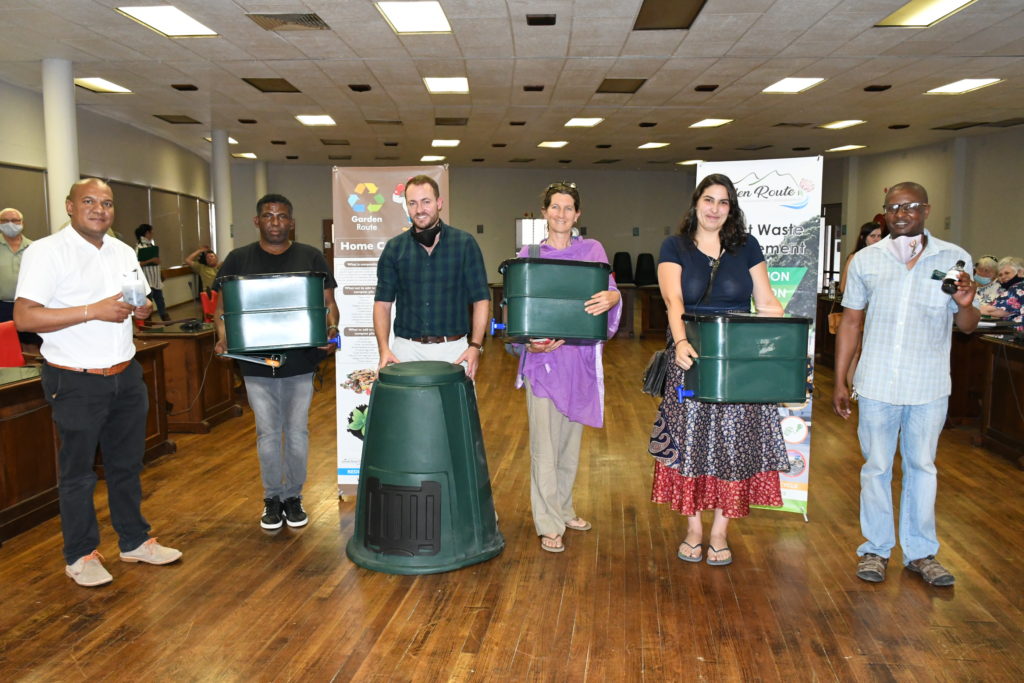
Yesterday, 01 July 2021, the Garden Route District Municipality (GRDM) staff that participate in the Home Composting Pilot Project, commenced with the capturing of their organic waste data. These thirteen (13) participants from various Sections within the organisation received their worm farms and composting bins from the GRDM Waste Management Unit on 11 June 2021 at the Municipality’s head-office in George.
Participant, Monnique Anthony, said: “I support the idea of reducing waste at our landfill site. I am excited to see the results but the process requires time and patience which will be quite exciting, yet challenging at the same time”.
Thirteen (13) staff members from various Sections within the organisation forms part of the project. Before taking the items in acceptance, the participants attended an information workshop that was presented by Johan Gie, the GRDM District Waste Management Officer. The following topics were discussed during the session: the profile of domestic waste in the Garden Route; the benefits of home composting; types of composting such as cold, warm and vermi-composting; what to compost and what not to compost etc.
The project has already been implemented in all seven (7) local municipal areas of the Garden Route.
The information workshop was presented by Johan Gie, District Waste Management Officer at Garden Route District Municipality.
According to Gie, from January 2018 – December 2020, a total of sixty (60) tons of recyclable materials was weighed, recorded and diverted from landfill by means of the GRDM Office Recycling Programme”. He added: “This initiative aims to divert waste even further by extending the programme to include organic waste composting generated in the offices, e.g. tea bags, coffee grounds, banana peels, apple cores, etc.”. With these projects, internally and in the various communities, the municipality aims to reach the targets set by the Department of Environmental Affairs and Development Planning (DEA&DP) to divert 50% of organic waste from landfill within the entire district by 2022. Gie further emphasised that the targets set by DEA&DP include a total ban on organic waste to landfill by 2027. “Therefore, as a district municipality, we are striving towards reaching these targets for the Garden Route,” he highlighted.
In ensuring that the participants are fully equipped to start with the capturing of information, they each received an electronic scale, datasheets, and a composting guideline. These resources will enable each participant to accurately record essential information relating to their recycling activities. All information will then be reported to the GRDM Waste Management Unit on a monthly basis for a one year period.
The composting bin and worm farm that were handed over to each participants of the project.
A guide and scale provided to each participant to capture the information throughout the year.
The data collected from the Home Composting Pilot Projects will be used to demonstrate the feasibility and motivate the various local municipalities within the district to further roll out home composting programmes within their respective municipalities.
Did you know?
The benefits of compost include:
With Compost, you are creating rich humus for your garden. This adds nutrients to your plants and helps retain moisture in the soil;
Composting can divert as much as 30% of household waste away from the garbage bin;
Diverting organic waste from landfill – extend lifespan of landfills and reduce transport & management costs;
Microscopic organisms help aerate the soil, break down organic material for plant use and ward off plant diseases;
Composting offers a natural or “green” alternative to chemical fertilizers (emissions transport & machinery, packaging) – it is good for the environment;
No need to purchase compost or fertilizers.
What waste to compost?
Kitchen waste
Fruit & vegetable scraps
Eggshells (crushed)*
Green leaves
Grass clippings
Garden plants
Lawn & Garden weeds*
Coffee grounds
Tea leaves / bags
Manure*
Shrub prunings
Wood ash
Dry leaves
Cardboard
Newspaper & shredded paper*
Sawdust & wood chips*
What not to compost
Anything containing meat, oil, fat or grease
Diseased plant material
Sawdust or woodchips from treated wood*
Dog or cat faeces
Weeds that have seeds*
Dairy products
Coal ash
Cooked foods
Nappies and used tissues
Glossy or coloured paper*
For more information regarding recycling or home composting, contact the GRDM Waste Management Unit at 044 693 0006 or via e-mail at: johang@gardenroute.gov.za.
Media Release: Eradication of illegal dumping campaign in George extended to end of March 2021
For immediate release 4 February 2021
With the roll-out of the Illegal Dumping Project in George last year and the various phases that have been implemented so far, the timeframe of the project has now been extended to the end of March 2021, according to Morton Hubbe, Garden Route District Waste Manager.
The Illegal Dumping Project is a joint initiative between Garden Route District Municipality (GRDM) and George Municipality in the fight against the illegal dumping of waste in the George and surrounding areas. The project was launched in Thembalethu and Pacaltsdorp during October last year, however the financial assistance by GRDM to George Municipality for the renting of machines to remove the waste has ended on 30 November 2021. George Municipality subsequently decided to continue with the renting of machines at their own cost.
Waste burnt in skips placed at hotspots areas within the George municipal area.
With the funds made available to George Municipality, Hubbe said: “Nine skips were placed at various spots within the Thembalethu and Pacaltsdorp areas and are rotated to other illegal dumping hotspots within these two areas”.
George Municipality is already in the process to secure more funds in order for the project to continue to achieve the desired outcomes.
Deployment of EPWP workers
In addition to the project, two teams of thirty Expanded Public Works Programme (EPWP) workers are working in both areas to clean-up illegal dumping hotspots throughout these areas. Various items are then placed into nearby skips, for removal. So far nearly 2700 tons of illegally dumped items have been removed with JCBs and Tipper Trucks in both areas.
Awareness about illegal dumping
One of the components of the project, is to create awareness about illegal dumping in the most effected areas. For this purpose, 36 educators were appointed to conduct door-to-door sessions in the respective areas. Households reached also have an opportunity to complete a survey regarding the issue at hand. Questions focus specifically on personal experience in relation to waste removal in their specific areas, the reporting of illegal dumping to the local municipality etc. To date, two thousand (2000) households have been visited and the more are expected to follow. These visits will be conducted until the end of March this year.
Waste burned in Skips
Although the skips are placed at identified hotspots, it has come under the attention of the both municipalities that people within these areas are burning their waste in the skips. This is an unacceptable behaviour and residents are requested to directly report these incidents to the Law Enforcement Unit of George Municipality at 044-801 6350 or sprins@george.gov.za. The skips are only used for the purpose to dump waste and efficient plans to remove full bins are in place.
Media Release: Municipalities place skips in Thembalethu and Pacaltsdorp
For Immediate Release 24 November 2020
Illegal dumping sites remain a problem for all seven (7) local municipalities in the Garden Route. As part of the Garden Route District Municipality (GRDM) and George Municipality (GM) illegal dumping response, Thembalethu and Pacaltsdorp have been earmarked for additional assistance. As of now, nine (9) x 6m³ waste skips have been placed at illegal dumping hotspots. This includes seven (7) for Thembalethu and two (2) for Pacaltsdorp. These waste skips are being hired for the interim until George Municipality has concluded the procurement process of their own waste skips to be placed in and around illegal dumping hotspots in George.
Members of the public are urged to make proper use of the waste skips for disposing their household waste. The skips are meant to be used for refuse that cannot be stored until the weekly refuse removal days of GM.
According to Johan Compion, Manager: Municipal Health and Environmental Services for GRDM, “The placement and proper management of skips could also provide a solution to illegal dumping. We are hopeful that a notable change will be visible as this pilot project continues, in addition, we await survey data being collected at the moment to provide more insights into the issue.”
Skips are free for everyone to use, but at the same time the public has to keep in mind that once skips are removed from hotspot areas, it does not mean that illegal dumping is permitted. General assumptions by GRDM about illegal dumping is that it takes place more frequently in informal or poorer communities because people can’t afford the transport or removal of waste to waste transfer stations.
The process of ensuring that skips are frequently emptied involves skip contractors. These small business owners are responsible for transporting waste skips to the George Waste Transfer Station. After emptying each skip, the containers are returned to the hotspots where they were collected. The help of 30 EPWP workers is evermore important as they assist municipalities to clear areas inaccessible to machinery. These same EPWP workers also tasked to assist the public, especially the elderly and children, to dispose of waste into the skips.
Twelve (12) Expanded Public Works Programme (EPWP) participants are still on the ground working with the JCBs to clear illegal dump sites. Thirty six (36) educators are also doing door-to-door education and awareness as well as a survey to determine the causal factors of illegal dumping; and the community requirements; or possible solutions to prevent issues in future. Twenty four (24) educators are working in Thembalethu and 12 in Pacaltsdorp. Each person, who moves in a group of six (6), is easily identifiable by a high visibility vest and identification cards.
Garden Route District Municipality wants to remind the public that Illegal dumping is a danger to your health and that of your children and animals – let’s put an end to illegal dumping and report perpetrators to our local municipalities.
Caption: A skip used for dumping waste at a spot in Nelson Mandela Boulevard.
Media Release: Awareness about the dangers of illegal dumping continues
For Immediate Release 12 November 2020
Garden Route District Municipality (GRDM) and George Municipality recently started weekly clean-up activities in the illegal dumping and Covid-19 hotspots in Thembalethu and Pacaltsdorp areas in George. A Memorandum of Agreement (MOA) has already been signed to cement both institution’s agreement to achieve a certain set of goals over a 4-month period with the option of extending clean-up it. The MoA, provides specifics in terms of how the project will continue and how funding of R2.47 million injected into the project by GRDM will be utilised.
One of the frequently found items at illegal dumping sites – face masks.
Expanded Public Works Programme (EPWP) workers and educators have been appointed to be the change-makers tasked to bring about a clean, green and a safe George. During their initial discussions, both municipalities identified the need for educators to interact and share valuable information with communities about illegal dumping, refuse removal and communication about waste management. Thirty six (36) educators are already doing door-to-door education and awareness as well as a survey to determine the causal factors of illegal dumping; and the community requirements; or possible solutions to prevent issues in future. Twenty four (24) educators have been assigned to Thembalethu and 12 to Pacaltsdorp. Each person, who moves in a group of six (6), is easily identifiable by a high visibility vest.
Educators received training on 10 November and the eager group commenced work on 11 November. The educators use masks and hand sanitisers in order to ensure that all health protocols are adhered to during their daily walkabouts, which is expected to continue for a 4-month period.
Executive Mayor for GRDM, Alderman Memory Booysen and the Portfolio Chairperson for Community Services at GRDM, Cllr Khayalethu Lose, and other leaders decided that the regional waste management office needs a joint approach to confront the illegal dumping phenomena. “We can only solve illegal dumping if municipalities get the buy-in from the public and their support for the project,” said Alderman Booysen. He further stated that, “GRDM and all the local municipalities wishes to remind the public that illegal dumping is a crime – we cannot let this continue and ruin our beautiful Garden Route. What about our future, that of our kids and our environment?”
The waste management unit, communicators and environmental health practitioners from GRDM work closely with George Municipality and have weekly planning sessions to address challenges. Morton Hubbe, GRDM Manager: Waste Management, said: “By having educators on a grassroots level we hope to gain a better understanding about public perceptions relating to waste management, current service delivery gaps and general issues in some wards”.
GRDM wishes to remind the public that illegal dumping of waste is dangerous and a health hazard. Waste should be collected in refuse bags and placed for collection on waste removal days. The communities are also urged to participate in the survey in order for municipalities to determine what needs to be done to assist the communities to prevent illegal dumping.
Weekly clearing of illegal dumping sites continues – above is an example of the good work done.
Some of the educators who are already in Pacaltsdorp and Thembalethu to create awareness about illegal dumping.
ENDS
Caption for feature image: Two of the 36 educators raising awareness about illegal dumping and conducting surveys in Pacaltsdorp.
Media Release: Garden Route DM collaborates with Oudtshoorn Municipality on a home composting model
For Immediate Release 17 November 2020
Garden Route District Municipality (GRDM) has collaborated with the Greater Oudtshoorn Municipality in a home composting pilot project to motivate households in the municipal area to consider home composting to reduce the burden on the Grootkop Waste Disposal facility.
The project was launched on 4 November 2020 at the Oudtshoorn Municipality’s Banquet Hall, in an information session attended by the residents of the Greater Oudtshoorn who showed interest in participating in the initiative. The 30 residents of the Greater Oudtshoorn who committed to participate in this pilot project received home composting bins, guidelines, worm farms, datasheets and scales.
Johan Gie, the GRDM’s waste management officer said the reason that motivated the GRDM to initiate this project with municipalities throughout the district is because, “approximately 30% of all household waste being disposed of at landfill consists of organic waste that could potentially be diverted from landfill by means of household composting”.
“The organic waste stream in municipal areas is increasingly becoming a challenge to manage,” Gie said. “Growth in population densities, new environmental legislation, limitations in the sustained availability of disposal space and public pressure to accept a more environmentally friendly approach has led to an increased awareness on local government level of the role that organic waste materials play in waste management.”
The Oudtshoorn Municipality welcomed this initiative. “Although we are not in a dire situation like our neighbouring municipalities with regards to landfill space in the district, we eagerly welcome this initiative to make the best of our household and garden waste to the benefit of our communities,” said Rodwell Witbooi, Oudtshoorn’s manager for solid waste.
“The active participation of our community members is illustrating the eagerness to partake in sustainable development projects – addressing waste management; and this is exciting.”
During the information session, the officials showed residents how to do composting, introduced the participants to composting methods and the benefits of composting, among others. Each participant was required to sign a contract to abide by the requirements of the agreement with the GRDM, which include the weighing of the collected data, and submission of a monthly report of composting for a period a year.
“A successful implementation of the home composting project could result in more opportunities for residents,” Gie concluded.
Garden Route District Municipality, in collaboration with Kannaland Municipality, will roll out a Household Composting Pilot Project in Zoar. Approximately 30% of household waste being disposed of at landfill consists of organic waste that could potentially be diverted from landfill by means of household composting. Further, household composting could subsequently result in a huge waste management cost saving and put sorely needed nutrients back into our soil.
The pilot project will run for a duration of one year and the data collected will be used to motivate the further roll out of the project to all households in the Kannaland municipal area. Permanent residents in Zoar are invited to apply for participation in the pilot project.
It must be noted that provision was made to accommodate only thirty (30) households in the pilot project who will be provided with a composting bin, and / or a worm farm, a scale and data sheets. Due to the limited number, the first thirty applications received will be selected to participate in the project.
All applicants must conform to the following criteria:
Must reside permanently in Zoar for the duration of the pilot project (at least one year).
Must attend an information session regarding the composting project that will be held in Zoar.
Must be willing to participate in the pilot project and report organic waste quantities on a monthly basis for the duration of the pilot project (one year).
Composting bins will only be distributed to households with a garden / lawn / vegetable garden(s) generating green waste.
Households / apartments that do not have gardens / yards i.e. that generate green waste can be provided with only a worm farm for kitchen scraps etc.
Click here to download the application forms to participate in the pilot project.
Completed application forms must be sent to wayne@gardenroute.gov.za by no later than Friday, 30 October 2020.