Author: Marillia Veldkornet
11 October 2023 Media Release: Health Professional Council of South Africa (HPCSA) on roadshow in the Garden Route
Media Release: Health Professional Council of South Africa (HPCSA) on roadshow in the Garden Route
For immediate release
11 October 2023
Health Professional Council of South Africa (HPCSA) roadshow focused on the Garden Route
The Health Professional Council is a statutory body established in Terms of the Health Professions Act, 56 of 1974, to protect the public and guide professions related to the Act.
As part of their yearly roadshow, board members of the Environmental Health Profession visited the Garden Route District Municipality (GRDM) on Monday, 2 October 2023, to engage with management regarding the future of Environmental Health. In attendance were also the GRDM Municipal Manager, Monde Stratu, Chief Financial Officer, Rian Boshoff, Manager, Municipal Health and Environmental Health Services, Johan Compion and GRDM Chief Environmental Health Practitioners of the various regions within the Garden Route. This engagement discussed the scope of the profession of Environmental Health, continued professional development (CPD) and Community Services for students.

On Tuesday, 3 October 2023 a conference was held as part of the roadshow, which was also attended by Environmental Health Professionals. The event took place at Oubaai Hotel and Resort, George. The programme included presentations on current issues affecting the health and wellbeing of communities and the issue if illegal dumping, especially the illegal dumping sites, which is a country wide challenge. The need for research regarding illegal dumping was identified.
The rest of the presentations included ethical behaviour and decision-making by Environmental Health Practitioners registered with the HPCSA.
The HPCSA in conjunction with the twelve (12) professional boards that function under its jurisdiction including Environmental Health; and the Association is committed to:
- Promote the health of South Africa’s population.
- Determine standards of professional education and training.
- Setting and monitoring fair standards of professional practice.
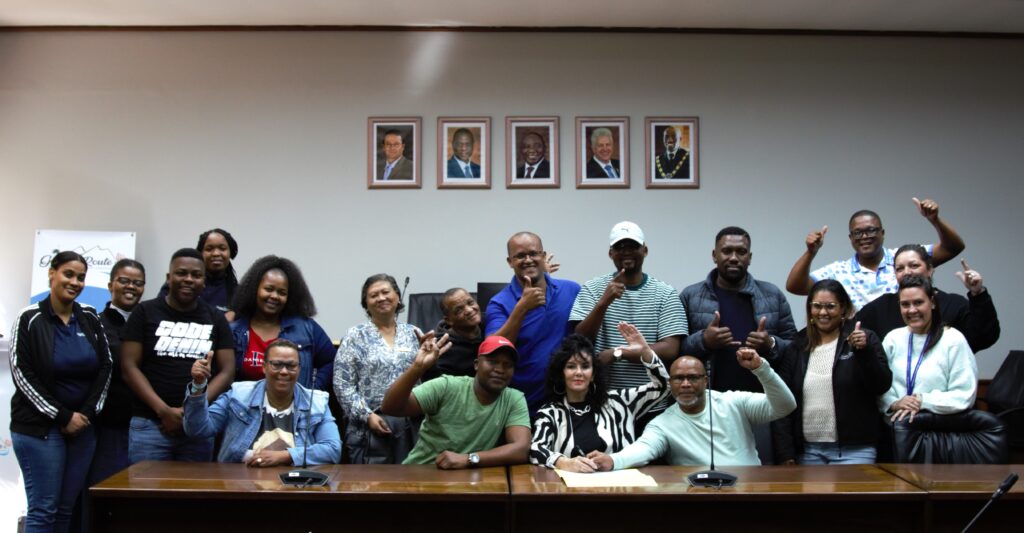
Feature Image: Environmental Health Practitioners attended the HPCSA roadshow in George.
ENDS
6 October 2023 Media Release: A ‘first of its kind for Garden Route District Municipality’ – Pilot Programme for Occupational Firefighter Training
Media Release: A ‘first of its kind for Garden Route District Municipality’ – Pilot Programme for Occupational Firefighter Training
For immediate release
6 October 2023
After receiving accreditation to be a Skills Development Provider from the Quality Council for Trades and Occupation (QCTO) in the latter part of 2022, the Garden Route District Municipality (GRDM) officially kicked off its pilot Occupational Firefighter Training programme to 24 aspiring firefighters.
The programme recently commenced at the Municipality’s Calitzdorp Hot Springs Resort, 25km from Calitzdorp, and will conclude in June 2024.
This is a milestone for the GRDM. Key stakeholder, the QCTO, plays a significant role in promoting and supporting quality occupational training and development in South Africa, ultimately contributing to a skilled and productive workforce. The main aim of QCTO is to ensure that occupational training and qualifications, in this case the one relating to firefighting, is relevant to industry needs and align with national standards.
The participants who are currently undergoing the training programme represent all seven (7) municipal areas of the GRDM, including Bitou, Knysna, George, Oudtshoorn, Mossel Bay, Kannaland and Hessequa Municipal areas.
The programme comprises of knowledge modules, practical modules as well as a workplace-based component where students are required to apply the knowledge and practical skills. The skills and knowledge are applied through relevant assignments and ultimately aid them in reaching the required exit level outcomes.
GRDM’s lead facilitator is Platoon Commander Brian Afrikander, supported by a Skills Mecca Administrator.
At this stage, the training programme is going well and as per schedule.
ENDS
Feature Photo: GRDM’s Lead Facilitator and Platoon Commander, Brian Afrikander (11th from right), with participants of the pilot Occupational Firefighter Training programme
6 October 2023 Media Release: GRDM’s Environmental Health Practitioners conduct Health and Hygiene sessions in Knysna
Media Release: GRDM’s Environmental Health Practitioners conduct Health and Hygiene sessions in Knysna
For immediate release
6 October 2023
Recently, Garden Route District Municipality’s (GRDM) Environmental Health Practitioner (EHP) from Knysna reached out and presented health and hygiene training sessions to early childhood development facilities in their region.
Mendy Tyhawana, GRDM’s EHP, conducted sessions at the northern area of Knysna, as well as at Isiseko Creche situated in the Damsebos residential area.
More than 50 children and their caretakers participated in the sessions. The focus area was again the washing of hands and overall hygiene practices.
The following topics were addressed during the session:
Why is it important to wash hands?
Handwashing is one of the most effective ways to prevent the spread of bacteria and is one of the most important steps to take to avoid getting sick and spreading germs to others.
What are good and bad bacteria, and bad bacteria – how do these affect humans?
- Most types of bacteria are not harmful, and some are even helpful.
- Some bacteria, called pathogens, can cause infections that require treatment with antibiotics. Harmful bacteria e.g., salmonella and E. coli can cause illness.
When should hands be washed?
- Before, during and after preparing food.
- Before and after eating food.
- Before and after caring for someone at home.
- Before treating an open wound.
- After using the toilet.
- After changing diapers.
- After blowing your nose, coughing, or sneezing.
- After touching an animal, animal feed, or animal waste.
- After touching waste.
What are the IMPORTANT steps linked to washing hands properly?
- Wet hands with clean, preferably running water.
- Apply enough soap to cover all surfaces of hands and wrists.
- Rub hands together briskly and thoroughly. Make sure to scrub all surfaces of hands, fingertips, fingernails, and wrists.
- Scrub hands and wrists for at least 20 seconds.
- Rinse hands and wrists under clean, preferably running water.
- Dry hands and wrists with a clean towel or let them air-dry.
- Use a towel to turn off the tap.
Ends
5 October 2023 Media Release: GRDM Firefighters assist Overstrand Municipality with water provision for its residents
Media Release: GRDM Firefighters assist Overstrand Municipality with water provision for its residents.
For immediate release
5 October 2023
Last week, the Garden Route District Municipality (GRDM) Fire and Rescue Services responded to a request to assist the Overstrand Municipality with water provision in Hermanus and surrounding areas.
After impacts of severe rains that hit the western part of the Western Cape on the weekend of 25 September 2023, many water systems were severely impacted, so much so that multiple towns were left without drinking water for an extended period of time.
On Thursday afternoon, 28 September 2023, two (2) firefighters from the GRDM Fire Services left the Garden Route with a fire truck that carried 5500 litres of water to assist Overstrand. GRDM’s Martino Jacobs and Petrus Jordaan further assisted by delivering water to various residential areas, carting water from Standford to Hermanus for a four-day period.
Chief Fire Officer, Deon Stoffels, indicated: “It was a humble and proud experience for the GRDM firefighters to assist a neighbouring district and towns with residents that were in real need of an essential commodity. As usual GRDM is proud to be of assistance in times of crisis,” he concluded.
ENDS
02 October 2023 Media Release: Coastal degradation and flooding will require substantial funding
Media Release: Coastal degradation and flooding will require substantial funding
For immediate release
02 October 2023
“Degradation along the Western Cape coastline is well documented and is increasingly a cause for concern as valuable properties and infrastructure ends up either damaged or destroyed, and even lives are lost due to severe storm surges surprising the unsuspecting unable to move to higher ground and swept away by powerful waves. But what would be the long term effect of coastal degradation?”, asks Cobus Meiring of the Garden Route Environmental Forum (GREF).
Ironically, Marlene Laros heading up the Biodiversity and Coastal Management Division of the Western Cape Environmental Affairs and Development Planning (DEADP), in June 2023, did a presentation on coastal vulnerability at the Annual GREF Climate Change and Environmental Management Indaba explaining the indicators used to determine where the future high water mark would be and how drastic the implication to land owners and authorities would be in terms of climate change and sea level rise, and the most recent climate induced disasters causing billions of Rand to mend is a stark warning that the change is real.
The Southern Cape and Garden Route economy and tourism sector is highly dependent on its coastline, scenic rivers and lakes, forests and mountains, and degradation of these assets over time can negatively affect the allure of the region as a world class destination, and planning for change is paramount.
Regional authorities, including the Garden Route District Municipality (GRDM) and all the coastal municipalities are acutely aware of where their respective vulnerable infrastructure is in terms of exposure to storm surges and flooding, and where possible are already planning to move assets away from potential exposure, and not rebuilding where history no doubt will repeat itself.
Regular and severe flooding did hit the Western Cape badly throughout 2023, and the damage to infrastructure, agriculture and the economy at large, is substantial. Coupled with damage inflicted by storm surges and regular power outages caused by load shedding is not helping the regional economy as even the most resilient is affected one way or the other. Addressing coastal degradation requires substantial investments in mitigation and adaptation measures and may include beach nourishment, seawalls, and other engineering solutions to protect coastal areas. The long-term costs of these measures can be significant, and does not bode well for cash strapped municipalities.
Governments globally lack the funds to assist coastal communities exposed to sea level rise and the destruction of storm surges, and South Africa is certainly no exception. Fixing bridges, hard infrastructure and roads after severe flooding are extremely expensive with significant knock- on socio- economic impacts as products cannot reach markets and power and water security is compromised for prolonged periods of time.
From an environmental point of view, coastal degradation often leads to the destruction of valuable coastal habitats, including wetlands, dunes, and estuaries. These ecosystems provide essential breeding grounds and shelter for many marine species.
In summary, coastal degradation in the Western Cape, as in other coastal regions, has far-reaching and potentially devastating long-term consequences for the environment, economies, and communities. Addressing these issues typically involves a combination of strategies, including sustainable coastal management, land-use planning, climate change adaptation measures, and conservation efforts to mitigate the impacts and preserve coastal ecosystems.
Feature Image: Plettenberg Bay main beach after storm surge – coastal degradation and washed-away beaches caused by the 16 September 2023 storm surge leaves coastal economies dependent on tourism in dire straits.
Issued: Garden Route Environmental Forum (GREF)
ENDS
28 September 2023 Media Release: Klein Karoo and Mossel Bay EHPs celebrate World Environmental Health Day
Media Release: Klein Karoo and Mossel Bay EHP’S celebrate World Environmental Health Day
For immediate release
28 September 2023
The theme of World Environmental Health Day which is celebrated on 26 September 2023 was “Global Environmental Public Health: Standing up to protect everyone’s health each and every day”.
As part of the build–up activities towards World Environmental Health Day, the Environmental Health Practitioners (EHP) from Garden Route District Municipality (GRDM) in the Klein Karoo region engaged in various activities to reach out to food handlers, crèches and community members to create awareness about the impact of the environment on our overall health and well-being.
The emphasis of the various awareness actions was to convey the message of the importance of a clean environment to ensure a good quality of health and life.
Illegal dumping awareness was done at crèches and in the community and health and hygiene awareness information was provided to persons in charge of -and food preparers of food premises.
It is important that children learn from a very young age to prevent littering and waste pollution and to use acceptable and appropriate methods that are available to dispose waste effectively. A clean environment encourages outdoor play without fear of children being injured by playing near waste heaps and trash.
Community members were sensitised on the fact that a clean neighbourhood free from illegal dumping holds many benefits to our communities and that a clean environment is a healthy environment. No illegal dumping means no pollution from hazardous substances and chemicals that could cause damage to the soil, the air and the surrounding groundwater. An environment, free from illegal dumping prevents the presence of insects like flies and mosquitoes, rodents like rats and mice, as well as bad smells. It furthermore ensures the health, safety and well-being of communities.
According to the World Health Organisation statistics, an estimated 600 million people in the world fall ill because of contaminated food. A shocking 420 000 of these cases end in death each year. Regulation 638 of 2018 requires that all food premises, new and existing, have to be in possession of a Certificate of Acceptability. Also, the person in charge of -and any other person(s) working on the food premises must be adequately trained in the principles and practices of food safety and hygiene. Additionally, new innovations in food production, as well as the re-emergence of food-borne diseases must be adequately addressed to adapt to the changing conditions and environments.
Furthermore, in Mossel Bay the GRDM Environmental Health Practitioners, serving the area, created awareness and shared valuable advice and useful information on how to keep food safe during periods of load shedding. The session took place at the Evethu Clinic. As part of the programme, EHPs also disseminated pamphlets to visitors that were present during the session.
Click here to read more on how to keep food safe during loadshedding.
ENDS
22 September 2023 Media Release: Focus on the Garden Route District Municipality Industry Working Group
Media Release: Focus on the Garden Route District Municipality Industry Working Group
For immediate release
22 September 2023
The industry working group focusing on air quality management was established early in 2011, short after the new National Environmental Management: Air Quality Act (NEMAQA) came into full effect on 1 April 2010 and the old Atmospheric Pollution Prevention Act (APPA) of 1965 repealed. The focus of the platform is to actively involve the industrial sector in Air Quality Management and to serve as a platform for information sharing and capacity building purposes.

The quarterly engagement include topics such as licence application procedures, the South African Atmospheric Emission Licensing & Inventory Portal (SAAELIP), emission monitoring and reporting, legislation and proposed amendment, etc.
As the time progressed, a self-compliance auditing system was introduced which requires industry to verify compliance with conditions of their Atmospheric Emission Licence. The compliance verification is completed on the municipal collaborator portal which is tailored to each individual AEL.
“Since the transition from APPA to NEMAQA, and the handover of the Atmospheric Emission Licence function from Department of Environmental Affairs and Development Planning (DEADP) to the district, the working group from the district side is viewed not only for compliance purposes, but to improve service delivery, consultation, openness, and transparency and giving best value” said Dr Johann Shoeman, District Manager for Air Quality in the Garden Route.
Another achievement is that since its establishment, not one quarterly meeting was missed. “Even during Covid 19, we managed to hold meetings virtually and currently meetings are held hybrid to accommodate attendees from far,” Schoeman said.
The GRDM Air Quality unit is often complemented by external stakeholders, specifically on the Working Group and all indications are that this platform forms an essential part of managing air quality sufficiently in the Garden Route district.
ENDS
20 September 2023 Garden Route District Municipality and stakeholders collect nearly 500 bags of waste, including recyclable materials, in Thembalethu
Garden Route District Municipality and stakeholders collect nearly 500 bags of waste, including recyclable materials, in Thembalethu
Representatives from the National Department of Forestry, Fisheries & the Environment (DFFE), with the Western Cape Department of Environmental Affairs & Development Planning, Garden Route District and George Municipalities, Cape Nature and stakeholders from the Private Sector including John Dory’s and the Spur Foundation, embarked on a clean-up operation near the Schaap-kop River on 15 September in Thembalethu, George.
The clean-up operation included 65 Expanded Public Works Programme (EPWP) members, including a Working-on-Fire Team from George. The programme formed part of the Clean-Up and Recycle – South Africa initiative and was also part of the International Coastal Clean-Up Day that is celebrated in September each year. Approximately 100 participants, with the stakeholder representatives, rolled up their sleeves to clean up the littered area.
A few bags of waste collected at the site during the cleanup operation.
On behalf of CapeNature, Stakeholder Engagement Officer, Thabiso Mokoena, said that with the initiative and the impact of pollution on the environment, he hopes that it will inspire the community to do better in terms of how household waste is disposed of. Katt Perry, Senior Manager at John Dory’s, said that they have a vested interest in the project, and she stressed that “if waste comes through the river, it will end up in the oceans and eventually, we won’t be able to help the fish that are disappearing”. Perry thanked participants present for their hard work and said: “It takes that one person to make a difference”.
Dawid Adonis, Director for Community Services at George Municipality, during his remarks said: “We need to make sure that we keep the environment clean – we need communities to assist us to keep our environment clean and take responsibility”. In addition, he said: “Each and every one of us is an ambassador to make sure that our households use the bags and separate household waste as it will help the municipality to take less waste to the landfill facility”.
Before the groups went into different directions, each with refuse bags, GRDM’s Waste Management Officer, Innocentia Sikweyiya, explained the purpose of the various bags and what waste types are allowed in the different bags”.
At the end of the event, more approximately 320 black bags and nearly 50 recyclable bags were collected. Thank you to all stakeholders and participants who formed part of this initiative.
Stakeholders and members from the WOF and EPWP teams during the Cleanup operation in Thembalethu.
Did you know?
- BLUE/CLEAR bags are used for non-soiled recyclable materials, including plastic, paper, cardboard, glass etc.
- GREEN bags are for green waste, including organic kitchen waste such as fruit and vegetable peels, as well as garden waste, including grass cuttings, leaves etc. No soil is allowed in green bags.
- BLACK bags are for ‘wet’ waste, things that cannot be recycled.
How do you recycle?
- PAPER that CAN be recycled: office paper, newspaper and magazines, cardboard (boxes flattened), brown paper bags, take away containers (food removed and rinsed), milk and juice cartons (rinsed and flattened) and books (hard covers removed).
- PAPER that CANNOT be recycled: napkins, tissue paper, paper towels, wax paper, laminated or waxy paper, punch confetti, carbon paper and stickers.
- METAL that CAN be recycled: cooldrink and beer cans, food tins (rinsed clean), metal lids of glass, jars, aluminium cans, rusty cans can be recycled and recycled batteries (taken to correct depot).
- METAL that CANNOT be recycled: batteries, motor oil cans, paint and aerosol cans, and tinfoil.
- GLASS that CAN be recycled: all colours of glass bottles and jars, beer and wine bottles (rinsed).
- GLASS that CANNOT be recycled: mirrors and windows, ceramic, crystal, drinking glasses and light bulbs.
- PLASTIC that CAN be recycled: all plastics numbers 1-7 (rinsed), grocery and retail plastic bags (clean) and milk sachets.
- PLASTIC that CANNOT be recycled: cling wrap, and polystyrene (is recyclable but no facility on Garden Route for now).
ENDS
18 September 2023 Invitation to Tender/Quotation Submission – Construction of New Regional Waste Management Facility and associated Infrastructure
Project: The Construction of a New Regional Waste Management Facility and associated Infrastructure
Contract Number: GRDM/24/21-22
For attention: Interested Local SMMEs in the Garden Route
The Contractor wishes to invite all interested SMMEs in the Garden Route District For the Following Packages:
1. GRDM/TEFLA/21-22/FENCE-01 – Supply and Erect new Temporary Fence 3.92 km
2. GRDM/TEFLA/21-22/FENCE-02 – Supply and Erect new PetroSA internal security fence – 5.328 km
3. GRDM/TEFLA/21-22/SECURITY-03 – Security Services
4. GRDM/TEFLA/21-22/TRAINING-04 – Training
5. GRDM/TEFLA/21-22/TRAINING-05 – Cut and stockpile material (Supply all plant required, Excavators, FEL, Tipper trucks and Dumpers)
6. GRDM/TEFLA/21-22/TRAINING-06 – Remove topsoil and stockpile
7. GRDM/TEFLA/21-22/TRAINING-07 – Laboratory Testing Services
8. GRDM/TEFLA/21-22/TRAINING-08 – Supply of Diesel
9. GRDM/TEFLA/21-22/TRAINING-08 – Supply of Plant (yellow machines)
- Briefing Session: Compulsory
Tender Briefing Session
Date: 22nd September 2023
Time: 11h00
Venue: Site Camp, Next to Gourikwa Landfill (PetroSA), Mossel Bay NB!
Tender documents will be issued during the tender briefing as per the attendance register.