Continue and accelerate collaboration and cooperation among all District skills development role players.
Ensure that Skills Development leverages digital infrastructure as far as possible to ensure learning and processes methods are and remain cutting edge.
As far as possible link Skills Development to Investment and Economic Development opportunities to the advancement for all.
Ensure that all Skills Development processes in the Garden Route always proactively considers renewable energy.
Engage with all willing partners, in particular the SETAs and the National Skills Fund, to explore the development and implementation of projects across the District.
Consider and leverage local skilled people, including retired people, within the District, to accelerate the growth of the Skills Mecca.
All public and / or private skills development projects and/or programmes in all municipalities are acknowledged, recorded on Skills Mecca on line solution and supported within resource limitations.
Progressively support the development of the new apprenticeship of 21st Century (A21) in the District.
Budget, plan and implement an annual Skills Summit that is held in a different local municipality rotationally and alphabetically….2020 – Knysna – proposed on 5 March 2020.
1. Regional Waste Management Facility on Farm 419 Mossel Bay
The Development of a Regional Waste Management Facility on the property of the Garden Route District Municipality (GRDM), Farm 419, will be finalised by the end of 2019.
The facility will occupy +-70% of the 205-hectare property (approximate size of 143.5 hectares) belonging to GRDM. A private partner was selected by GRDM and a Public Private Partnership agreement will soon be entered into between the District Council and the company. Constructing and operating the facility for a period of ten years will be the responsibility of the appointed company.
Bitou, Knysna, George and Mossel Bay Municipalities will make use of the Waste Management Facility which will deal with domestic and hazardous waste disposal. Mobile chipping and crushing facilities will be included to assist the four Local Municipalities with Green Waste Management.
In addition to the Regional Landfill Facility, the following two proposals were received and are subject to all applicable legislation, application requirements and approvals. One proposal was received from Ikusasa Processing Engineering Consultants (PTY) Ltd and the other from Moumakoe-Geza Joint Venture. Sufficient land (+-30% of the 205 hectares of land) is available on Farm 419 for these developments.
The Garden Route Investment Conference, which was held in March 2018, stimulated the interest of two multi-national companies to invest in the Garden Route. One of the two, which is known as Ikusasa Processing Engineering Consultants (PTY) LTD, approached GRDM with a proposal stating their intent to erect a chemical plant that will support the wide variety of sectors in the region and outside portion of Farm 419 in Mossel Bay. The size will be determined once the necessary plans are finalised and presented to the Garden Route District Municipality and approved by Mossel Bay Municipality. Necessary studies i.e. EIA’s will also have to be undertaken for this proposed development.
3. Moumakoe-Geza Joint Venture
Moumakoe-Geza Joint Venture has recently requested to lease 10 hectares of GRDM land, which forms part of Erf 419, adjacent to PetroSA for the construction of lubricant oil or a lube oil blending plant. The plant will have the capacity of producing 20 800 000 liters of blended products per annum. Studies have revealed that South Africa has a lubricant demand of 2 million barrels per annum. This project is, therefore, a win-win solution for the Garden Route in terms of social and economic development. Necessary studies i.e. EIA’s will also have to be undertaken for this proposed development.
Most of the
southern towns of the Garden Route District have bulk water in storage to
address their current water demand, at least until the first winter rains. The
northern parts of the Garden Route District are not looking good at the moment.
Currently, the towns Calitzdorp and Zoar in the Kannaland Municipal area do not
have a secondary water supply apart from their bulk storage dams.
In July 2018
the Raubenheimer dam, which is the main water source for Oudtshoorn, was at an
extremely low level of 31%. Fortunately, rain over this area and a drop in the
daily consumption lead to an increase in this dam’s level to 53,54% (measured
at the end of December 2018). In addition to the Raubenheimer dam, Oudtshoorn
has access to the Blossoms Wellfield that could still be connected to provide
groundwater that would be able to sustain the basic water needs of about 50
litres per person, per day, should the town face a “day zero” scenario.
Unfortunately,
the Kannaland municipal area is in a less fortunate position in terms
of their main water supply at Nel’s Dam, which is located in Calitzdorp.
The dam is at an alarmingly low level of 11%, leaving the town with
approximately five months of water. In Zoar, the main source of water, the
Tierkloof Dam ran dry after Christmas and their alternative source the
Jongmansland dam on an farm Amalienstein which is at a 12% level. The water
demand in this area is 1.4 megalitres of water per day, at the current rate of
abstraction water in storage would last only for the next month.
The average water usage per household in the region is as follows:
The smallest amount of water on average being used by households is in Oudtshoorn @ 121 litres per person per day;
George 126 litres per person per day;
Knysna 156 litres per person per day;
Hessequa 168 litres per person per day;
Bitou 180 litres per person per day;
Mossel Bay 189 litres per person per day; and
The most water being used per household is in Kannaland @ 314 litres per person per day.
Background on the situation in Kannaland
On 28 December 2018, the
Garden Route District Municipality (GRDM) Disaster Management Centre was
contacted by Kannaland Municipality, who raised concerns that Zoar could run
out of water due to the Tierkloof Dam level dropping to 10%. The Jongmansland
dam, which is also an emergency augmentation dam in Kannaland was at a 20%
level of water. Another issue is that the municipality has been
experiencing serious challenges at their water purification works. The water treatment works are not equipped to deal
with the poor quality of water supplied from both these dams. At the Calitzdorp
water, purification works pose a similar problem, but added to this, the
quality of water fed to town from the Nel’s dam had to include additional
purification measures to ensure that the water quality stays fit for human
consumption.
The GRDM Disaster
Management Centre advised the Kannaland Municipality’s Technical Services to
lower the pressure from the main water reservoirs that are supplying water to
Zoar. The goal is to lower usage to 70 litres per
person per day.
GRDM Disaster Centre also provided 3 x 5000-litre water tanks to be placed at the higher situated areas in Zoar, as these areas would be first to be affected due to the pressure reduction in the system. In addition, 1 980 x 5 litre bottled water (9 900 litres) and 7 992 x 2-litre bottle water (15 984 litres) were provided to be distributed to affected residents.
On the 17th of
January 2019 the GRDM Head of Disaster Centre, Mr Gerhard Otto, joined the
Kannaland Mayor, Cllr Magdalene Barry and Kannaland Municipal Manager, Mr
Reynold Stevens in a meeting with Zoar community leaders to discuss the urgency
of the town’s water situation as well as to inform community leaders that
drastic steps would have to be taken to reduce the town’s water demand. Later
on the same day, the GRDM Municipal Manager, Mr Monde Stratu and GRDM Executive
Management met with the Kannaland Municipal Manager and his team to discuss the
assistance required from the GRDM.
At this meeting, it was
agreed that at this point in time both the towns, which include Ladismith and
Van Wyksdorp, are not of immediate concern, but that the focus should be on
Zoar and Calitzdorp’s. Steps will now be taken to ensure that water
augmentation is prioritized and in place for the latter mentioned two towns. In
order to address these urgent needs, a meeting with Provincial as well as
National stakeholders was scheduled for Friday the 18th of January
2019.
On Friday, 18 January 2019’s meeting, the following action steps were resolved:
Due to immediate capacity constraints, the Provincial Department of Local Government will deploy a full-time engineer to assist Kannaland to develop and implement both short-and medium-term drought interventions;
Groundwater consulting firm GHT has recently completed a groundwater augmentation study for both the towns Calitzdorp as well as Zoar. The findings of this study will form the basis of emergency interventions and will not only include drilling but equipping and linking of these groundwater augmentation sources to these towns;
The Provincial drought awareness team would be called upon to assist with the immediate roll-out of a drought and water conservation awareness campaign in the greater Kannaland area;
The irrigation of the bulk of the Lucerne at the farm Amalienstein will be stopped in order to conserve the water available in the Jongmansland dam. The Provincial Disaster Management Centre, as well as the Provincial Department of Local Government, will meet with the Department of Agriculture and the management of the Amalienstein farm (CASIDRA) in order to come to a suitable agreement in terms of the purchase of fodder for the animals at Amalienstein due to the foreseen loss of lucerne production;
From Monday the 21st of January 2019 the Kannaland Technical team will implement water shedding in Zoar as the demand needs to be reduced from the current 1 400 000 million litres of water per day to less than 350 000 litres per day;
The Kannaland Municipal Disaster Management Centre have requested 20x additional 5000-litre water tanks from the GRDM to be placed in Zoar as well as at water-stressed communities in the rural Kannaland Municipal areas.
At the
GRDM Council Meeting on 21 January 2019, the following was resolved:
The GRDM Council has approved the purchasing of 20 x 5000-liter water tanks and cement retainer blocks to be used to erect platforms for these tanks at a cost of R120 000.00.
Rent of 34 000 litre water tanker for a period of three months to assist with the filling of these tanks as well as tanks previously placed at water-stressed communities in the rural Kannaland Municipal areas will be paid at a cost of R240 000.00.
The purchasing of 20-litre water containers will be distributed to households in Zoar to be used during water shedding at a total cost of R140 000.00.
The Nel’s Dam in Calitzdorp is currently at an alarming 11% of its capacity.
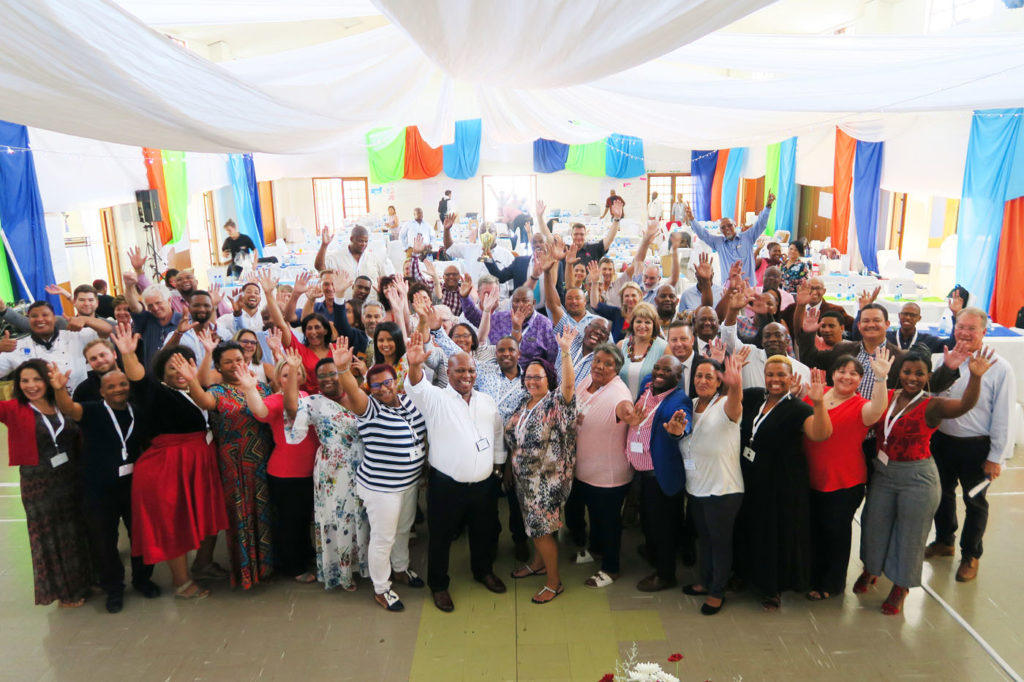
All employees of Garden Route District Municipality gathered at Swartvlei Caravan Park on 7 December 2018 to celebrate the municipality’s successes to date. Employees were given the opportunity to immerse themselves into a distinctive entertainment experience through music and mingling with others who they do not usually see on a daily basis.
The vision of the municipality reads: “Garden Route District Municipality, the leading, enabling and inclusive district, characterised by equitable and sustainable development, high quality of life and equal opportunities for all”.
Public Notice: Tabling of 2017/18 Annual Report of Garden Route DM
Notice is hereby given that the Annual Report for the 2017/18 financial year will be tabled at the Garden Route District Municipality Council meeting on 13 December 2018 in terms of Section 127(2) of the Local Government: Municipal Finance Management Act (MFMA), 52 of 2003. Also, the Annual Report is tabled as informed by circular 63 of the MFMA.
On 21 October 2018 wildfires ignited in Vermaaklikheid near Riversdale in Hessequa. A few days later, more wildfires started in the George municipal area. The Disaster Management Centre of Garden Route District Municipality (GRDM) recorded 12 wildfires over the month of October/November 2018, which also resulted in the death of 9 people, including a Working on Fire pilot.
Said to be one of the biggest wildfires recorded since the great wildfire of 1869, the Garden Route is facing a new “normal”. The change can be seen across the globe and it is almost common knowledge that climate change is not on our side. This poses an important question – how can we address this? Can we prevent these type of occurrences in the future or are we doomed?
In short, the Head of Disaster Management at Garden Route District Municipality, Mr Gerhard Otto explains: “ Municipalities and stakeholders, together as a collective we have to develop a system to better plan for fires in our wildland-urban interphase (WUI). Our town planners need to factor wildland fire risk into future development planning and our bylaws, as well as building codes, will have to be altered to ensure resilience to this type of fire incidents. With this, I mean that there should be adequate by-laws in place to address issues like high fire hazard areas. When we look at the urban fringes (where homes at the edge of neighbourhoods meet the forests), inhabitants should be made aware of the fire risk in these areas and a defensible space should be created around all properties not only to create a buffer area but also to provide a space from where firefighters could launch their firefighting actions when fires do approach these areas. In my opinion, the current fragmented approach to fire service delivery is central to many of our challenges, the sooner we centralise firefighting services by establishing a metropolitan municipality and address integrated veld fire management the better – “all efforts should be coordinated from one central authority”. He also added: ”During the recent wildfires, we managed to pull resources from all over South Africa together to work at our Joint Operations Centre at the GRDM head office. I know that since last year’s Knysna fires we have improved the way in which we do things, but there is always room for improvement”.
The following role players must be thanked for their selfless dedication to protect our communities and infrastructure over the past month: Provincial Disaster Management Centre, Working on Fire (WoF), South African National Defence Force, Cape Nature, SANParks, George Municipality, Knysna Municipality, Oudtshoorn Municipality, Bitou Municipality, Hessequa Municipality, Mossel Bay Municipality, Kannaland Municipality, Overberg DM, Cape Winelands DM, West Coast DM, City of Cape Town, Various NGOs and FBOs (Lions Alert, Rotary SA, Gift of the Givers, Garden Route Rebuild), SPCA, National and Provincial Departments, Department of Health, EMS, Human settlements, Rural Development, Housing Development Agency, Department of Agriculture, Department of Education, SASSA, DSD, ESKOM, Department of Transport, Provincial Traffic and SAPS.
All controlled burning of land in the Garden Route is prohibited.
Controlled burns are not permitted to be done by any person other than the fire control authorities.
It has come under the attention of the Garden Route DM Joint Operations Centre (JOC) that some land owners are attempting to start controlled burns.
Everyone needs to adhere to these precautionary measures until further notice.
The municipality appeals to all people who live, work and visit the area to exercise extreme caution at all times; to make fires in protected and designated areas only, and to dispose of cigarette butts safely. There is a long, hot summer ahead and we need everyone to help in keeping our region safe.
For more information regarding fire permits, contact:
George – 044 801 6300
Hessequa – 028 713 8000
Mossel Bay – 044 606 5107
Kannaland – 044 805 5071
Oudtshoorn – 044 203 8911
Knysna – 044 302 8911
Bitou – 044 533 5000
For enquiries relating to wildfires, contact the Garden Route DM JOC on 044 805 5071.
It has come under the attention of Garden Route District Municipality (GRDM) that the public is concerned about smoke emissions in the Knysna municipal area. These emissions are caused by biomass burning at Geelhoutvlei Timbers. This area contains pine wood chips from untreated wood only. No arsenic or treated wood products are stored at the facility and the smoldering is caused by the burning of wood chips. It was already burning before the wildfire destroyed the wood mill.
The pollutants emitted by this smoldering area is mainly Oxides of Nitrogen, particulate matter, Carbon monoxide, CO2 and small concentrations of volatile organic compounds – these compounds normally form part of the pollutants emitted when biomass burns. The fire poses no severe health threat to the surrounding communities but will result in a nuisance effect, depending on the distance from the source, the wind speed and or direction thereof.
During a joint operations meeting held this morning, 13 November 2018, at GRDM, a decision was taken that the owners of Geelhoutvlei Timbers should be informed that this situation is triggering a National Environmental Management Act, 1998 (Act 107 of 1998 (as amended), Section 30 incident. Section 30 incidents involves, amongst others, the unexpected, sudden and uncontrolled release from a major emission such as a fire. The responsible person in terms of Section 30 is the owner of the property – in this case, Geelhoutvlei Timbers. Subsequently, the owner of the property must take all reasonable measures to contain and minimize the effects of the incident, undertake clean-up procedures and remedy the effect of the incident.
If the property owners do not respond to this instruction, the relevant authority may follow steps and implement measures it considers necessary to contain and minimize the effects of the incident. This involves the undertaking of clean-up operations and remedy the effects of the incident. Government may claim for the reimbursement of all reasonable costs incurred at the scene, in terms of subsection (8) of the National Environmental Management Act from the responsible person.