Skip to content Skip to left sidebar Skip to footer

Author: Herman Pieters

2021 04 22 Media Release: Garden Route DM helps Non-Profit Organisations and students with funding support

Garden Route DM helps Non-Profit Organisations and students with funding support

For Immediate Release
22 April 2021

An annual highlight for the Garden Route District Municipality (GRDM) is when the institution is able to finalise and officially hand over its committed funding support to students and Non-Profit Organisations (NPO). This year, the GRDM supported fourteen (14) NPOs, as well as twenty-two (22) students who are studying towards accredited NQF qualifications; some are studying degrees such as Chemical Engineering, Tourism, Computer Science or LLB Law.

During his keynote address, Alderman Memory Booysen, Executive Mayor for GRDM, said: “We supported NPOs with R210 000.00, even though we all face tough budget cuts because of the impact of the COVID-19 pandemic. We also provided funding support to the tone of R510 000.00 to students, which was partly funded by the Western Cape Provincial Treasury.”

He also alluded to the fact that “we are the poorest of all eight (8) municipalities in the Garden Route, and we have been told that we often punch about our weight”. However, he stated that the GRDM would continue to try its best to help communities as far as possible.”

Ald. Booysen pleaded for external bursary recipients to never forget where they are coming from, particularly for what their parents fought for. “Do not forget your grannies, fathers, uncles and aunts, amongst others; some of them had to drop out from school to make money and support their family members who had dreams of studying further.

Ald. Booysen asked: “What does the future hold for South Africans?” He then answered: “I do not have answers to where our country will be in the near future, but the GRDM is trying its best to play a small part in the solution.” 

When referring to students, he said: “I am optimistic about your futures and that you will not drop out – that you will shine and make a success of this opportunity”.

The Human Resources Manager at GRDM, Ms Nontobeko Klaas, highlighted that the municipality places an advertisement in newspapers, social media (Facebook and Twitter) around the beginning of October annually. This call-to-action is intended to invite students and families who require assistance with funding their studies to apply for such support. Cllr Rowan Spies, who was the programme director of the handover ceremony, also boasted about the GRDM Education, Training and Development Committee he serves on. He said: “Mayor, without undermining the efforts of other committees I serve on; this specific committee gives us the most gratification because of the impact it has on communities”.

During the address by Mr Siphiwe Dladla, GRDM Chief of Staff, he provided a brief background of the Grant-in-Aid support offered by the Mayor’s office. He said: “We advertise during November or December, but the COVID-19 pandemic shifted our deadlines to January 2021”. He further added: “We received forty (40) applications and had to utilise internal policy directives to guide our selection process. Currently, we focus on NPOs who work with causes such as HIV/AIDS, Senior Citizens, Disabled, Youth and Substance Abuse.” 

WORDS OF APPRECIATION 

One of the recipients of an external bursary for BCom Accounting through the University of the Western Cape, Mr Lizalise Gamane, said: “This financial contribution towards me and others is a gesture of confidence in us as the youth of the Garden Route – it provides a great deal of hope for families who are here. Children from marginalised families now also have the opportunity to study and eventually support their families when landing jobs in their respective career fields”. 

Ms Elmarie Maxim delivered a word of appreciation on behalf of the NPOs by saying that beneficiaries are honoured and happy for the gesture by the GRDM to support them.

“We are all trying to recover from the adverse financial impacts of the COVID-19 pandemic. NPOs need to constantly look for funding, at the same time, it remains difficult for us to find such support, especially after the public offered so much support since 2020 ,” she said.

NPO Recipients (in no particular order).

List of NPOs who received funding support:

  1. Golden Movement Service Centre – Knysna/ Karatara 
  2. Epic Sports Project – Kleinbrak River 
  3. The Plett Aid Foundation – Plett 
  4. Outeniqua Dawn – George 
  5. Paul M.Draay soup drive – Mossel Bay 
  6. The Living cornerstone alzeimers res – Sedgefield 
  7. Smiling ducks Educare – Albertinia 
  8. J-Square empowerment – Riversdale 
  9. Knysna Association for Persons with Disabilities – Knysna 
  10. Vermont Old Age Home – Knysna 
  11. Hephziba Solutions – Sedgefield 
  12. Youth for Change – Plett 
  13. Linos – Calitzzdorp
  14. Tinkerland Nursery School – Knysna 

External Bursary Recipients (in no particular order):

Please note that some of the recipients were represented at the handover ceremony by their parents.

  1. Jose Rossouw
  2. Zukhanye Marikeni
  3. Lizalise Gamana
  4. Zanda Ncedani
  5. Leighton Cherry
  6. Teddy Thomo
  7. Johannes Van Wyngaard
  8. Lynne Erasmus
  9. Jaylin Opperman
  10. Luciano Cobrim Trantraal
  11. Sanelisiwe MgQobhozi
  12. Sandre Adams
  13. Anjahlay Julene
  14. Cajtlin Samatha
  15. Robert Swart
  16. Alutha Althea
  17. Shurenay Magan Jacobs
  18. Heimne Giselle Elizabeth Esau
  19. Ngamela Matiwane
  20. Ernest Lamprecht
  21. Wayiene Windwaai
  22. Annie Muller
    List of Grant In Aid Applications for year 2021:

    1 Golden Movement Service Centre Sandalina Afrika
    6 Hospice Plett Cecily van Heerden
    10 Epic Sports Project Nicolaas Bezuidenhot
    12 Outeniqua Dawn Xoliswa Bomvana
    13 Paul M.Draay Soup Drive William Sam
    14 The Living Cornestone Alzeimers Res Gilda Scammell
    15 Smiling Ducks Educare Arita Terblanche
    16 J-Square Empowerment Justin van Rensburg
    17 Knysna Association for Persons with disabilities Veronique Fortune
    19 Vermont Old Age Home Magdallena Hillary Brouwers
    29 Hephziba Solutions Cleone Vanstone
    37 Youth For Change Sithenkosi Innocent Bobani
    38 Linos Coffee Christolino Pêrel
    39 Tinkerland Nursery School Elmarie Maxim

View the video recording here: https://www.youtube.com/watch?v=PceyEOjKE1E 

ENDS
15 April 2021 Media Release:Garden Route District Municipality (GRDM) hosts Khoisan-Kleinkrantz Project Engagement

Media Release: Garden Route District Municipality (GRDM) hosts Khoisan-Kleinkrantz Project Engagement

For Immediate Release
15 April 2021

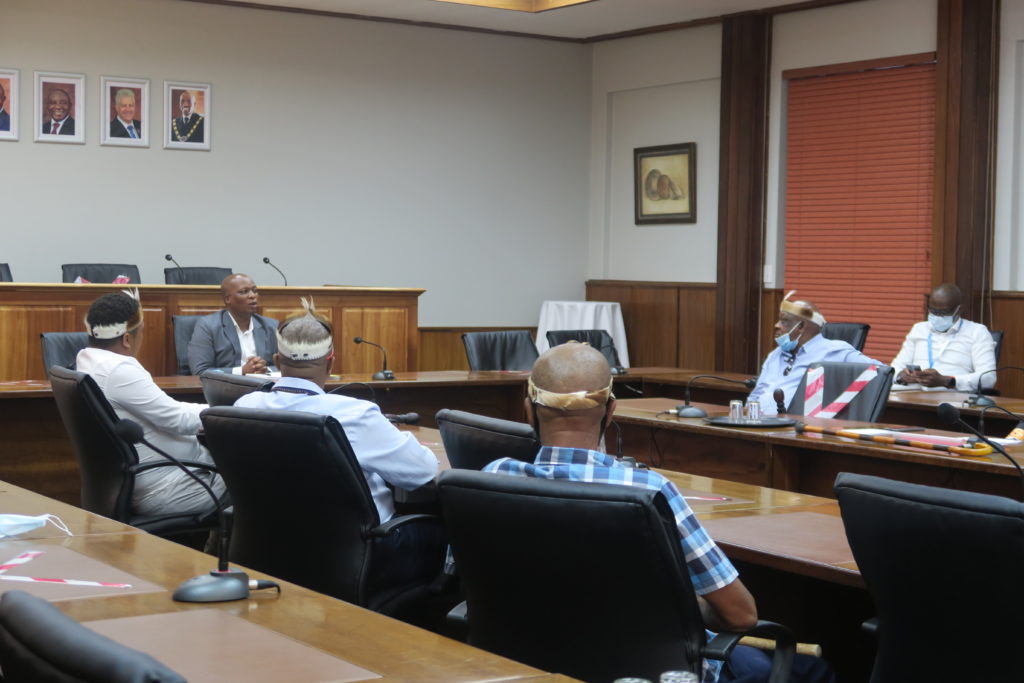
Garden Route District Municipality (GRDM), on 12 April 2021, hosted a meeting regarding the Khoisan-Kleinkrantz Project with the Khoi -San traditional leaders of Kleinkrantz.

Mr Monde Stratu, Municipal Manager of GRDM, chaired the meeting, accompanied by the Executive Manager for Planning and Economic Development at GRDM, Mr Lusanda Menze, and other officials. Senior Chief from Gona – Hess !Kwe Royal Kingdom, Mr Lionel Prins, was accompanied by Headman Jeemon Adams, Chief John Nankoe, Assisting Senior Chief Neville Olyn, Chief Dullin Appels, Senior Chief William Sukers, Paramount Chief Vernon Andries, Senior Paramount Chief and King Cornelius Botha fifth.

The narrative of the engagement was around processes relating to Khoi and San representation in the Garden Route District Council, in light of the development of Kleinkrantz being an important aspect for the King of the Khoisan and the community of Kleinkrantz. Mr Stratu explained that the “GRDM Council is ready to implement the Traditional and Khoisan Leadership Act 3 of 2019 as per the direction of the Western Cape MEC”. For the improvement and growth of relations between the municipality and the Traditional Leaders, this engagement was a step in the right direction for Kleinkrantz. Stratu highlighted the fact that both teams share a mutual understanding of how traditional leaders integrate into municipal structures.

During his concluding remarks, King GQona extended a word of thanks to the Stratu and his team by stating: “I am satisfied to hear the optimism from the municipality’s side to work with us. It is not just about Kleinkrantz, but our heritage too”.

Editor’s note:

The Traditional and Khoi-San Leadership Act 3 of 2019 aims to:

  • provide for the recognition of traditional and Khoi-San communities, leadership positions and for the withdrawal of such recognition;
  • provide for the functions and roles of traditional and Khoi-San leaders;
  • provide for the recognition, establishment, functions, roles and administration of kingship or queenship councils, principal traditional councils, traditional councils, Khoi-San councils and traditional sub-councils, as well as the support to such councils;
  • provide for the establishment, composition and functioning of the National House of Traditional and Khoi-San Leaders;
  • provide for the establishment of provincial houses of traditional and Khoi-San leaders;
  • provide for the establishment and composition of local houses of traditional and Khoi-San leaders;
  • provide for the establishment and operation of the Commission on Khoi-San Matters;
  • provide for a code of conduct for members of the National House, provincial houses, local houses and all traditional and Khoi-San councils;
  • provide for regulatory powers of the Minister and Premiers;
  • provide for transitional arrangements;
  • amend certain Acts;
  • provide for the repeal of legislation; and
  • provide for matters connected therewith.

Download the Act here: Traditional and Khoi-San Leadership Act 3 of 2019

ENDS

7 April 2021 Media Release: Bitou Municipality initiates Kranshoek Pilot Project on Covid-19 Awareness

Media Release: Bitou Municipality initiates Kranshoek Pilot Project on Covid-19 Awareness

For Immediate Release
7 April 2020

Kranshoek Neighbourhood Watch team on their door-to-door awareness and education of Covid-19 virus.

The Multi-Disciplinary Team in the Bitou Local Municipal area, recently arranged a Pilot Project for the Kranshoek community. The Project aims to raise Covid-19 awareness by utilising the structures in place to reach residents within the local community and considers all Covid-19 Alert Level 1 Regulations, adjusted from 1 March 2021.

Disaster Management Officer at Garden Route District Municipality (GRDM), Lee-Ann Joubert, in conjunction with Sergeant Jansen from Kwano-South African Police Services (SAPS), steers this Pilot Project. The Plettenberg Bay, Kranshoek Neighbourhood Watch (NHW) teams represent the teams on the ground who will ensure that the intended audiences are informed. Kranshoek NHW team members were provided with training on the awareness of Covid-19. Following this, they were tasked to do door-to-door awareness, educating the community on the virus and how to stay safe. This project was put in place to stretch over a period of 31 days, with ongoing monitoring and weekly feedback from the NHW. After completion of the 31 days, the success of the project will be evaluated through another multi-disciplinary awareness campaign in the area. The statistics of the new Covid-19 cases within the community, from the beginning to the end of the project, will also be collated and compared to assist with determining its impacts.

All door-to-door visits will highlight the importance of sanitising hands, wearing face masks, reporting any symptoms to a clinic, what to do when someone tests positive for Covid-19, and the contact details of information centres, as well as all relevant stakeholders.

Role players including representatives from the SAPS, Garden Route District Disaster Management, Bitou Communications, the Western Cape Department of Health, Kranshoek NHW, Community in Blue, Plett-Hospice, the Ward Councillor and Ward Committee, Law Enforcement and Environmental Health Practitioners, all play an important role in the success of the project.

ENDS

30 March 2021 Media Release: Garden Route DM supports the Klein Karoo Export Agri Hub to create a unique rural economy

Media Release: Garden Route DM supports the Klein Karoo Export Agri Hub to create a unique rural economy

For Immediate Release
30 March 2021

This partnership seeks to develop the Klein Karoo economy, to create a sustainable environment and jobs – some of the important focus areas for the Garden Route District Municipality (GRDM), which wants to form part of efforts to turn around the high unemployment rate of Kannaland communities. A recent partnership came into fruition when the GRDM Council gave the go-ahead for the GRDM Municipal Manager, Monde Stratu, to enter into a Memorandum of Agreement (MoA) on behalf of the GRDM Council with the Calitzdorp Export Agri Hub. This landmark agreement will see that high impact pomegranate farms in the Klein Karoo get off the ground.

The immediate need for the Calitzdorp Export Agri Hub was for a R600 000.00 injection to carry out a water study for the area. This phase, which was eventually funded by GRDM, includes a water study that involves the drilling of boreholes. Subsequently, two desalination plants for reverse osmosis, capable of cleaning 60 000ℓ of water per hour, were donated by the Calitzdorp Export Agri Hub to GRDM. These plants have an original purchase value of R2.5 million.

SAFE SUSTAINABLE YIELD OF BOREHOLES

According to Dirk Rudolph, the contracted Geohydrologist, boreholes are currently being drilled in accordance to a geophysical survey that indicated that the most viable option would be to drill formations north-west of the pomegranate farm. This area includes the Baviaanskloof, Skurweberg, Goudini and Cedarberg formations.

At the moment, each borehole is analysed at regular intervals by using a V-notch weir during drilling. This will help the Geohydrologist to get an estimate of the blow yield of each borehole. According to Rudolph, this will be followed by each borehole being subjected to a 72-hour constant pumping test.

POMEGRANATES IN THE SOUTHERN HEMISPHERE

Research indicates that pomegranates require 6000 m³ water per hectare. This is 2.5 times less than almonds and about 2.8 times less than Lucerne, which makes it this the crop with the highest return per litre of water. Although this type of farming is still quite a young industry in South Africa and the Southern hemisphere, studies indicate that Kannaland and Oudtshoorn offer the best micro-climate for pomegranates in the Southern part of Africa.

The project, coined the ‘Klein Karoo Export Hub’, wants to see the 1% pomegranate export market held by South Africa expanded. According to Monde Stratu, GRDM Municipal Manager: The plan is to meet the demand for pomegranates during off-seasons to other parts of the world and the Klein Karoo Export Hub aims to export at least 50% of all pomegranate from this hub to other parts of the world. The GRDM’s partnership with the Klein Karoo Export Hub was carefully considered, subsequent to available research about pomegranate exports from South Africa. “The demand and supply factors relating to the industry, local soil analysis, climatic and environmental studies are some of the many factors we had to get insights about,” he said.

SPIN-OFFS FOR LOCALS

The GRDM Council supports the drive to promote economic growth through a co-ordinated regional approach and partnership in agriculture and Agro-processing that is focused on employment creation and exporting. “If all goes according to plan, a 1000 hectares (10 million square metres) of land will be acquired, of which 10% will be reserved for ten (10) Black Economic Empowerment (BEE) farmers,” said Alderman Memory Booysen, Executive Mayor for GRDM. “According to our calculations, each of these farmers will receive 1%, or otherwise calculated as 100 000 square meters or 10 rugby fields of land to produce pomegranates and to form part of the pomegranate crop value chain,” he explained. “We therefore fully support the Klein Karoo Export Hub project because we will also be able to create a unique model for rural development in the region that can be duplicated elsewhere. This is also in line with our efforts to implement the Joint District Metro Approach (JDMA).”

The project would see the establishment of an Agri-village, housing approximately 600 farm workers who will own their own properties. “We anticipate that the project will create 1800 permanent jobs and 2000 seasonal jobs, pomegranate orchards and attract Agri Tourism,” said Booysen. Project Klein Karoo Export Hub has already secured 30Ha for the development of the Agri Village.

It is planned to grow Wonderful Pomegranates in the Calitzdorp area. The area is already known for exporting apples, pears, peaches, plums, grapes, and apricots elsewhere. The Klein Karoo Export Hub, known as Celebratio, already has a packhouse for fresh fruit and will also build juicing, oil pressing and process facilities to enhance its business model.

The GRDM Planning Department implements the project through its Project Management Unit. According to PMU Manager, Mr Passmore Dongi, “the idea is to create sustainable rural economies that can withstand the shocks and test of time”. It is imperative that as a District we have a paradigm shift in terms of sustainable development and begin the process of looking at development in a holistic manner. In order to deal with unemployment, poverty and other issues we need to be visionaries and begin to use locally available resources to address local challenges and to capitalise on comparative advantage as it pertains to our region. This project is aimed to bring a new dimension and perspective to the concept of rural development as this is aimed to demonstrate what honest PPPs arrangements can yield – if the engagements are transparent and with the objectives of addressing the needs of society at heart.  This project will create an oasis of wealth in an area deemed to be of no significant value because of the climatic conditions. The project will also have significant green energy projects to power most of the activities in the hub. “We will create a smart clean rural Agri hub that responds to the UN Sustainable development goals,” said Dongi.

Feature image: Alderman Memory Booysen, GRDM Executive Mayor (middle), with two of the ladies working at the Celebratio packhouse, Lewonia April (left) and Andrew-leen Jacobs (right).

ENDS

30 March 2021 Media Release: 2021–2040 Garden Route Growth and Development Strategy approved by Council

Media Release: 2021–2040 Garden Route Growth and Development Strategy approved by Council

For Immediate Release
30 March 2021

The Garden Route, similar to other parts of South Africa, continues to illustrate stark contrasts of spatial and economic circumstances. In fact, the haves and the have nots are still living worlds apart, although in many instances, spatially less than a kilometre away from one another. It is for this reason that the Garden Route District Municipality (GRDM) spearheaded the process of changing, not only the trajectory of the Garden Route economy, but also to build prosperity with equity. At the centre of this vision is a finalised and approved long-term strategy known as the Garden Route Growth and Development Strategy (GDS). This key document has been successfully developed in collaboration with the Western Cape Economic Development Partnership (WCEDP) and was finalised today when the GRDM Council approved it.

According to Executive Manager for Planning and Economic Development at GRDM, Lusanda Menze, “COVID-19 delayed many of the consultative engagements, but this was expected in the formulation of the strategy because such a strategic document has to be consistent with internal resources and external environments”.

“The first stakeholder workshops took place on 29 and 30 October 2019, while the draft Garden Route GDS was presented to all Garden Route Local Government Mayors and Municipal Managers on 11 February 2021,” he said.

Executive Mayor, Ald. Booysen elaborated, the Garden Route GDS encompasses a few objectives, including: “A shared 20-year vision for the regional economy stretching until 2040; how to do things differently; developing a common economic agenda to improve the economic development and system relating to it.”

“What makes this strategy different is that it is intended to be a ‘living strategy’ and a ‘risk-driven strategy’”. Ald. Booysen explained: “By the descriptions we mean that the implementation, monitoring and evaluation forms part of our collective ongoing learning and ability to adapt, while at the same time the Garden Route GDS requires a collective approach in order to efficiently navigate through challenges and changes.”

The strategy is shaped by the profile and regional priorities of the district, which are divided into themes such as; water secure future, circular economy, resilient agriculture, sustainable tourism, support for well-being and resilience, sustainable local energy transition and a connected economy.  The document is further grounded in several core-principles such as being people-centred; valuing cultures; preserving ecological heritage; approaching change collaboratively; recognising uncertainties of innovation and responsiveness; being conscious of sustainable and resilient factors directly impacting the region; good governance; being mindful of constraints; and open to a changing yet interconnected and interdependent region.

The GDS for the Garden Route articulates the region’s development path. This Garden Route GDS would not have been possible without broad consultation, which greatly assisted the GRDM to build a collective and shared strategy for the Region/District. It is an aspirational strategy, which would need to align to the GRDM five-year Integrated Development Plan (IDP) going forward. This means that the Garden Route GDS frames the IDP and ventures the GRDM’s long-term ambitions, strategies and overarching decisions that will bring to effect that change the region wants to see by 2040.

Access the Garden Route District Growth and Development Strategy here.
Access the Garden Route Investment Prospectus here.

ENDS

30 March 2021 Media Statement: One finding away from a Clean Audit: Garden Route DM receives its 3rd consecutive Unqualified Audit Outcome

Media Statement: One finding away from a Clean Audit: Garden Route DM receives its third consecutive Unqualified Audit Outcome

30 March 2021
For Immediate Release

Garden Route District Municipality (GRDM), one (1) of the five (5) district municipalities in the Western Cape, obtained its third consecutive unqualified audit outcome. For the year under review (2019/2020), the Auditor-General of South Africa’s (AGSA) reported one (1) finding; an improvement for the GRDM compared to 2018/19.

Alderman Memory Booysen, Executive Mayor for GRDM welcomes the Audit outcome, and he said, “We invested a lot of time and energy in assuring that we comply with all relevant legislative prescripts in Local Government environment and that we apply the relevant standards when preparing our financial statements.

According to GRDM Municipal Manager, Monde Stratu: “There were no financial material misstatements, no performance management misstatements and no material inconsistencies reported in our Annual Report”. The only material finding identified by the AGSA relates to the composition of our Bid Adjudication Committee, which was the same finding raised in the previous audit and was corrected in November 2019, however it was raised even though it was corrected. The AGSA regarded this as a transversal matter and dealt with it as such. It was subsequently revealed by the AGSA that the GRDM is in a sound financial position.

The final step for the GRDM was to for its Municipal Public Accounts Committee (MPAC), to compile an Oversight Report in accordance with Section 129 of the Local Government Municipal Finance Management Act, 2005. This report was considered by the GRDM Council during a Special Council meeting today, 30 March 2021.

According to the GRDM Oversight Report and re-highlighted by Cllr Clodia Lichaba (MPAC Chairperson), the GRDM administration was congratulated “for maintaining an unqualified audit outcome, given the pandemic challenges. Many audit-related engagements took place during a critical time when the the institution only had skeleton staff to assist”. MPAC’s Chairperson furthermore noted that there was a vast improvement on the content of the Audit Report because of a drastic reduction in material matters.

During a GRDM Council meeting (top, left), two chairpersons logged in to discuss the Annual Report and Oversight Reports. Logged in via Zoom (right), Dr Adele Potgieter (Chairperson: Audit and Performance Audit Committee) and at the bottom, Cllr Clodia Lichaba (Chairperson: Municipal Public Accounts Committee).

The finding – Composition of the Bid Adjudication Committee

In the 2018/19 Auditors were of the view that the competitive bids were adjudicated by a bid adjudication committee that was not composed in accordance with Supply Chain Management Regulations 29(2), which provide guidance for the composition of Bid Adjudication Committees.

This regulation reads:

–  a bid adjudication committee must consist of at least four senior managers of the municipality or municipal entity which must include

(i) the chief financial officer or, if the chief financial officer is not available, another manager in the budget and treasury office reporting directly to the chief financial officer and designated by the chief financial officer;

(ii) at least one senior supply chain management practitioner who is an official of the municipality or municipal entity;

(iii) and a technical expert in the relevant field who is an official of the municipality or municipal entity, if the municipality or municipal entity has such an expert.

After the above finding was raised by the AGSA in 2018/19, management swiftly and formally appointed the Manger: Supply Chain Management, as a member of the BAC. This appointment was done during that audit in November 2019.  At the time of the AGSA’s final report, this was already corrected.

However, the same finding that was raised in 2018/19 and corrected in November 2019, has again been raised as a repeat finding, in the current year’s audit (2019/20 Audit). Management disputed this finding and it was referred to the AGSA Technical Unit. The reason for this dispute was based on the following premises:

  • That the matter was raised in previous audit as material finding affecting the audit opinion. The matter was immediately corrected even before the conclusion of 2018/19 audit.
  • Management is of the view that it serves no purpose to again raise the material finding that has already been rectified. The root cause has been identified in the previous year and the defect cured. It is an exercise in futility and actually negates the principles of fairness.
  • There is no remedial action proposed by the Office of the Auditor General and therefore this results in a situation where the municipality was found guilty the previous year, was punished, served the sentence and is again subjected to the same trial even after having corrected what was wrong. This is double jeopardy, a situation frowned upon by our legal system especially in the light of the fact that the decisions of the Auditor are administrative in nature and must adhere to the principles of fairness.

The AGSA acknowledged that this finding is raised as matter of consistency and is a result of their methodology and therefore cannot be ignored. They also acknowledge that they did not recommend any action to address this finding, as the Municipality has already addressed the matter.

However, they remain of the view that the non-compliance remained “material”, when considering the period (July 2019 to October 2019) before the GRDM Supply Chain Manager was appointed as a BAC member.

The GRDM management further confirms that this finding will not re-occur in 2020/21 audit, as this matter is now settled.

GRDM remains on a path that delivers and works in the best interests of all who live in the Garden Route.

Did you know?

Clean Audit Outcomes: The financial statements are free from material misstatements and there are no findings on reporting on performance objectives or non-compliance with legislation.

Unqualified Audit Opinions: The financial statements contain no material misstatements. Findings may have been made on either reporting on predetermined objectives or non-compliance with legislation, or both these aspects.

Qualified Audit Opinions: The financial statements contain material misstatements in specific amounts, or there is insufficient evidence for us to conclude that specific amounts included in the financial statements are not materially misstated.

Disclaimer of Opinion: On some occasions, an AQ is unable to complete an accurate audit report. This may occur for a variety of reasons, such as an absence of appropriate financial records. When this happens, the auditor issues a disclaimer of opinion, stating that an opinion of the firm’s financial status could not be determined.

ENDS