Skip to content Skip to left sidebar Skip to footer

Local Government News

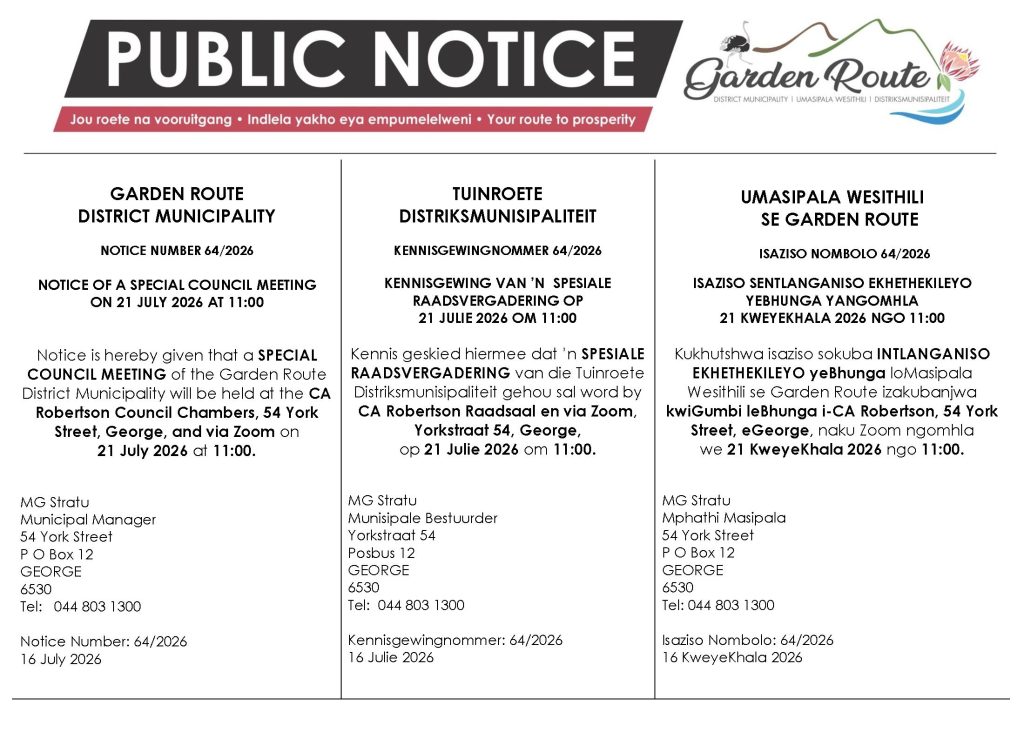
18 February 2026 Save the Date: NOTICE OF A COUNCIL MEETING ON 25 FEBRUARY 2026 AT 10:00

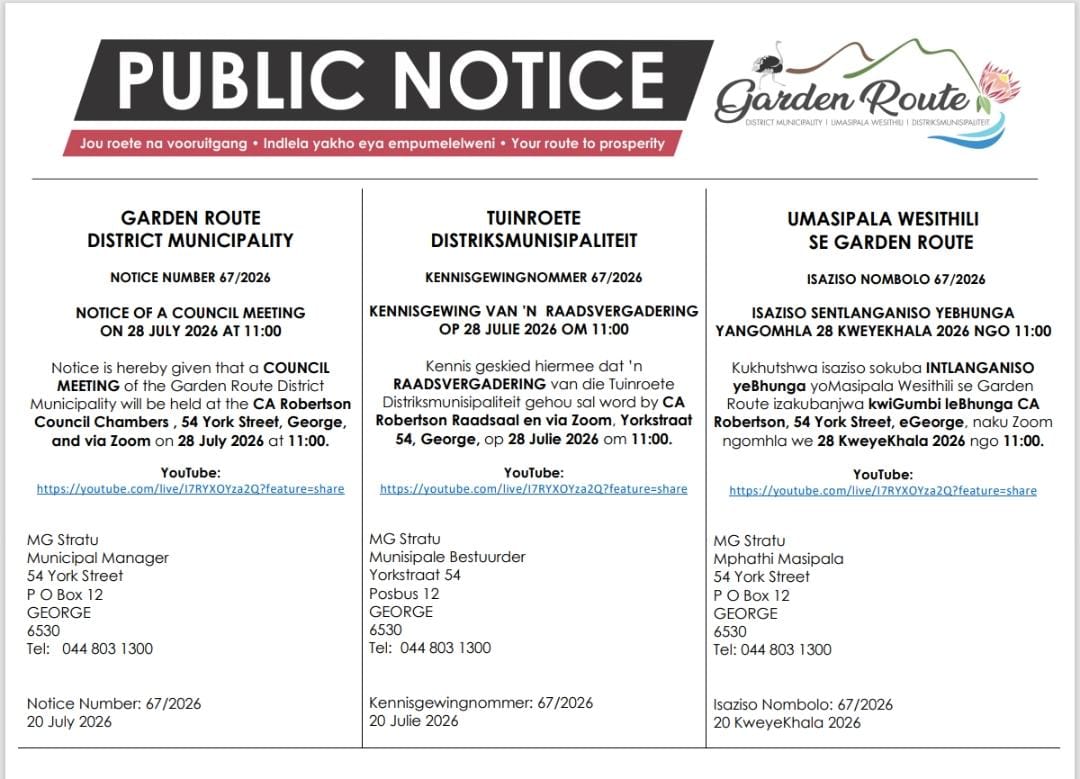
NOTICE OF A COUNCIL MEETING ON 25 FEBRUARY 2026 AT 10:00 

NOTICE NO 10/2026

Notice is hereby given that a COUNCIL MEETING of the Garden Route District Municipality will be held at the CA Robertson Council Chambers and via Zoom, 54 York Street, George, on 25 February 2026 at 10:00.

Access the scheduled video here: https://youtube.com/live/mpl_jvVMnVw?feature=share

18 February 2026 Media Release: Green School Program Expands with Colour-Coded Bin System to Drive Waste Minimisation Awareness

Media Release: Green School Program Expands with Colour-Coded Bin System to Drive Waste Minimisation Awareness

18 February 2026

The Garden Route District Municipality (GRDM) continues to advance its Green School Program with the rollout of a new colour-coded bin system across participating schools. This initiative is designed to strengthen waste minimisation education and promote environmental awareness among learners.

“Waste minimisation begins with awareness and action. Equipping schools with the tools and knowledge to manage waste responsibly, we are empowering learners to become champions of sustainability in their communities,” said Innocentia Sikweyiya, GRDM District Waste Management Officer.

On 12 February, GRDM visited two schools in the Bitou municipal area to introduce the program. The following day, GRDM collaborated with Landmark to hand over 85 recycling boxes to Outeniqua High School, enabling learners to separate waste in their classrooms.

The initiative introduces clearly marked bins for paper, plastic, metal/cans and glass, making it easier for students and staff to practice responsible waste separation.

Today, 18 February, GRDM, in collaboration with the Gouritz Cluster Biosphere Reserve, will extend the programme to three schools in the Hessequa municipal area, reaching more than 700 learners. Learners will be taught how to separate waste correctly, followed by interactive Q&A sessions to assess their understanding. They will also practise identifying the correct waste streams for each colour-coded bin, reinforcing the importance of responsible waste management.

“We would like to acknowledge POLYCO, MPACT, and the Department of Environmental Affairs and Development Planning (Western Cape Government) for partnering with us to ensure the success of this programme,” Sikweyiya said.

The Green School Program is a GRDM led initiative that promotes sustainability through practical education, hands-on activities, and  partnerships. By focusing on waste minimisation and recycling, the program equips learners with the skills and values needed to make eco-conscious choices.

-END


18 February 2026 Media Release: Mayor Welcomes Renewed Construction Activity at Regional Waste Management Facility in Mossel Bay

Media Release: Mayor Welcomes Renewed Construction Activity at Regional Waste Management Facility in Mossel Bay

18 February 2026

The much-anticipated Garden Route District Municipality (GRDM) Regional Waste Management Facility (RWMF) construction has officially gained momentum again. This is a significant milestone for the GRDM, following a lengthy process followed to appoint a new contractor to complete the work that fell behind schedule.

The Executive Mayor of the Garden Route District Municipality (GRDM), Marais Kruger and his MCC for Community Services, Cllr. Jobieth Hoogbaard, conducted an oversight visit to the landfill site in Mossel Bay yesterday, to assess progress on the ground. Their visit confirmed that construction is now underway and progressing according to the agreed plan and schedule.

“The commencement of construction is a critical step forward for the region,” said Mayor Kruger.

“This facility will provide a compliant, sustainable and long-term solution for waste disposal for our region, while strengthening environmental protection and service reliability for our municipalities.”

According to Johan Gie, GRDM District Waste Manager and the Project Manager of this mega-project: “Upon completion of construction, the facility will undergo the required inspections and testing by the Department of Water and Sanitation before waste disposal operations begin”. He added: “This licensing process can take up to three months and GRDM is exploring ways for approvals to run concurrently with the final stages of construction to ensure no unnecessary delays”.

Civils 2000 (Pty) Ltd, was recently appointed through a competitive bidding process and the company will continue the construction of Phase 1 of the project at a contract value of R109 million. All participating municipalities were represented throughout the tender process, underscoring the importance of inter-governmental relations at a Local Government level.

Following the submission of all required compliance documentation and the expedited issuing of a Construction Work Permit by the Department of Employment and Labour, the construction site was formally handed over on 11 February 2026, with site establishment and construction commencing on 16 February 2026. The project is scheduled for completion on 24 February 2027.

Looking ahead, Phase 2 of the project will be advertised at a later stage and will include the construction of a domestic waste cell (Cell 1B), a hazardous waste cell and associated infrastructure. Planning for Phase 2 is already underway to ensure the facility keeps pace with growing waste volumes and future regional needs.

In a further positive development, GRDM has resolved to introduce a fixed waste tariff per ton for participating municipalities, replacing the previous cost-sharing model. “This simplified tariff structure aligns with the ‘polluter pays’ principle, improves fairness and transparency, and enables the finalisation of waste disposal agreements, including with Knysna Municipality”, said Gie.

The Executive Mayor concluded his visit with a message of reassurance to residents: “The project reflects decisive action and long-term planning and, this facility represents progress, accountability and a commitment to environmental responsibility”.

“The region can be confident that we are building a resilient and sustainable waste management future for the Garden Route.”

Issued by the Office of the Executive Mayor of the Garden Route District Municipality.

Caption: Pictured (fltr): Deon van der Merwe (Civils2000), Cllr Jobieth Hoogbaard (GRDM MMC: Community Services), Ald. Marais Kruger (GRDM Executive Mayor), Johan Gie (GRDM District Waste Management Manager) and Johan Compion (GRDM Senior Manager: Municipal Health, Waste Management and Air Quality)

Media Enquiries:

Kabelo Mohlohlo
Manager: Office of the Executive Mayor
kabelo@gardenroute.gov.za
079 133 0543

Herman Pieters
Communications Manager: GRDM
herman@gardenroute.gov.za 
081 455 5699

ENDS

17 February 2026 Media Release: Garden Route Trails Remain Open – Riders Urged to Stay Vigilant Amid FMD Concerns

Media Release: Garden Route Trails Remain Open – Riders Urged to Stay Vigilant Amid FMD Concerns

17 February 2026

The Garden Route continues to offer some of South Africa’s most scenic and well-managed trail experiences, attracting mountain bikers, trail runners and outdoor enthusiasts from across the country. While KwaZulu-Natal is currently at the centre of a widespread Foot and Mouth Disease (FMD) outbreak, FMD outbreak has been reported in the Garden Route in Mossel Bay, with a suspect case in George. Control measures include quarantine, vaccination, movement restrictions of animals from the quarantined area to outside areas, and enhanced surveillance.

The Garden Route is home to arguably the most extensive network of high-quality trails in South Africa. With the Mossel Bay municipal area currently affected by FMD, recreational users must understand that individuals can unintentionally act as mechanical carriers of the virus through contaminated mud, soil or organic material on footwear, bicycles and vehicles.

Trail users are urged to avoid entering private farmland without permission and respect any biosecurity access restrictions.

Cyclists need to understand that mud and soil can cling to bike tyres, pedals, shoes and clothing. Therefore, thoroughly cleaning equipment before and after rides particularly if you have travelled from other provinces, is essential.

Minimise Vehicle Contamination

Vehicles travelling through muddy or agricultural areas can carry soil on tyres and undercarriages. Cleaning vehicles before entering rural areas helps reduce risk.

Respect Temporary Closures

Precautionary closures or biosecurity measures must be strictly observed. Such measures protect livestock, farmers’ livelihoods and the broader agricultural economy.

By respecting the land and the people who steward it, we safeguard not only livestock and livelihoods, but also the long-term sustainability of the Garden Route’s cherished trail networks.

For updates on livestock health matters, residents and recreational users are encouraged to access resources here:
https://www.gardenroute.gov.za/document-category/foot-and-mouth-disease/
https://www.elsenburg.com/foot-and-mouth-disease-fmd-outbreak-information/

Ends


17 February 2026 Public Notice: Notice of the 2024/2025 Annual Report and Oversight Report

Notice of 2024/2025 Annual Report and Oversight Report

Notice No.   08/2026

Notice is hereby given in terms of Section 129(3) of the Local Government: Municipal Finance Management Act, 2003 (Act 56 of 2003) that the Garden Route District Municipal Council hereby makes the Oversight Report on the Annual Report for the 2024/2025 financial year public.

The 2024/2025 Annual Report was also approved in a Council Meeting on 12 February 2026.

The 2024/2025 Annual Report and Oversight reports are available at the Garden Route District Municipality’s IDP Unit, 54 York Street George and on the Garden Route District Municipal website at www.gardenroute.gov.za.

For further enquiries, please contact: Mercy James (IDP Unit) at Tel no: 044 803 1431.

M G STRATU
MUNICIPAL MANAGER

Click here to download the Official Notice

13 February 2026 Media Release: GRDM, Kannaland, Recyclers and DLG Join Forces to Promote Recycling and Fight Illegal Dumping

Media Release: GRDM, Kannaland, Recyclers and DLG Join Forces to Promote Recycling and Fight Illegal Dumping

13 February 2026

On Monday, 10 February 2026, the Garden Route District Municipality (GRDM), in collaboration with Kannaland Local Municipality, met with recyclers, waste pickers, community members, and representatives of the Western Cape Department of Local Government (WCG DLG).

During the engagement, Innocentia Sikweyiya, GRDM Waste Management officer, outlined the purpose of the engagement by focusing on what the program was about, identifying needs such as protective gear, training, infrastructure, and fair pricing mechanisms. . She also emphasised the importance of building trust and cooperation between government, recyclers, and communities.

“We must recognise the vital contribution of waste pickers and recyclers in reducing landfill waste and supporting environmental sustainability,” she said.

Sikweyiya also highlighted the importance of exploring ways in which both informal and formal recycling activities can be incorporated into municipal waste management plans and the Green Flag School Programme.

The WCG DLG reported that it has been tasked with addressing illegal dumping in Zoar, with surveys already completed. Waste recyclers welcomed the initiative and pledge to work with the municipality in promoting cleanliness and sustainable waste management practices in Kannaland.

The meeting ended with agreement on holding a follow-up session to tackle illegal dumping in Zoar and boost recycling efforts. This engagement is an important step in supporting recyclers and promoting sustainable waste management in the district.

-END-

Opsomming in Afrikaans

Op Maandag, het die Tuinroete Distriksmunisipaliteit (TDM), in samewerking met Kannaland Munisipaliteit, ’n vergadering gehou met herwinnaars, afvalplukkers, gemeenskapslede en verteenwoordigers van die Wes-Kaapse Departement van Plaaslike Regering.

Tydens die vergadering het Innocentia Sikweyiya, TDM se Afvalbestuursbeampte, die doel van die program uiteengesit en behoeftes soos beskermende toerusting en klere, opleiding, infrastruktuur en billike prysmeganismes geïdentifiseer. Sy het ook die belangrikheid van vertroue en samewerking tussen die regering, herwinnaars en gemeenskappe beklemtoon, asook die noodsaaklikheid om informele en formele herwinningsaktiwiteite in munisipale afvalbestuursplanne en die ‘Green Flag’ Skoleprogram te integreer.

Die Wes-Kaapse Departement van Plaaslike Regering het aangedui dat hulle reeds opnames voltooi het om onwettige storting in Zoar aan te spreek. Herwinnaars het die inisiatief verwelkom en hul steun toegesê om saam met die munisipaliteit te werk om netheid en volhoubare afvalbestuur in Kannaland te bevorder. ’n Opvolgvergadering sal gehou word om verdere stappe teen onwettige storting te bespreek en herwinning te versterk.

-EINDE-

12 February 2026 Media Release: Garden Route District Municipality  Rolls Out Annual First Aid Level 3 Training Programme

Media Release: Garden Route District Municipality  Rolls Out Annual First Aid Level 3 Training Programme

12 February 2026

Annually, the Garden Route District Municipality (GRDM) Disaster Management Section delivers a series of First Aid Level 3 training sessions to community member and organisation across the district.

The First Aid Level 3 programme forms part of GRDM Disaster Management’s annual awareness initiative, designed at capacitating both employed and unemployed Garden Routers with life-saving skills. It also empowers individuals, especially in disaster-prone areas such as the GRDM, to remain calm under pressure and respond confidently to medical, injury, or environmental emergencies.

The upcoming First Aid Level 3 Training sessions  for 2026 are tentatively scheduled for:

  • 23 – 27 February 2026
  • 16 – 20 March 2026
  • 20 – 24 April 2026
  • 18 – 22 May 2026
  • 22 – 26 June 2026

Since 2008, the municipality has trained more than 2,000 community members, significantly strengthening local emergency preparedness.

Each training session runs over the course of a week and normally take place once per month.  Sessions are facilitated by experienced GRDM Disaster Management officials at the municipality’s Head Office in George.  On the final day of each session, participants complete a practical examination and are assessed as competent, demonstrating their ability to confidently apply the skills learned.

During the comprehensive training, participants cover both theoretical and practical aspects of first aid, including:

  • Basic principles of First Aid
  • Safety and lawful aspects
  • Patient assessment
  • Basic life support
  • Airway management
  • Treatment of shock
  • Dressing and bandages
  • Injury emergencies
  • Medical emergencies
  • Environmental emergencies
  • Emergency childbirth

The Garden Route District Municipality encourages community members to participate in these vital training sessions to enhance their ability to save lives during emergencies.

Did you know?

  • There is no cost if you complete the training and sign up as a Disaster Management Volunteer. If you do not plan to become a volunteer, the fee is R682.00 (valid until 30 June 2026).
  • Training takes place at the GRDM Joint Operations Centre, 54 York Street, George.
  • Download the application form: https://tinyurl.com/m5sjuzmk
  • Submit completed forms to: gail.bekeer@gardenroute.gov.za or wouter@gardenroute.gov.za
  • For more information, contact:

Gail Bekeer: 044 803 1347
Wouter Jacobs: 044 803 1316

-END-

9 February 2025 Media Release: New Wetland Strategy Nears Adoption

Media Release: New Wetland Strategy Nears Adoption

9 February 2025

The Garden Route District Municipality (GRDM) is advancing an updated Wetland Strategy and Action Plan (2026 2031) designed to protect, manage and restore the region s wetlands. Wetlands critical ecological infrastructure that supports biodiversity, climate resilience and community well-being.

Access the draft document here: https://tinyurl.com/yc8hfwps

Wetlands within the Garden Route District, which includes globally significant sites such as the Wilderness Lakes Ramsar site and extensive coastal lake systems, provide a range of ecosystem services including:
– water filtration;
– erosion control;
– water storage; and
– clean drinking water supply.

Wetlands are a lifeline for communities because they also support local livelihoods through resources such as medicinal plants, raw materials, fishing, and important recreation and tourism opportunities.

“They are nature’s infrastructure, known to protect us from climate shocks and sustain our communities,” said Dr Nina Viljoen, Head: Environmental Management.

“This updated strategy strengthens how we plan, manage and invest in these systems so that we safeguard their benefits for future generations.”

Why a Strategy Matters

Despite their value, wetlands globally have been historically degraded through urban and agricultural expansion, modification of natural water flows, pollution, and invasive alien plants. Left unmanaged, degradation can lead to loss of services that communities and natural systems rely on. This would force costly engineered solutions to replace what nature provided free of charge.

The 2026-2031 strategy sets out a clear and actionable set of priorities to:

  • Increase awareness and understanding of wetland functions and values across government, communities, and development sectors.
  • Improve governance and management, aligning with national and provincial wetland laws and environmental frameworks.
  • Strengthen partnerships among local municipalities, conservation agencies, and civil society to enhance coordinated wetland protection and restoration.
  • Guide on-the-ground actions to rehabilitate degraded wetlands, monitor conditions, and integrate wetland values into land-use planning and climate adaptation efforts.

Next Steps Toward Adoption

Before formal adoption by the GRDM Council, a final stakeholder workshop will be held to refine the strategy and ensure broad alignment with community, sector and government interests. Final adoption is expected to follow this collaborative step, marking an important milestone for long-term environmental planning in the Garden Route.

Picture: Grant Duncan-Smith

ENDS

9 February 2026 Media Release: GRDM’s 5th Clean Audit and its Impact on Residents and Visitors

Media Release: GRDM’s 5th Clean Audit and its Impact on Residents and Visitors

9 February 2026

The Garden Route District Municipality (GRDM) has proudly received its 5th consecutive, Clean Audit, an achievement that reflects strong financial management, good governance, and accountability. While many may see the term “clean audit” and scroll past it in the news, it is important to understand how it impacts the entire region.

What exactly is a clean audit?

A clean audit, also known as an unqualified audit opinion with no findings, is the best possible audit outcome a municipality can receive from the Auditor-General of South Africa. It is globally recognised as a stamp of “trust” for an institution.

Clean Audits indicate that a municipality’s activities are done responsibly, honestly and that the municipality reports accurately on its performance, and that it does this within the relevant laws and regulations of the country.

A clean audit outcome is the best possible audit result, where financial statements are free from material misstatements and there are no material findings on, or non-compliance with, key legislation and performance reporting. It indicates that an organization’s financial records are transparent, credible, and compliant with relevant standards.

Why do we want to achieve a clean audit every year?

A Clean Audit is about trust. The public expects a municipality to be honest and transparent about its management of public funds.  It also means the municipality has systems and practices that work well and can be replicated by other institutions.

Having a clean audit doesn’t always mean the municipality is delivering all services perfectly, no municipality is perfect. According to the Auditor-General, ‘clean municipalities’ plan effectively for service delivery, with performance indicators aligned to their mandate and core functions. They consider the needs of approved informal settlements, have accessible complaints management systems, and address service issues promptly.

What does a clean audit mean for communities?

A clean audit is not merely an achievement for a municipality; it is a strong testament to effective governance and accountability to the community it serves. It builds confidence among stakeholders and creates an environment that encourages investment, as businesses and investors are more likely to support a town or city that consistently meets its commitments and demonstrates sound financial and management practices.

  • Proper use of public funds: Money allocated for services such as roads, fire services, disaster management, and infrastructure are spent as planned and accounted for.
  • Improved service delivery: Proper financial management helps a municipality to plan better and deliver services more effectively. If planning is not in place, a municipality risks running out of funds, leading to little or no delivery of services.
  • Trust and accountability: Communities can have confidence that the Municipality is acting in their best interest and using taxpayer money responsibly. If people do not trust government, then why should they govern the people they are supposed to serve and help?
  • Attracting investment and support: Clean audits make areas more attractive to investors and improve their chances of securing grants, funding and long-term relationships. No company would like to start a business in a town where the roads are full of potholes because it would drive up insurance claims; a town where water is not delivered to homes and businesses, some businesses operate with thousands of litres of water a day.
  • Long-term sustainability: Good governance ensures that services can be maintained not only now, but also in the future.
  • Foundation for service delivery: While not guaranteeing perfect service delivery, it ensures that financial mismanagement is unlikely to be the cause of service delays.

How the community can support a clean audit

Communities can play an important role in ensuring municipalities manage their finances and services responsibly. Here’s how residents can help:

  1. Pay for services on time: Paying your rates, water, and other municipal services on time helps the municipality provide services properly. Without rates and taxes, a municipality will not be able to roll out projects or employ people to do the work.
  2. Report issues and complaints: Residents should report faults, service disruptions, or misuse of resources so they can fix them quickly.
  3. Participate in public meetings: Participate in ward meetings, budget consultations, and Integrated Development Plan (IDP) discussions to advocate for community needs and priorities. Municipalities strive to address the needs of their communities while ensuring the necessary maintenance and operations to keep services running effectively.
  4. Hold officials accountable: Engage actively by asking questions, staying informed, and providing feedback on municipal projects and expenditures to promote transparency. ​ Freedom of expression in the media also plays a vital role in highlighting questionable actions and holding municipalities accountable.

Four municipalities within the Garden Route District achieved clean audit outcomes for the 2024/25 financial year, namely the Garden Route District Municipality, George, Hessequa, and Mossel Bay Local Municipalities.

Achieving a clean audit once again is commendable but receiving it for the fifth consecutive time shows consistency, strong leadership, and a culture of accountability within the Municipality.

The Garden Route District Municipality acknowledges the dedication of its officials, management, and Council in achieving this milestone. Most importantly, this achievement belongs to the communities in the district, as it reflects the Municipality’s commitment to serving residents with integrity and responsibility.

“We remain focused on building on this success to ensure continued service excellence and positive outcomes for all communities in the Garden Route District.”

-END-

9 February 2026 Media Release: The Environmental Cost of Human-Caused Fires

Media Release: Understanding the Environmental Cost of Anthropogenic Fires

9 February 2026

At the request of Cobus Meiring of the Garden Route Environmental Forum (GREF), sustainability analyst Ryan Kaye comments on the environmental impact of recent and ongoing fires in the Southern Cape.

With the recent spate of runaway fires along the Garden Route echoing the devastating fires experienced in Los Angeles in 2025 it is important to reflect on their broader implications. Beyond the obvious financial, infrastructural and emotional toll, fires carry significant environmental costs that are often overlooked in public discourse.

Fire plays an important, and in the case of fynbos sometimes vital, role in maintaining healthy ecosystems. However, not all fires are beneficial. Fires that are started or intensified by human activity, known as anthropogenic fires almost always cause more environmental harm than good.

Naturally occurring fire cycles help prevent bush encroachment, open new habitats for pioneer species, recycle nutrients into the soil and enable the germination of certain fynbos plant species. These fires occur in relatively stable cycles shaped by fuel build-up, climatic conditions and ignition sources such as lightning. Local plant species have adapted to these rhythms, allowing enough time for vegetation recovery and seed banks to replenish between fires. Natural fires also burn at predictable intensities, sparing many mature plants and buried seeds.

Controlled burns carried out by conservation land managers mimic these natural cycles and play an important role in maintaining ecosystem health while reducing risk to infrastructure. Outside of these carefully planned interventions, most human-caused fires lack the safeguards inherent in natural systems.

Human ignitions far exceed lightning-caused fires, resulting in fires that occur too frequently and at inappropriate times of year. This disrupts plant recovery and depletes seed banks. The problem is intensified by invasive alien plant species along the Garden Route, which increase fuel loads and cause hotter, longer-burning fires that destroy both mature plants and seeds. Climate change, unsustainable land use and excessive water abstraction by alien vegetation further worsen these conditions.

Following fires, the loss of plant cover leads to soil erosion, weakening ecosystems and making them more vulnerable to invasion by alien species creating a destructive feedback loop. Wildlife is also affected. While many species are adapted to natural fire cycles, frequent, intense and fast-moving fires in fragmented landscapes reduce escape routes and increase animal mortality.

Reducing the ecological damage of anthropogenic fires requires proactive fire prevention, rapid response capacity and, critically, addressing underlying drivers such as invasive species, land-use practices, water management and climate change.

Ryan Kaye holds an MSc in Biodiversity, Conservation and Restoration from the University of Antwerp and works as a Sustainability Analyst.
GREF is a public platform for environmental managers and landowners and serves a climate change think tank (grefecsf.co.za)

Issued on behalf of Ryan Kaye