Skip to content Skip to left sidebar Skip to footer

Municipal Health

Eden District Municipal Health Office in Mossel Bay donated dog food to the Mossel Bay SPCA

“100 Nelson Mandela Centenary 2018” Celebrations

Officials from the Eden District Municipal Health Office in Mossel Bay donated dog food to the Mossel Bay SPCA and also used the opportunity to play with the dogs at the facility. Executive Deputy Mayor of Eden District Municipality, Cllr Rosina Ruiters, Cllr Erica Meyer, Mr Wayne Odendaal, Ms Marlene Losper, Dr Johann Schoeman, Ms Jenay van Niekerk and Mr Angus Andries, participated in the initiative.

Kennel Manager of the facility, Ms Jolandi Esterhuizen, thanked the team and received the items on behalf of the facility.

Municipal Health in George celebrated Mandela Day with clean-up operation

“100 Nelson Mandela Centenary 2018” celebrations

Officials from the Eden District Municipal Health office in George celebrated “Mandela Day” by means of a clean-up operation at the Molen River in Thembalethu, George.

This operation was carried out in collaboration with the following stakeholders: Breede-Gouritz Catchment Management Agency, DWS, Cape Nature, George Municipality (Waste Management & Expanded Public Works Programme) and a few community members of Thembalethu. Instead of 67 minutes, 100 minutes were devoted to the initiative as part of the “Nelson Mandela Centenary 2018” celebrations.

Eden DM Municipal Health in Hessequa visited Kruisrivier and Goedgegund Primary schools

“100 Nelson Mandela Centenary 2018” celebrations

The Eden District Municipal Health Office in Hessequa visited the Kruisrivier and Goedgegund Primary schools (rural schools) where the team donated pencil bags, water bottles and school clothes to the learners.

It is always heart-warming to see the smile on the face of a child. However, the team feels it is disappointing that they “can not reach out to communities in this way, on a regular basis”.


Municipal Health officials in Bitou visited the New Life Creche in Qolweni

“100 Nelson Mandela Centenary 2018” celebrations

Eden District Municipal Health officials from Bitou celebrated Madiba Day in Plettenberg Bay when they visited the New Life Crèche in Qolweni.

The team consisting of Mr Gawie Vos, Ms Zoleka Goniwe, Ms Nokuphiwa Mbali, Mr Yusuf Isaacs and Ms Busisiwe Jacobs assisted the staff with their daily duties including: hand washing, serving of food and washing of dishes. The visit was concluded on a high note when each toddler received a healthy party pack from the team.


Eden DM Mossel Bay donated toiletries to D’Almeida residents

“100 Nelson Mandela Centenary 2018” celebrations

Executive Deputy Mayor, Councillor Rosina Ruiters, and Cllr Erica Meyer, as well as Mr Sam Bendle, Ms Rinay Cloete, Ms Monique Anthony, Mr Lukanyo Mafuduka, Ms Delmarie Lewis and Ms Ikanya Hendricks from the Eden DM Municipal Health Office in Mossel Bay generously donated toiletries to the “Creating Effective Families” facility situated in D’Almeida, Mossel Bay. The toiletries were well received by representatives of the Facility.

Role and interventions by the Eden Municipal Health Department during the Knysna Oyster Festival

29 June – 8 July 2018

Annually, Environmental Health Practitioners (EHPs) of the Eden District Municipality’s (Eden DM) Municipal Health Service act proactively in planning and implementing mitigation measures and monitoring work schedules before, during and after the Oyster Festival.  This is done to minimize and address public health issue that might arise during the festival.

This year, Knysna will be hosting the 37th Oyster Festival and it is anticipated that more than 50 000 visitors will visit the town during the 10-day event.

The EHPs from the Knysna office will be responsible for delivering the following services before and during the festival:

Environmental Health Practitioners must make sure that Oysters sold to the public is fit for human consumption.

FOOD CONTROL
Inspections of informal food premises will includes the following:

  • Daily inspections at the Oyster Festival “Hot Spots”;
  • Central Festival grounds inspections;
  • Inspections at various locations in town, where thousands of oysters will be kept under health prescribed conditions, impose by EHP’s;
  • Several batches of oyster samples have been dispatched to the Merieux Nutriscience Laboratory in Cape Town for bacteriological analysis, prior to the start of the festival in order to establish the status of the holding tank water, as well as the bacteriological oyster quality.
  • EHPs across the district have been requested to assist with the sampling and surveillance of oysters procured in other areas within the Southern Cape.
  • Drinking water (Sachets) to be provided to the athletes participating in the Forest Marathon, will be analyzed to ensure compliance as stipulated under the Bottled Water Regulations: “Regulation 692 of 1997, promulgated under the Foodstuffs, Cosmetics and Disinfectant Act (Act 54 of 1972)”.

WATER QUALITY MONITORING

  • Bacteriological water monitoring of the Knysna Estuary will be undertaken by sampling water at 14 identified sites in and around the estuary.
  • Bacteriological Water Monitoring at sites where recreational water – sport events will take place, will be monitored.

HEALTH SURVEILANCE OF PREMISES
Regular inspections and health surveillance of premises of all related public amenities will be undertaken during the Festival, including:
•    Public toilet facilities;
•    Accommodation establishments;
•    Festival grounds;
•    Food markets; and
•    Tobacco control at premises.

COMMUNICABLE DISEASE OUTBREAK
A strict communication protocol regarding the reporting of any communicable disease outbreak to the local District Municipal Health authority has been established with all relevant medical health care providers, which included both the Private and Provincial Hospitals, General Practitioners and Pharmacies.

Health Surveillance of Premises by Garden Route District Municipality

Environmental Health

Environmental Health is concerned with the health and well-being of people and other living things. This field of study does this by addressing elements of health and safety and assessing various physical, chemical, biological and social factors in the surrounding environment that may negatively impact the health of present and future generations.

Environmental Health Practitioner

Environmental Health Practitioners (EHPs), sometimes referred to as Health Inspectors, play a critical role when communicable diseases are at large. EHPs’ role in such instances includes preventative measures which revolve around hygiene inspection of premises, the general environment, health education and awareness campaigns.

The content of this article will focus on one (1) key performance area of Municipal Health Services namely ‘Health Surveillance of Premises’ whereby only two (2) types of premises will be discussed, ie.

  1. Cleaning and laundry facilities
  2. Health surveillance on farms

Health surveillance of premises is a Municipal Health Services Function, performed by Environmental Health Practitioners (EHPs) of the relevant local authority.
The National Act of 2003 (Act 61 of 2003) specifies that environmental health inspections and investigations be undertaken. Environmental Health inspections involve the identification, monitoring and evaluation of health risks, nuisances and hazards on any premises and instituting remedial and preventative measures where necessary.

1. Cleaning and laundry establishments

Environmental health inspections focus on the following areas of a b:

Structural requirements:

  • The layout of the facility;
  • Ventilation requirements;
  • Drainage system(s);
  • Interior wall surfaces;
  • Ceilings;
  • Floor surfaces; and
  • Height from floor to ceiling.

Water supply and sanitation facilities:

  • Total toilet facilities and hand wash basins;
  • Toilet facility requirements;
  • Provision of change rooms determined by the number of employees working at the premises;
  • Provision of soap and disposable towels at hand wash basin; and
  • Effective drainage and sewage disposal system requirements.

Storage, work areas and facilities:

  • Provision of a workroom, fixed and movable equipment;
  • In the case of receiving depots – provision of a separate area;
  • Floor area requirements;
  • Provision of a separate area and separate designated counter for receiving and dispatching of articles;
  • Provision of area for receiving and marking of soiled and dirty articles (working tables, adequate containers, hanging rails and shelves);
  • Provision of storage room;
  • Provision of hazard-free lockable storage for chemicals;
  • Packaging shelves requirements;
  • Machinery and equipment equipped with adequate suction fans;
  • Provision of a separate pre-rinsing area; and
  • Sanitary conditions of all fittings, equipment and appliances.

General requirements:

  • Compliance with emission levels regarding the National Environmental Management: Air Quality Act, 2004 (Act No. 39 of 2004);
  • Provision and requirements of staff kitchen; and
  • Fire department requirements.An inspection report indicating the conditions of the facility as well as recommendations (if any) will be issued to the owner or person in charge after every inspection.

2. Health surveillance on farms

The purpose of Municipal Health Services on farms is to enable the Municipality to protect and promote the long-term health and well-being of all people in the municipal area.

A suitable qualified EHP is appointed to perform duties as unpacked in the National Health Act (Act 61 of 2003) and Health Professions Act (Act.56 of 1974), to render municipal services routinely on an 18-month interval on every farm in the Garden Route District.

The municipal health services/functions require the following to comply with:

  • Structural facilities such as farm workers residence must comply with the requirements of the National Building Regulations and the Building Standards Act, 1977 (Act No. 103 of 1977);
  • Drinking water supply and treatment method;
  • Proper drainage systems;
  • Waste management;
  • Vector control;
  • Safe storage and control of Hazardous Substances;
  • Sanitation; and
  • Other activities such as farmstalls, B&Bs or Guesthouses, Home industry and Creches.

Food Safety training provided to food handlers in Oudtshoorn

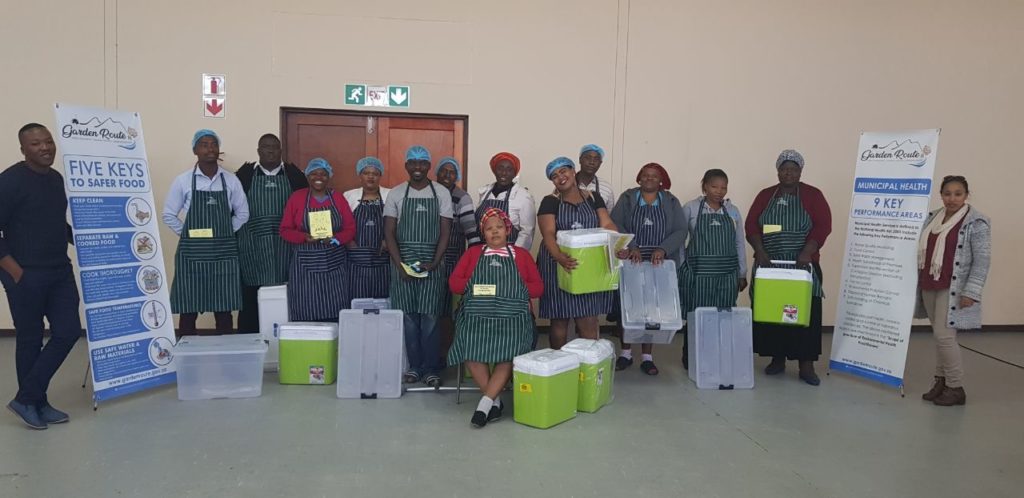
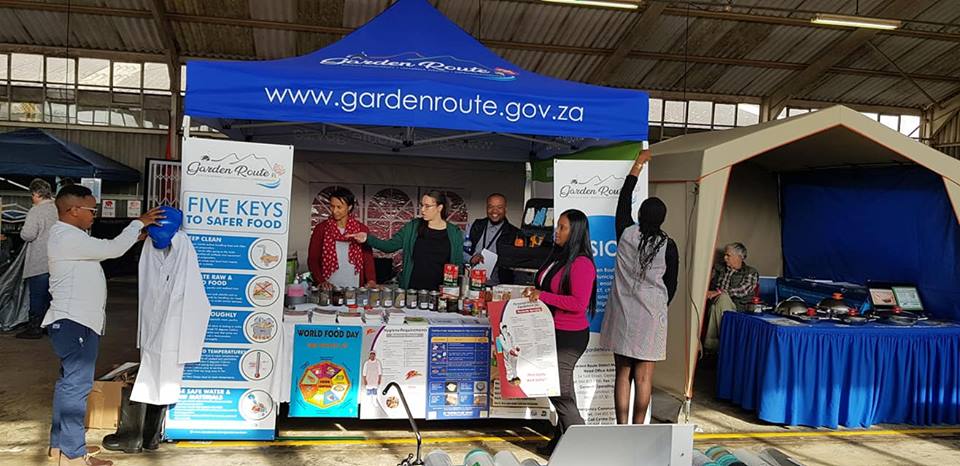
Food safety is one of the nine Key Performance Areas (KPAs) of Municipal Health and Environmental Services, which forms part of the Directorate Community Services at Eden District Municipality (Eden DM). Food safety includes the monitoring of food premises and safe handling of food at formal and informal food premises. Education on hygiene awareness is also done by Environmental Health Practitioners to the public.

Food safety training was recently presented to food handlers of formal and informal food premises in Oudtshoorn.

Environmental Health Practitioners Mr Francois Koelman, Ms Elizna Barnard and Mr Pieter Crous of Oudtshoorn Municipal Health office presented the training.

The content of the training focused on the World Health Organisation’s Five keys for safer food, which include:

1. Keep clean

Wash your hands before handling food and often during food preparation;
Wash your hands after going to the toilet;
Wash and sanitise all surfaces and equipment used for food preparation;
Protect kitchen areas and food from insects, pests and other animals;

2. Separate raw and cook foods

Separate raw meat, poultry and seafood from other foods;
Use separate equipment and utensils such as knives and cutting boards for handling of raw foods;
Store food in containers to avoid contact between raw and prepared foods;

3. Cook thoroughly

Cook food thoroughly, especially meat, poultry, eggs and seafood
Bring foods like soups and stews to boiling to ensure that they have reached 70 ͦ. For meat and poultry, make sure that juices are clear, not pink. Ideally, use a thermometer.
Reheat cooked food thoroughly.

4. Keep food at safe temperatures

Do not leave cooked food at room temperature for more than 2 hours.
Refrigerate promptly all cooked and perishable food (preferably below 5ºC).
Keep cooked food piping hot (more than 60ºC) prior to serving.
Do not store food too long even in the refrigerator.
Do not thaw frozen food at room temperature.

5. Use safe water and raw materials

Use safe water or treat it to make it safe
Select fresh and wholesome foods
Choose foods processed for safety, such as pasteurized milk
Wash fruits and vegetables, especially if eaten raw
Do not use food beyond its expiry date

Participants now have a greater understanding about the importance of their roles and responsibilities in when handling food. A Certificate of Attendance was issued to those who received training and informal food traders also received incentives, which included cooler boxes and aprons.

PJ Badenhorst Primary School given training through WASH Project

The WASH (water, sanitation and hygiene) Project in Schools is a programme which is supported by the World Health Organisation (WHO) to improve water, sanitation and hygiene conditions at schools. The school manager, educators of PJ Badenhorst Primary School in Dysselsdorp and the Eden District Municipality (Eden DM) Municipal Health Section based in Oudtshoorn, collaborated to establish a WASH committee. The committee strives to ensure that sustainable good health prevails among educators and learners and that the school environment is kept clean and healthy. The committee is supported by the school governing body. Involvement of educators, learners, parents, communities and government institutions is important in WASH projects.

The Manager of the Eden DM Municipal Health Services: Klein Karoo, Mr Desmond Paulse, gave a presentation to the WASH committee on the important components of a Programme, which include:

  • water facilities, water conservation and access to water;
  • hygiene promotion;
  • sanitation;
  • control of communicable and vector-borne diseases;
  • cleaning and waste disposal;
  • food storage and preparation especially in case of school feeding schemes; and
  • importance of hand washing.


Environmental Health Officials from Eden DM with staff and learners of PJ Badenhorst Primary School in Dysseldorp who is involved in the school’s WASH project. Front FLTR: Mr Desmond Salmans (Chairperson: School Governing Body), Ms Clinique Esau (Learner), Mr John Wayne Pietersen (Learner), Ms Lorinda Paulse (Acting Principal). Middle FLTR: Mr Willie Plaatjies (Senior Environmental Health Practitioner), Ms Beverley Oktober (Food preparer-School feeding scheme), Ms Sunelle Zaayman (Admin Clerk), Ms Ann Botha (Food preparer), Ms Cecelia Lindt (Food preparer). Back FLTR: Mr Francois Koelman (Environmental Health Practitioner), Mr Jacques Van Aswegen (Educator), Ms Gran Ayford (Educator), Ms Caroline Botha (Food preparer),Mr Desmond Paulse (Manager Municipal Health: Klein Karoo).

Environmental Health Practitioners Francois Koelman and Willie Plaatjies did a presentation to food preparers of the school feeding scheme on food safety and safe storage of food. The Municipal Health Section of Eden DM will continue to support the school with WASH projects.

Diarrhea and worm infections, which are two of the main diseases that affect school aged children, can be drastically reduced through improved water, sanitation and hygiene practices. Children can carry infectious agents from childcare settings and schools into the home and vice versa, causing those in contact with them to get infected. WASH in schools focuses generally on the prevention of diseases that can be transmitted from person to person, and the program aims to ensure the following:


  • learners that are healthier,
  • learners that can positively influence hygiene practice in their homes, among family members and in the wider community;
  • learners to observe, communicate, cooperate, listen and carry out decisions about hygienic conditions and practices for themselves; and
  • change in current hygiene behavior and continue better hygiene practices in the future like correct hand washing with soap which is an important barrier to transmission of infections and has been cited as one of the most cost-effective public health interventions. Hand washing with soap can reduce the incidence of diarrhea from 48 to 42 percent. Improved sanitation behavior has also been associated with a reduction in gastro-intestinal illnesses.

District celebrates Women’s day

Eden District Municipality’s women, on 18 August 2017, were treated to a day of motivational talks in commemoration of Women’s Day at the George Correctional Services recreational hall. Financial planning and donations were provided by Capitec; women’s health information was shared by Agness Maree from CANSA; dressing according to your body shape by Annalidda; and self-defense tips by Mr Malcolm Pojé. Ladies from Eden DM were dressed up to the theme “Sassy, Candy, Mismatch”, which represents a woman being bold, full of spirit and talkative, colourful, sweet and not one in the same.

Cllr Rosina Ruiters‚ Eden DM Executive Deputy Mayor delivered the keynote address and expressed her passion for progressive women and especially the contribution that women offer to their families and society in general. “I am here to honor the power and struggles of women who have broken all barriers and reached the pinnacle of success in every sphere of life,” she said. Cllr Ruiters also highlighted 09 August 1956, as one of the turn-around events in the struggle for freedom and women’s rights in South Africa. “It was on this day that more than 20 000 women of different races staged a march to the Union Buildings in Pretoria to protest against the proposed amendments to the Urban Areas Act (commonly known as the pass laws) of 1950.”

“Women are like glue to their families, but still face abuse in today’s life; emotionally, physically and financially.”
“Women must speak out and put a stop to the abuse. Wathinta abafazi wathinta imbokodo ‘you strike a rock – you strike a woman’,” Cllr Ruiters concluded.

Malcolm Pojé, Communication Officer and Spokesperson of the Southern Cape, South African Police Service (SAPS), shared his admiration and respect for women. He then presented various self-defense skills, which proves to be effective when a person faces an attacker. He specifically pointed out how a woman should target specific areas of a man’s body to temporarily disable him, which would ensure her with adequate time to escape to a safe space.


SAPS Communication Officer and Spokesperson, Malcolm Pojé, educated Eden DM ladies about self-defense by
demonstrating possible situations of how attackers could be temporary disabled. Ms Amagene Koeberg, the Garden Route and Klein Karoo Tourism Coordinator, took part in the demonstration.

Eden District Municipality, Portfolio Chairperson of Strategic Services, Cllr Erica Meyers, extended a word of appreciation to Eden DM women for their hard work and dedication. She also thanked, CAPITEC Bank, Malcom Pojé from SAPS, Annalida (fashion designer) and Ms Maree from CANSA for supporting and offering motivational talks to Eden DM women.
The décor was done by Margaret Powell and Marlene Nqumse, who had to make do with minimal funds – Eden DM would like to thank them for doing a sterling job!