Skip to content Skip to left sidebar Skip to footer

GREF

25 March 2026 Media Release: Garden Route land restoration

Media Release: Garden Route land restoration

25 March 2026

An enormous number of farms along the Garden Route drylands have over time become barren due to drought, over grazing, climate change and historical negative land use practices.

Persistent drought is forcing farmers off the land as it is no longer feasible to farm in dry areas. Degraded soils and large scale sheet erosion have had a massive impacts on the carrying capacity and water security on farms in the Klein-and Groot Karoo over past decades, and it is on the increase.

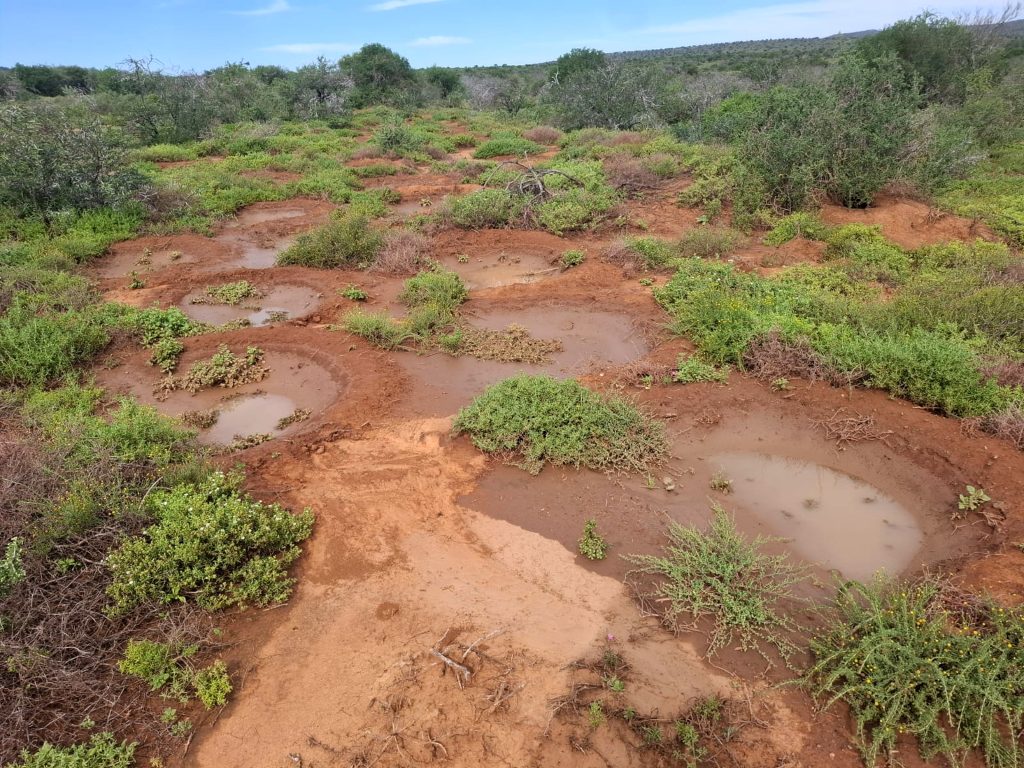
On a positive note, many farmers are using tried and tested methods of land restoration to great effect. “One of the most effective ways to bring back life to barren soil is through a practice named ponding”, says Cobus Meiring of the Garden Route Environmental Forum (GREF).

Shallow ponds scattered throughout barren zones where no grass nor plants can take root, forms very effective water and soil retention traps. Multiple ponds allows plant recovery and surface water to soak into the earth and replenish the water table below. In the rain shadow of the Outeniqua and Swartberg Mountains, land restoration is a painfully slow process, but eventually it does yield positive results from a resilient environment and nature bounces back spectacularly.

Thunderstorms and floods over the Garden Route and Karoo interior presents much relief to farmers and towns alike. Still, episodic rains inflict much harm to the land where degraded surface areas cannot retain top soil and run-off water, leaving behind ever more erosion and further degradation. Through interventions such as ponding these rainfall events can make a huge difference in land restoration and water security.

As the changing climate brings about uncertainty in terms of rainfall and rainfall patterns, it is more important than ever that land managers adapt and allow land recovery initiatives to their own benefit and in the process create a high quality environment.

The Garden Route Environmental Forum (GREF) is a public platform for environmental managers and serves as a climate change think tank. For more information visit grefecsf.co.za and info@hiveenergy.co.uk.

Picture: Ponding on barren landscapes is a simple but very effective method to allow barren land to recover and replenish water tables.

ENDS

16 March 2026 Media Release: Greening Townships Key to Surviving Rising Heat

Media Release: Greening Townships Key to Surviving Rising Heat

For immediate release
16 March 2026

“Given the rising temperatures across the region, serious consideration should be given to greening townships, schools and crèches where people have little protection from the blazing sun,” says Cobus Meiring of the Garden Route Environmental Forum (GREF).

“Shade provided by trees can bring much-needed relief, and greening projects should become a budgeted priority for municipalities as part of long-term climate change adaptation and planning.” In many communities there is little escape from extreme heat, particularly for children and the elderly, making urban greening an important public health intervention.

Heatwaves and extremely hot, dry conditions are currently affecting communities across the Garden Route interior. From Uniondale to Ladismith in Kannaland, drought conditions persist and residents are increasingly feeling the pressure of limited water supplies.

According to residents in De Rust, the town’s water supply is presently not suitable for drinking, highlighting the vulnerability of smaller towns during prolonged dry periods. While the Garden Route interior is accustomed to hot summers, many residents say this season has been particularly severe, with sustained high temperatures and little rainfall.

Weather forecasts indicate there is little prospect of substantial rainfall before April, and possibly even later. In recent weeks parts of the Western Cape have recorded temperatures approaching 50°C, reinforcing concerns that predicted climate change impacts and shifting rainfall patterns are becoming a reality.

Water shortages remain a grave concern not only for households but also for agriculture and the broader regional economy. Farming communities depend heavily on seasonal rainfall, and prolonged drought threatens both livelihoods and food production.

A high quality of life is not feasible without reliable potable water supplies. While communities wait for seasonal change, residents are urged to heed water-use restrictions and to use water responsibly wherever possible. Long-term climate adaptation measures will become increasingly important as temperatures rise and water scarcity becomes more common.

GREF is a public platform for environmental managers and a climate change think- tank (www.grefecsf.co.za)

ENDS

02 March 2026 Media Release: GREF Comments on South Africa’s Draft National Invasive Species Strategy and Action Plan (2026-2036)

GREF Comments on South Africa’s Draft National Invasive Species Strategy and Action Plan (2026-2036)

For immediate release
02 March 2026

The Garden Route Environmental Forum (GREF) welcomes the development of South Africa’s Draft National Invasive Species Strategy and Action Plan (2026-2036), facilitated by the South African Local Government Association (SALGA). Municipalities and stakeholders nationwide have contributed to the draft, underscoring the growing urgency of addressing invasive alien species.

South Africa faces a serious and escalating problem with invasive alien plants (IAPs), particularly along river systems, mountain catchments and biodiversity hotspots. While a national strategy is necessary, it is not new. Comprehensive policies already exist under legislation such as the National Environmental Management: Biodiversity Act (NEMBA). “South Africa has strong environmental legislation, but implementation and sustained funding remain the real challenges,” says Cobus Meiring of GREF. “Without consistent action across all spheres of government, invasive species will continue to spread faster than we can contain them.”

The Garden Route is one of the regions most affected by IAPs, with infestations expanding steadily. Invasive species are transforming natural landscapes, reducing biodiversity and placing immense pressure on already vulnerable ecosystems. The financial burden of clearing operations including capital equipment, labour and follow-up treatments continues to rise, impacting municipalities, conservation agencies and private landowners alike.

The implications are far-reaching. Invasive alien plants reduce water runoff in critical catchments, directly threatening water security in the drought-prone Southern Cape. Dense infestations also increase fuel loads, contributing to more intense and destructive veld fires. Recent severe wildfire seasons have prompted stronger compliance among landowners, many of whom have demonstrated commendable commitment to clearing their properties in accordance with environmental legislation.

Climate change further intensifies the challenge. Rising temperatures and shifting rainfall patterns favour invasive species, compounding stress on indigenous habitats and ecosystems.

A concerning decline in national funding for eradication programmes means municipalities and landowners are increasingly required to rely on their own limited resources. GREF supports a strengthened, properly funded and measurable national action plan focused on catchment-level priorities to safeguard biodiversity, water security and regional resilience.

GREF is a public platform for environmental managers and landowners and serves a climate change think tank (grefecsf.co.za)

Picture: Lantana Camara: an aggressive alien invasive plant in the Garden Route

10 December 2025 Media Release: Coastal Erosion Threatens Homes and Infrastructure Along Western and Eastern Cape

Media Release: Coastal Erosion Threatens Homes and Infrastructure Along Western and Eastern Cape

For Immediate Release

10 December 2025

“Coastal erosion is a harsh reality along the Western and Eastern Cape coastlines. The damage is visible, measurable, and ongoing as rising sea levels and increasingly severe storm surges take their toll,” says Cobus Meiring, Chairperson of the Garden Route Marine and Coastal Committee.

Coastal degradation is now a high priority for towns and cities along the coast, with planning increasingly focused on relocating infrastructure out of harm’s way. The Committee recently raised these concerns in a meeting which included municipalities, SANParks, and CapeNature, highlighting the urgent need for the implementation of proactive coastal management strategies. The issue also received attention at the Eastern Cape Sustainability Seminar hosted at Nelson Mandela University in Gqeberha in early December.

In Cape St. Francis, there are growing fears that the marina and properties bordering the canals from the Krom River could be flooded if the dune system protecting them from the ocean collapses. This erosion results largely from human interventions that disrupted large scale natural dune movement, leaving dune systems exposed and unable to perform their protective function.

Different approaches have been tried along the coast. Langebaan required hard engineering interventions, while in Buffels Bay, softer methods like heavy sandbagging have shown some success. Despite these efforts, landowners with sea-front properties remain at risk, and unregulated attempts to protect property can worsen erosion on neighbouring land due to the shifting of kinetic energy of surging waters.

The problem extends beyond property damage. Sand build-up in river mouths such as the Touw river and estuaries disrupts ecosystems, while ongoing drought conditions in 2025 have reduced freshwater flow, contributing to the water crisis in Buffels Bay.

Looking ahead, municipalities and landowners face a complex challenge. More research, smart planning, and innovative engineering solutions are essential to manage the changing coastline.

The Garden Route Environmental Forum provides a public platform for landowners, managers, and climate change experts to share knowledge, explore solutions, and promote sustainable coastal management. (www.grefecsf.co.za)

Image: Unsightly hard intervention was the only option to save properties in Langebaan from flooding following aggressive storm surges

ENDS

18 November 2025 Media Release: Lack of government funding fighting invasive plants poses a challenge

Media Release: Lack of government funding fighting invasive plants poses a challenge

For immediate release
18 November 2025

“The multiple fires we’ve seen in the Garden Route over recent weeks again confirm what we have warned about for years,” says Cobus Meiring of the Garden Route Environmental Forum (GREF). “With rainfall figures remaining low, invasive alien plants proliferating, and climate conditions becoming harsher, the region is facing rising fire danger and intensifying pressure on already stressed water resources.”

Invasive alien plants (IAPs) are one of the greatest threats to the Garden Route’s critically endangered habitats, sensitive mountain catchments, and the ecological functioning of rivers and estuaries. Species such as pines, wattles, Lantana, bugweed, gums and hakeas consume large volumes of water, starving rivers of sustained flow and undermining the health of estuaries that depend on reliable freshwater input. At the same time, these invasives create dense, highly flammable fuel loads that can turn ordinary wildfires into uncontrollable events.

To better understand and respond to these risks, entities such as the Southern Cape Fire Protection Association (SCFPA), SANParks, CapeNature and the Garden Route District Municipality established the Risk Reduction Task Team – a working group that continuously evaluates the growing threats posed by IAP’s and advises on coordinated mitigation.

However, the challenge is outpacing the resources available. Government grants, including those that previously supported large-scale clearing under programmes such as Working for Water, have shrunk dramatically. The breeding and release of biological control agents- once an essential tool for suppressing the spread of several invasive species is now no longer freely available, further compounding management difficulties. As a result, landowners, conservancies and local initiatives are increasingly left to carry the financial burden themselves, with uneven success.

More sustained investment from government is essential. Firefighting is expensive, and so are the preventative measures required to reduce risk, but prevention is far cheaper than disaster. Alien plant control must be funded consistently, prioritised strategically, and integrated with fire management, biodiversity conservation and climate-adaptation planning. Without this, the region’s water security, natural heritage and community safety will remain increasingly vulnerable.

The Garden Route Environmental Forum is a public platform for landowners and environmental managers and a climate change think tank. (www.grefecsf.co.za)

Photo: Homestead saved from raging wildfire by determined GRDM fire fighters and the landowner in Hessequa in October 2025 – Michael Raimondo.

ENDS

25 September 2025 Media Release: Revival of commercial forestry in the Southern Cape a huge relief

Media Release: Revival of commercial forestry in the Southern Cape a huge relief

25 September 2025

“The Southern Cape’s economy was built on forestry for close to two centuries. Unfortunately, this vital industry, supporting thousands of jobs and a wide downstream value chain, which included saw mills and timber sales, has fallen into sharp decline as major plantations on state land have not been replanted and only small pockets remain on private land,” says Cobus Meiring of the Garden Route Environmental Forum (GREF).

One of the unfortunate environmental impacts were that vast areas formerly managed as commercial plantations were no longer managed and thousands of hectares of land succumbed to dense infestations of invasive alien plants. This in turn held considerable risks for the region including potential wildfire disasters, water security and loss of biodiversity.

Over and above the environmental risks posed the demise of commercial forestry coincided with substantial job losses, loss of skilled labour, experience and a generational forestry management culture developed over a century.

The recent reversal of government policy allowing Cold Stream Timber Company (CTC) to replant a number of dormant plantations is a welcome relief to the Garden Route. Commercial forestry can create huge amount of jobs to skilled and unskilled labour at a time when unemployment in the region carries enormous socio- economic risks.

The newly formed Garden Route Risk Reduction Task Team (RRTT) welcomes the additional capacity of the forestry industry in protecting the region against overwhelming fire risks as a result of more available manpower and resources. This will include controlled burns, large scale management of invasive plants, the development of essential fire breaks and critical biodiversity corridors free of invasive plants.

As the Southern Cape again enters a period of low rainfall in the medium term fire risk increases exponentially, as the recent wild fires in Ruitersbos are testimony to. Combatting wild fires are extremely costly, and since its re- occurrence is guaranteed it requires an integrated approach, constant planning, vigilance and a high state of preparedness.

The Garden Route Environmental Forum (GREF) is a public platform for environmental managers and a climate change think tank. www.grefscli.co.za

Photo: The return of commercial forestry brings hope to the Southern Cape socio- economic and biodiversity sustainability

25 August 2025 Media Release: Garden Route Risk Reduction Task Team to Be Established

Media Release: Garden Route Risk Reduction Task Team to Be Established

For immediate release
05 August 2025

“Growing concerns about an increase of fire risk exposure levels in the Garden Route have led to the establishment of a Risk Reduction Task Team (RRTT),” says Cobus Meiring of the Garden Route Environmental Forum (GREF).

The mission of the RRTT is to help prevent a recurrence of catastrophic events such as the 2017 Knysna and Plettenberg Bay wildfires, which were worsened by uncontrolled growth of invasive alien plants (IAP).

The RRTT aims to be a collaborative platform focused on strategic risk reduction and sustainable landscape management, working closely with landowners, conservation bodies, and enforcement agencies across the Garden Route.

Key stakeholders who form part of the task team will assist and encourage private landowners to reduce IAPs on their properties. Where necessary, action will be taken through the Department of Forestry, Fisheries and the Environment (DFFE) Biosecurity resources.

Awareness creation will be a central pillar of the RRTT strategy. This will include direct engagement with landowners and sustained information-sharing campaigns through traditional media and social media platforms over the long term.

The RRTT will include experts and representatives from the Southern Cape Fire Protection Association (SCFPA), Garden Route District Municipality’s (GRDM) Disaster Management, local municipalities, DFFE, Nelson Mandela University, and GREF stakeholders.

Individuals or entities involved in invasive alien plant management, are invited to register as interested and affected parties by writing to louisamare@gmail.com.

The GREF is a climate change and environmental management think-tank. (www.grefscli.co.za).

Feature Image: Without collective action by all landowners in the Garden Route the region remains highly vulnerable to wildfire disasters.

ENDS

14 August 2025 Media Release: Garden Route plays host to Fynbos Forum

Media Release: Garden Route plays host to Fynbos Forum

For immediate release
14 August 2025

“The Garden Route played host to the Fynbos Forum from 12 to 14 August at the iconic Wilderness Hotel”, says Cobus Meiring of the Garden Route Environmental Forum (GREF)

Established in 1997 the Fynbos Forum is South Africa’s premier conservation and research group dedicated to the preservation of the South African Fynbos Biome.

Vital to indigenous bio- diversity the Southern Cape is home to a magnificent treasure chest of Fynbos species. Unfortunately much of what remains of our once abundant Fynbos is critically endangered due to intensive agriculture, over development, encroachment of invasive alien plants and animals as well as frequent wild- fire disasters.

The Fynbos Forum is a scientific group of natural scientists, researchers, planners, managers, landowners and key stakeholders. It meets annually to discuss the collaborative production of knowledge that underpins regional conservation efforts in the Fynbos Biome in South Africa.

The good news is that as more land and conservation corridors in the Garden Route are becoming available for conservation and rewilding purposes as well as awareness grows on the incalculable value of Fynbos, there is a real chance that it may prevail despite many challenges.

As a transdisciplinary regional learning network, the Fynbos Forum supports discussions on management issues and research results, prioritizing future research and conservation management actions required to ensure the conservation and sustainability of fynbos ecosystems.

The Garden Route Environmental Forum (GREF)- a climate change and environmental management think- tank.(www.grefscli.co.za)

ENDS

22 May 2025 Media Release: Fire danger place Invasive Alien Plants in the spotlight

Media Release: Fire danger place Invasive Alien Plants in the spotlight

For immediate release
22 May 2025

Approaching winter fronts have the Garden Route on edge as fears of a repeat of the 2017 mega fire disaster looms as a clear and present danger”, says Cobus Meiring of the Garden Route Environmental Forum (GREF).

Regional environmental and disaster management agencies are in agreement that the 2017 conditions conducive to the worst fire disaster in South African history are again ready for the perfect storm.

Despite best efforts and collaboration between landowners affected by the 2017 fire disaster, Invasive Alien Plants (IAP’s) have made a comeback on the Knysna as well as the 2018 Outeniqua burn scars providing more fuel for a wild fire than ever before. Not only is Knysna and surrounds again in the path of danger, but many other areas including George, Wilderness, Sedgefield and Great Brak.

The Garden Route District Municipality (GRDM), George Municipality the Southern Cape Fire Protection Association and many other entities involved with – fighting has ramped up their collective strength to deal  with an increasingly number of wild fires, but the core problem remains: Invasive Alien Plants on the Southern Cape landscape.

Garden Route landowners in the urban edge are especially exposed as they can only do so much in terms of safeguarding their properties by creating defendable zones, cleaning their gutters and prepare escape routes. All river systems, mountains and river corridors in the garden Route are infested with high density IAP plant growth.

Landowners are not unaware of the danger invasive plants pose, but more often than not lack the resources to do anything meaningful about it. Still, fire- proofing the Garden Route is important, and a collective effort u

Government efforts (e.g. The DFFE Working for Water Programme) to eradicate IAP growth has collapsed as a result of a lack of funding, no further investment in bio- control and limited capacity to enforce legislation.

GREF will be focusing on climate change and Invasive alien plant implications at the Annual Climate Change and Environmental Indaba in partnership with Nelson Mandela University on 27 June. At stake is not only fire risk, but hard hitting drought is looming in coming years and loss of critical bio diversity is negative for the region’s appeal as a world class destination.

The Garden Route Environmental Forum (GREF) is a public platform for environmental managers and landowners, and a climate change think tank. (www.grefscli.co.za).

ENDS

05 May 2025 Media Release: Indaba to discuss the likely impact of Climate Change on the Garden Route: A 20 year outlook

Media Release: Indaba to discuss the likely impact of Climate Change on the Garden Route: A 20 year outlook

For immediate release
05 May 2025

“The Garden Route is no stranger to natural disasters and increasingly so to which many ascribe to a fast-changing climate”, writes Cobus Meiring of the Garden Route Environmental Forum (GREF). The question begs how can environmental managers look into the future and make projections on what may be impacting on the region over the next two decades. The Garden Route conservation and environmental management community is blessed with recognised and highly educated academics and practitioners capable of modelling scenarios and impacts capable of creating scenarios of what an uncertain future may hold.

Floods, storm surges, drought and non-stop wild fire disasters are all posing serious challenges to hard infrastructure, fragile ecosystems and vulnerable Garden Route communities. Perhaps more importantly, a changing climate may well adversely affect the regional economy as it becomes harder for the all-important agricultural sector to be viable and sustainable unless it is able to adapt. The other significant regional economic driver is tourism, and a deteriorating natural environment due to natural disasters and loss of natural infrastructure, e.g. the deteriorating coast line and risk to properties will also be discussed at the upcoming Climate Change Indaba.

Over time budgets to repair hard infrastructure such as roads, bridges, storm water systems and infrastructure along the coast are decreasing, and governmental entities responsible for planning and construction must take into account potential risks associated with the impact of a changing climate and rain fall patterns. Torrential and episodic rain storms are becoming the order of the day, and storm water systems and roads must be designed in order to be able to survive such impacts.

The negative impact of Invasive Alien Plants (IAP’s) on the environment including providing fuel for out- of control wild fire disasters an severely affecting biodiversity, preventing water catchments and feeder streams to function effectively is not being addressed by landowners and spreading fast.

Across the region environmental disasters are on the increase, and disaster management agencies responsible for dealing with their aftermath must be better funded, better equipped, better trained and be pro-active in putting early warning systems in place to reduce exposure.

The GREF Climate Change and Environmental Management Indaba will take place on 27 June 2025 at Nelson Mandela University: George Campus.

Enquiries can be sent to louisamare@gmail.com.

The Garden Route Environmental Forum is a public platform for environmental practitioners and a climate change think- tank.(www.grefscli.co.za).

ENDS