
21 July 2025 Media Release: GRDM Achieves 88% Compliance in Latest National Municipal Health Services Assessment

Media Release: GRDM Achieves 88% Compliance in Latest National Municipal Health Services Assessment
21 July 2025
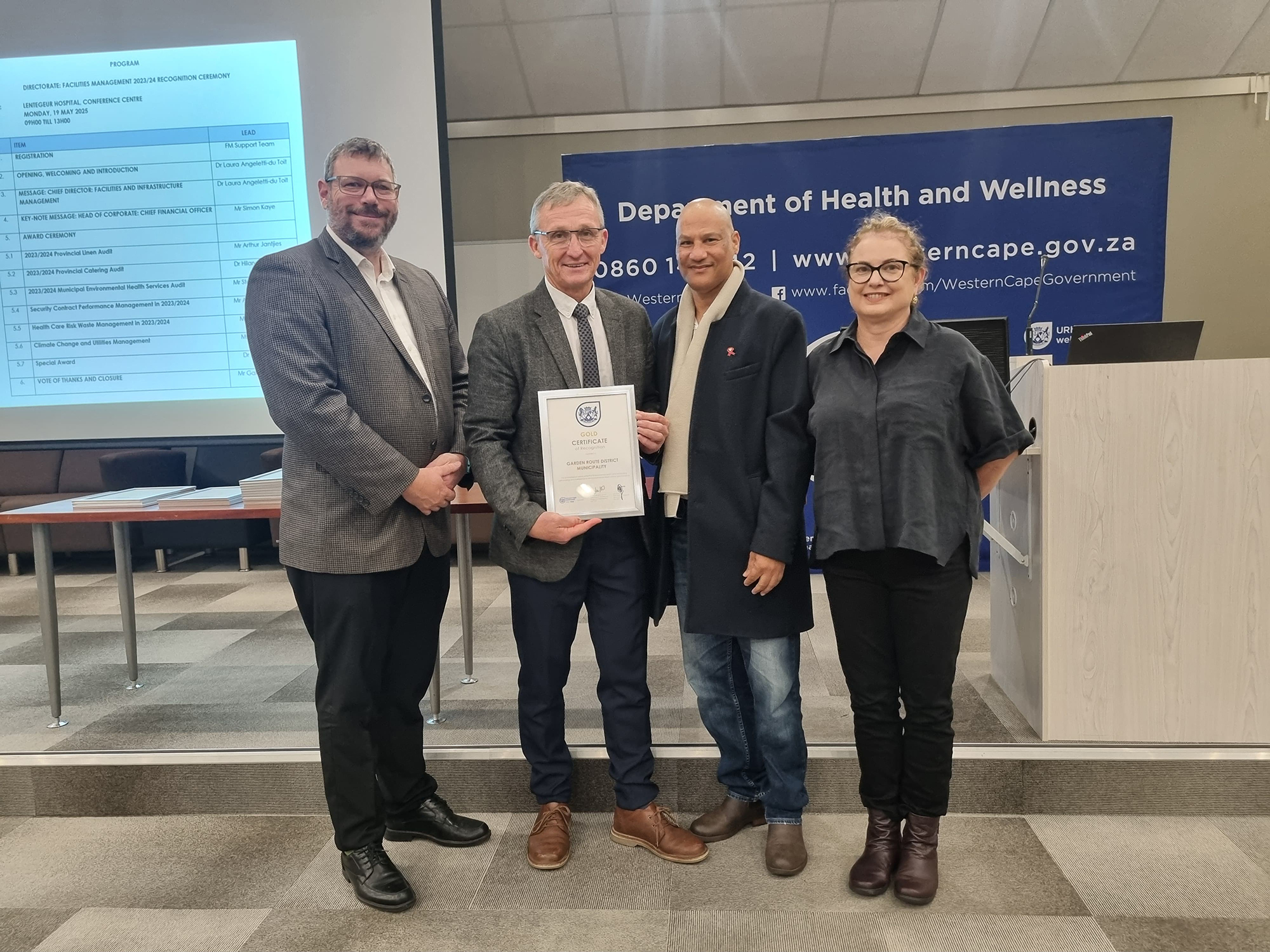
The Garden Route District Municipality (GRDM) has once again scored an impressive compliance standard in the latest national assessment conducted by the National Department of Health.
This assessment forms part of a three-year national audit cycle which is focused on the quality and effectiveness of Municipal Health Services (MHS) across the country. The National Department of Health oversees and coordinates MHS nationally. The Department uses this measuring tool to establish whether municipalities meet the prescribed ‘Norms and Standards’ for Environmental Health Services.
In response to the assessment results, Executive Mayor, Andrew Stroebel, said:
“I am immensely proud of the continued excellent work done by our Municipal Health Unit, especially given the challenges faced by municipalities country-wide with regards to funding. Despite limited resources our team continues to uphold the highest standards in service of public health and safety. I would also like to extend my congratulatory remarks to our Mayoral Committee Chairperson for Community Services, Cllr Jobieth Hoogbaard and the Executive Manager for Community Services, Nthabeleng Raisa-Mlandu and the Municipal Health team, from management, to Chiefs and each EHP”.
“Thank you for the tireless community services work you render and thank you for upholding health-standards to be proud of.”
The national audit tool consists of 114 questions grouped into 18 components. These are cover the full spectrum of the MHS mandate. Environmental Health Practitioners (EHP) prepare for the assessment by compiling and submitting detailed written records, proof of compliance, and participating in direct observational inspections.



New assessment tool and challenges noted
The 2025 audit marked the first time a newly developed assessment tool was used, which made comparisons with previous years difficult. The tool includes new components, some of which are under debate regarding the scope of services expected from District Municipalities and Metros. In spite of these complexities, GRDM still managed to achieve a solid 88% rating.
Presently, GRDM employs 29 EHPs, a shortfall in the EHP-to-population ratio, which impacts the frequency of inspections, especially on high-risk premises. The ratio currently stands at 1- 28 912 but should be 1-10 000 EHPs/population. This has been addressed previously by the GRDM because of the funding model of district municipalities not providing adequate budget for all the EHPs required. This is also an issue in other districts across the country.
While the new assessment introduced valuable reforms, some criteria evaluated functions not legislatively assigned to District Municipalities, resulting in deductions. GRDM has raised concerns about this misalignment.
Another point to note is that this initial national assessment round included only 17 municipalities across the country, limiting the ability to benchmark results. However, in previous assessments using the former tool, GRDM was the top-performing district in the Western Cape and among the best-performing districts nationwide.
Although this national audit is conducted every three years, the Provincial Department of Health will continue with interim assessments to ensure ongoing compliance and service excellence. GRDM remains dedicated to upholding and improving the standard of municipal health services, regardless of evolving assessment frameworks.
ENDS
Feature Image: Johan Compion, GRDM Manager for Municipal Health and Environmental Services, during an education event which focused on the correct way to wash hands.