Skip to content Skip to left sidebar Skip to footer

News

3 April 2020 Media Statement: Noticing illegal price hikes? Report it to authorities

Media Statement

For Immediate Release

3 April 2020

After the COVID-19 coronavirus pandemic started affecting South Africans, members of the public now face a myriad of challenges that no one anticipated.  One challenge, which was also brought to the attention of the Garden Route District Municipality’s (GRDM’s) Multi-Agency Command Centre, is the rapid increase of prices of essential goods within the Garden Route district. These items include various food products, toiletry essentials, disinfectants, to name a few.

The Competition Commission on 20 March 2020 issued a media statement to alert retailers regarding this type of conduct during this critical period. According to the statement, several complaints from the public about rising prices for essential products in particular certain food products, healthcare and hygiene products are noted.  The Commission also stated their concern about suppliers inflating prices as government, retailers and private healthcare companies embark on emergency procurement of products related to the curbing and managing of the spread of COVID-19.

The National Minister of Trade and Industry and Economic Development Ebrahim Patel on Thursday gazetted regulations in terms of the Competition Act and Disaster Management Act which aims to strengthen the ability of the commission and the National Consumer Commission to respond to incidences of exploitative pricing. These regulations empower the commission to prosecute cases where prices have increased materially without any cost justifications for the increase.

The Multi-Agency Command Centre urges retailers in the district, that should they not adhere to the regulations published by the National Minister, they will face severe penalties, including a 10 % of the store/business’ annual turnover for an offence of the first time and a 25 % of the annual turnover for a repeated offence. Further to this, directors of such companies who engage in illegal price hikes will face a potential imprisonment for a period of up to 10 years.

We therefore call upon all businesses/retailers within the Garden Route district to adhere to these Regulations to ensure that the residents/consumers of the district are fairly treated and served.

Consumers should bring their concerns to the attention of regulators through the toll-free no. 0800 014 880.

Written by Marillia Veldkornet | Communication Officer

Media Queries
Herman Pieters | Senior Communicator
Garden Route District Municipality
E-mail: communications@gardenroute.gov.za

Garden Route District Multi-Agency Command Centre

Comment by Premier Alan Winde on regulations around essential goods

3 April 2020

There has been a lot of debate online about how regulations, especially relating to what you can buy at the shops, are being interpreted.

I want to make something very clear: All of us have one clear objective in mind – and one only: to stop the spread of Covid-19, and to collectively, as a country, help save lives.

We know that the regulations were created for this reason. And any clarifications or updates to them – which, considering how quickly we moved into Lockdown is entirely normal – needs to be done with that ultimate aim in mind – to continue keeping us all safe

I also want to emphasise this, because it wasn’t reported correctly:

The Western Cape Government does not have the power to change regulations. From the outset we have shown our full support to President Ramaphosa for the lock-down and we are doing everything we can to help ensure these regulations are enforced.

The regulations are however at times vague, and residents across the province are confused about what it means for them.

We have tried to help with this interpretation, after consulting our legal team, and SAPS. We have done this only to provide the clarity many people need – so that they can abide by regulations properly. Everyone wants to play their part.

This requires common sense but also an understanding of the objective of the regulations: to keep people from gathering and spreading the virus.

I see the debate has largely centred on cigarette sales. But this is actually only one of many questions we sought advice on from SAPS.

For example, can you buy a data dongle so you can access e-learning resources? Can learners buy notebooks and pens to study? This is so important for our learners right now who need an education while our schools are closed.

There are many more.

I take cooperating with national government towards achieving our goal of beating Covid-19 very seriously.

I therefore called President Cyril Ramaphosa this morning to make clear that our concerns relate to the proper interpretation of the regulations, which are at times vague. Together with the national government, we want to apply a common sense approach to them that stops the spread, but also assists us with things like e-learning, for example.

The President has agreed that we can submit a list of these issues that require clarification to the Minister of Cooperative Governance today, and that a special President’s Coordinating Council will be called tomorrow to discuss regulations in particular.

Reference: https://www.westerncape.gov.za/department-of-health/news/comment-premier-alan-winde-regulations-around-essential-goods

3 April 2020 Media Release: Your donation is needed – CoronaVirus/Covid19 Pandemic

Media Release: Your donation is needed – CoronaVirus/Covid19 Pandemic

For Immediate Release
3 April 2020

South Africa is facing an unprecedented challenge with communities and the economy being affected by the growing COVID-19 pandemic. In the Garden Route District Municipality’s (GRDM) jurisdiction, with its seven (7) local municipal areas (Hessequa, Mossel Bay, George, Knysna, Bitou, Oudtshoorn and Kannaland), Garden Routers are coming together to combat the COVID-19 pandemic by lending a helping hand to others.

Donation of non-perishable food, toiletries, bedding for single beds and hand sanitisers will be of particular benefit to the less fortunate.   The Social Development Cluster of the GRDM Multi-Agency Command Centre kindly requests the public to make donations of this kind at the sites listed below:

Drop off points and/or contacts details per town are as follows:

HESSEQUA

Hessequa Fire Station, Mulder Street, Riversdale. Contact 028 713 7917 or 028 713 8000.

MOSSEL BAY

Mossel Bay Fire Station, Corner of Louis Fourie and Schoeman Streets, Mossel Bay. Charles Street, Great Brak River behind Mossel Bay municipal offices.  Contact the emergency call centre on 044 606 5000 or 044 691 3722.

GEORGE

Persons or organisations wanting to donate or provide  assistance in George can register via the online form http://bit.ly/CAW_Relief_Assistance  or contact the Social Development office on 044 802 2000.  Registered people, companies and NGOs will be contacted in due course.

KNYSNA

Contact Pam Booth on 060 998 6967 to make arrangements for collections.

BITOU

Bitou Fire Station, 1 Flying Cloud Drive, Plettenberg Bay. Contact Andile Sakati on 083 273 7057 / 072 272 4242 or Hadley Venter on 083 443 0120.

GREATER OUDTSHOORN

Oudtshoorn Fire Station (Disaster Relief Hub), 26 Church Street, Oudtshoorn. Contact Ms Sarah Olislager at 044 272 8977/ 083 689 2893 and Mr Wayne Peterson at 044 272 89 77.

KANNALAND

Disaster Management Centre, 23 Church Street, Ladismith (next to Standard Bank). Contact Wayne Robertson on 060 691 3029.

Before any donations are made, please contact the following DSD area representatives:

Mr Dennis Nghonyama [Oudtshoorn/ Kannaland] – 082 960 5746

Mr Mzukisi Skosana [George] – 083 628 7074

Mr Kenneth Mazaleni [Knysna/Bitou] –    082  226 9521

Ms Kholiswa Jobela  [Mossel Bay/Hessequa]- 078 210 5972

Donations by the public must happen without violating the isolation or quarantine measures in place or putting oneself or others at risk. It is advised that pre-arranged drop-off times be arranged to avoid overcrowding at sites. Donations will be controlled in adherence to lockdown regulations and responsibly distributed.

We thank you.

ENDS

Written by Marillia Veldkornet | Communication Officer

Media Queries
Herman Pieters | Senior Communicator
Garden Route District Municipality
E-mail: communications@gardenroute.gov.za

Garden Route District Multi-Agency Command Centre

2 April 2020 Media Release: Funeral undertakers trained to safely handle COVID-19 deceased

Media Release: Funeral undertakers trained to safely handle COVID-19 deceased

For Immediate Release
2 April 2020

Disease outbreaks often claim lives, and the number of lives lost since the start of the COVID-19 pandemic on a global scale, stands at 49,240. In light of the COVID-19 outbreak that hit South Africa, all 9 its provinces and subsequently, the Garden Route district, Environmental Health Practitioners from Garden Route District Municipality (GRDM), in conjunction with Forensic Pathology Services (FPS) and Emergency Medical Services (EMS), provided training to all funeral undertakers in the district. This was done to ensure that they are trained on aspects such as the safe handling and transportation of the deceased, including the donning and doffing of personal protective equipment and the disinfection of contaminated sites.

Training sessions took place yesterday in all municipal areas and accommodated 40 funeral undertakers in the Garden Route District.

Training sessions were conducted by officials from FPS, EMS, and Environmental Health Practitioners, who explained their different roles with regard to the handling and disposal of human remains and the disinfection of sites.

ENDS

Media Queries
Herman Pieters | Senior Communicator
Garden Route District Municipality
E-mail: communications@gardenroute.gov.za

Garden Route District Multi-Agency Command Centre

Media Release: Update on the coronavirus by Premier Alan Winde

2 April 2020

Tomorrow marks a week since the national lockdown was put in place to stop the spread of the coronavirus. This lockdown has been put in place to keep communities safe, to stop the spread and ensure that our health systems will be able to cope with the pressure that COVID-19 will place on it.

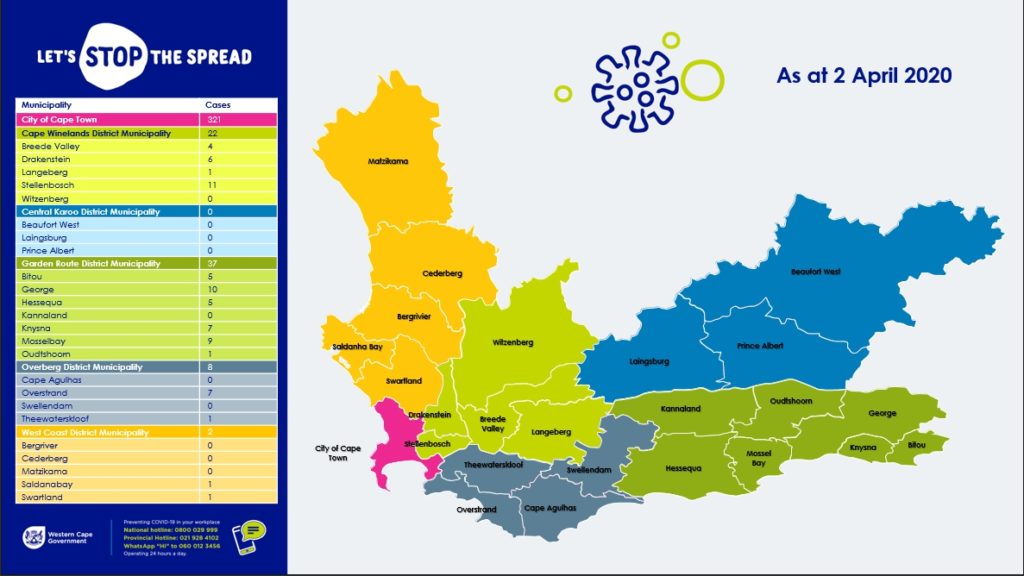
In the Western Cape, we have recorded 393 positively confirmed coronavirus cases now, with the majority of cases – 321 in the Cape Town metro. While infections have grown more slowly here than elsewhere, we are seeing trends which are cause for concern. Last Sunday, we announced our first cases in Khayelitsha and Mitchells Plain. We are also seeing an increase in the number of local transmissions and increasing admissions to hospital. As of this morning, 20 people in the Western Cape had been admitted to hospital, with seven in intensive care facilities.

Cape Town Metro Sub-Districts:

Metro
Cases
Western 124
Southern 110
Northern 21
Tygerberg 31
Eastern 17
Klipfontein 9
Mitchells Plain 7
Khayelitsha 2
Total 321

Non-metro districts:

Non-metro
District  Sub-district  Cases
Garden Route Bitou 5
Garden Route Knysna 7
Garden Route George 10
Garden Route Hessequa 5
Garden Route Mossel Bay 9
Garden Route Oudtshoorn 1
Cape Winelands Stellenbosch 11
Cape Winelands Drakenstein 6
Cape Winelands Breede Valley 4
Cape Winelands Langeberg 1
Overberg Overstrand 7
Overberg Theewaterskloof 1
West Coast Saldanha Bay 1
West Coast Swartland 1

Unallocated: 3

While these numbers are manageable now, every single resident needs to join our fight against the coronavirus so that we can save lives, particularly of those who are most vulnerable to this infection- the elderly, and those with underlying health problems who will be worst affected.

We all need to adhere to the rules of the lockdown, which means staying home. When we do leave our homes for necessities only, we must keep our distance, wash our hands, and avoid physical contact with others. If we are sick with flu-like symptoms, then we must stay home and call the coronavirus hotline on 0800 029 999  for advice. When we cough or sneeze, we do this into our arm or into a tissue which can be thrown away.

We understand that this lockdown is not easy and it has resulted in many people feeling afraid or confused. We are all in this together, and our strength of unity will get us through.

For our part, the Western Cape Government is currently looking at a number of sites and facilities across the province that we will be able to bring online as temporary healthcare facilities and quarantine and isolation sites. We are at an advanced stage in this process, and once we have completed all of the contractual matters, we will be making a further announcement.

Lockdown implementation:

The Western Cape Cabinet met with Western Cape police commissioner, Lieutenant General Yolisa Matakata, and her team yesterday where we received a briefing on their operations across the province. The provincial police also form part of our daily reporting meetings.

We continue to work with police to get clarity on the implementation of the regulations and the announcement of new regulations such as those pertaining to travel for funerals announced earlier today.

The province remains concerned about reports of brutality by police, law enforcement and the SANDF seen around the country. We raised this concern with them yesterday and will continue to monitor this situation closely.

Residents who have experienced incidents of brutality are urged to report these (the appropriate numbers are listed below).

SAPS has indicated that certain categories of crime have shown a decrease, which we welcome. However, we have also seen criminal elements taking advantage of the lockdown- with an increase in certain other types of crime and school vandalism incidents.

We are also concerned that the lockdown could result in increased incidents of domestic abuse, which are not being reported as a result of the regulations being in place. Those who are experiencing violence are reminded that they are able to report abuse to the police, or make use of the GBV reporting line services offered by the Department of Social Development. They can call the Gender-Based Violence Command Centre on 0800 428 428.

Services to victims of crime and violence are deemed essential and thus departmental and civil society organisations will continue to provide them, including shelter and psychosocial support.

The Department’s local offices remain open, and social workers are available to assist with emergency statutory services including victim empowerment, aiding children at high risk, child justice and probation services, services to persons with disabilities as well as older persons at high risk. Our hotline is also operational on 0800 220 250.

Transport and logistics:

Public transport has been a challenge during the first week of lockdown, and we are monitoring the impact of the new regulations for taxis announced yesterday.

Our transport and logistics workstream has distributed 8520 litres of sanitizer to the taxi industry and will be distributing a further supply to municipalities in the province.

A dedicated bus route to various hospitals has been implemented as from today in order to ensure that healthcare workers are able to get to work safely and on time.

Masks and personal protective equipment:

There has been much debate globally about whether it is recommended to make use of a facemask during the COVID-19 pandemic.

A policy guideline developed by the Department of Health, for sectors other than Health, indicates that as the epidemic unfolds, the wider use of masks is indicated even for people who are not ill, especially if they move around in the public.

The Western Cape Department of Health has worked together with leading independent scientists in South Africa, Professor Shaheen Mehtar and Dr Kerrin Begg of the College of Public Health Medicine Guidance task team, to provide clear advice for our residents on the appropriate and safe usage of masks – and who should use what kind of masks where and when.

The Golden Rules of Good Hygiene

Firstly, a mask is not a solve-all solution in the fight against COVID-19 and should never be used as a replacement for basic good hygiene considerations. The most important thing every resident should do is:

  • Wash your hands regularly for at least 20 seconds with soap and water
  • Do not touch your face with unwashed hands
  • Cough or sneeze into a tissue or the corner of your arm, and safely throw away the tissue
  • Keep a distance of 1,5m from others
  • If you are ill, stay at home, and if needs be call a medical facility to arrange for clinical assessment

This should be adhered to at all times, regardless of whether you have a mask or not.

Wearing  a mask does not make you safe from COVID-19 and members of the public must at all times follow these basic hygiene golden rules. They remain our most effective tool for the public to fight the spread of this virus.

Do not use N 95 Respirators and Medical masks:

At the outset it is important to distinguish between medical masks, or N95 respirators, and cloth masks (either home-made or procured).

One of the Western Cape Department of Health’s top priorities is to ensure that our front-line healthcare workers, who are caring for those with COVID-19, have the required N95 respirators and/or medical masks so that they are protected when undertaking their duties and helping us save lives.

There is a global shortage of these masks so we please urge all residents to not obtain or use these, so that we can ensure enough supply to the frontline healthcare workers in our hospitals and clinics.

Cloth masks:

A cloth mask, if appropriately used, and cleaned, can offer the following protection for residents:

  • The mask will reduce the transmission of droplets from the source (any person coughing or sneezing)
  • It will reduce inhaling a large number of droplets from others
  • Will reduce exposure in overcrowded areas such as taxis, shops of government buildings
  • Will create awareness around COVID-19
  • Inexpensive and can be produced in large quantities under clear specifications
  • Strict usage guidelines must be applied

 When could a cloth mask be used:

Cloth masks can be used by both the community and non-healthcare workers and where there is no physical contact. This includes:

  • Travel to and from work in public transport
  • When stepping outside the house to go shopping or seeking healthcare
  • In self isolation when contact with others is necessary (keeping a distance is still very important)
  • When stopping and talking to members of the public (for example, traffic police)
  • When conducting interviews during house to house visits (for example, Community workers)
  • When cleaning the streets/ disposing of domestic rubbish

How to properly use a cloth mask:

The usage of any type of mask should be accompanied by strictly adhering to safe use guidelines. Wash your hands before applying and after removing a mask, never touch the cloth part, never fiddle with it whilst wearing it, and refrain from touching your face. Discard disposable masks. Wash cloth masks with warm soapy water and iron when dry.

It is very important that residents use a cloth mask properly. If they do not, it might result in them putting themselves at risk of spreading COVID-19. The simple guidelines to use are:

  1. Only use a mask that has been cleaned & ironed
  2. Place the mask with the correct side facing your nose and mouth and covering both well
  3. Tie the strings behind your head, or if you are using elastic bands, make sure these are tight
  4. Make sure it fits well. Move it around to get the best fit. Never touch the cloth part.
  5. Once you have put on the mask, DO NOT TOUCH YOUR FACE again until you take it off
  6. When you take it off, undo the ties, and carefully fold the mask inside out, hold it by the strings/elastic and place the mask in a container preserved for washing the cloth mask.
  7. Wash hands thoroughly and dry before doing anything else

Maintaining the mask:

You must have at least two cloth masks per person so you will be able to wash one and have a clean one ready for use.

  • Wash the mask daily in soap and hot water (tolerated during hand wash).
  • Rinse thoroughly and dry
  • IRON THE MASK- this is the best means of disinfection!

How to make a mask:

A cloth mask can be made in any non-industrial or domestic setup, and is relatively simple to make. There are many videos on YouTube demonstrating a step by step guide on how to make a cloth mask of varying designs.

The following is the Western Cape Government approved cloth mask standard:

A cloth mask typically comprises square pieces of cloth with three pleats that can cover the face from ABOVE the nose to BELOW the chin and almost up to the ears.

Materials

  1. Outer layers:

Two layers, an inner and outer surface of the mask:

    1. Made from thick weave cotton like denim, calico or upholstery cotton fabric that can be easily washed
    2. Comprising two different patterns on the cloth – if possible – to distinguish between inside and outside of the cloth mask
  1. Inner layers:
    1. Two layers of ordinary cotton typically used for linen;
    2. If possible – between the two inner cotton layers – a laminate breathable layer of non-woven fabric which is washable at high temperatures – or if you don’t have that, something like a jacket lining inner.
  1. Strings or straps which can be tied behind the head

DO NOT USE STRETCHY MATERIAL WITH A LOOSE WEAVE such as T-shirt material. These offer no protection at all.

I want to call on the people of the Western Cape to only make cloth masks in line with our approved cloth mask standard – and to please make sure they follow these guidelines on their proper use. If you cannot make them properly or use them properly, it is safer to not use them at all.

Many homes have the materials required and can make masks immediately. So make for your home  – and then make more to donate to others can’t make their own. I will announce where and how we can get those masks from you shortly.

Anybody who receives a mask should wash and iron it before use.

In addition, I call on our textile industry to make these approved masks too – and for our civil society organisations – already working hard on helping us in many ways – to also help in the production of masks for all.

Cloth masks, when made and used properly, are one of the ways to keep all of us safe and healthy – and in these difficult and trying times – an opportunity for all of us to contribute to the cause of keeping everyone safe and healthy too.

As the epidemic unfolds and more research findings become available, we will keep the public abreast of these developments. In the meantime, our communications team will be creating and distributing easy to understand guides for cloth mask usage.

Reporting procedures and assistance:

Coronavirus national hotline: 0800 029 999

Coronavirus provincial hotline: 021 928 4102

To report crime or transgressions of the lockdown regulations: 10111

Reporting line for instances of abuse by police members: 073 890 1269

Reporting line for instances of abuse by the military: 012 676 3800 or email intake@milombud.org

Western Cape Police Ombudsman (complaints related to policing): Ombudsman@wcpo.gov.za

2 April 2020 Media Statement: AMENDMENTS TO THE COVID-19 REGULATIONS – SPECIFICALLY ATTENDING OF FUNERALS

GRDM MULTI-AGENCY COMMAND CENTRE POSITION

Please note that this statement replaces the previous statement issued by Garden Route District Municipality as new regulations have been promulgated.

A link to the District’s previous statement is available here: https://www.gardenroute.gov.za/2020/03/28/restrictions-to-funeral-services-during-the-covid-19-pandemic/

MEDIA STATEMENT

2 April 2020

THE MINISTER OF COGTA ANOUNCES AMENDMENTS TO THE COVID-19 REGULATIONS

In a quest to reinforce the national response and following extensive consultations with the Ministers responsible for the COVID-19 interventions and the National Coronavirus Command Council (NCCC), the Minister of COGTA, Dr Nkosazana Dlamini Zuma, has gazetted further amendments to the Regulations on the COVID-19 lockdown.

These amendments will enhance national integrated response measures while also clarifying the application of the regulations relating to government’s measures to reduce the risk of infection and curtail the rapid spread of the COVID-19 virus while maintain the integrity of the lockdown.

Movement in so far as funerals are concerned is being clarified in the amendment regulations.

The amendments allow certain individuals to move between provinces and, metropolitan and district areas for purposes of transporting a body for burial purposes.

The amendment also limits the individuals who are permitted to travel to funerals. The regulation now outlines a process for persons who wish to travel between provinces, or between metropolitan and district areas to attend a burial or cremation to obtain a permit.

It further determines that only the following persons, who live outside a province or metropolitan and district areas, may attend a funeral:
(i) spouse or partner of the deceased;
(ii) children of the deceased, whether biological, adopted or stepchildren.
(iii) children-in-law of the deceased;
(iv) parents of the deceased whether biological, adopted or stepparents;
(v) siblings, whether biological, adopted or stepbrother or sister of the deceased;
(vi) grandparents of the deceased; and
(vii) persons closely affiliated to the deceased.

The current prohibition of 50 persons attending a funeral is still in operation. The holding of night vigils is still prohibited.

The permit may be obtained from:
– A Magistrate who is the head of office or
– a station commander of a police station or a person designated by him or her

In order to obtain a permit:
A Magistrate who is the head of office or a station commander of a police station or a person designated by him or her must be provided with a death certificate or a certified copy of a death certificate;

It is important to note that:
A permit holder may stay at a hotel, lodge or guest house for the duration of the funeral or cremation. The permit must be presented to the owner or manager of the hotel, lodge or guest house.

The COVID-19 regulations and ammendment may be accessed for download at: http://www.cogta.gov.za/?p=7871 or https://bit.ly/2X46YJl

The members of the Inter-Ministerial Task Team (IMTT) on COVID-19 will brief the media today on the amendments. The details of the media briefing will be announced shortly.

Enquiries:
Mlungisi Mtshali
Cell: 0820885060

Issued by Ministry for Cooperative Governance and Traditional Affairs

Revisions to directions regulating public transport operations during lockdown period

The advent of the Covid 19 virus has plunged us into unchartered waters.  A situation that requires agility and decisiveness in our interventions and efforts to arrest the spread of the virus.  Public transport remains one of our biggest risk areas in the spread of the virus.  We must therefore do everything in our power to protect both the citizens who rely on public transport and those who operate the system from exposure and possible infection.

We indicated from the onset that we are on a steep learning curve and we will regularly review the measures we introduce from time to time in order to achieve the desired outcomes.

Since the lockdown came into effect at midnight of 26 March 2020, we have conducted an assessment of our measures and consulted with the taxi industry.
The consultation process also included relevant structures within government and individual Ministers.  As a consequence of this assessment and consultation, we have revised a number of our measures insofar as they relate to public transport.

In consulting with the taxi industry, I have engaged the leadership of the South African National Taxi Council (SANTACO) and the National Taxi Alliance (NTA).  I must commend the taxi industry for their efforts and commitment to playing their part in enabling mobility of the poor and vulnerable in these trying times.  Despite the economic challenges facing the industry, we were able to reach an agreement that guarantees continuous availability of public transport during the lockdown period.

We must all appreciate that the measures we introduce to curb the spread of this virus are about preserving human life, and not about our individual narrow self-serving interests.  Every one of us must appreciate this and play their part in eradicating this pandemic.

In our engagements, the taxi industry placed on the table critical issues, some of which we have processed while others remain work in progress.  At the time the lockdown was declared, we were in the process of finalizing our plans for the hosting of the National Taxi Indaba, which will be held later in the year, to address a number of critical economic issues confronting the industry.
Among the key issues to be considered by the Indaba is a sustainable economic empowerment model for the taxi industry.  This will include a public transport funding model, which must include a possible subsidy regime, in which the taxi industry is a full participant.

Subsequent to these engagements and consultations, we have taken steps to amend Directions relating to Public Transport.  Our engagements with our counterparts in government are ongoing to ensure alignment of our Directions with the Regulations published by the Minister of Co-operative Government and Traditional Affairs (COGTA).

We have therefore amended our Directives to give effect to the following measures:

During the lockdown period, the following public transport vehicles must reduce the number of maximum passengers to 70% of the licensed capacity, with no masks as follows:
• A minibus licensed to carry 10 passengers, is limited to carry a maximum of 7 passengers.
• A minibus licensed to carry 15 passengers, is limited to carry the maximum of 10 passengers.
• A midi-bus permitted to carry a maximum of 22 passengers, is limited to carry a maximum of 15 passengers
• A vehicle licensed to carry a maximum of 4 passengers is limited to carrying 50% of its permissible passenger carrying capacity.

ALTERNATELY
During the lockdown period, all Minibus and Midi-bus taxi vehicles are permitted to load their maximum 100% passenger loading capacity as provided for in their operating licenses, provided that all passengers are wearing masks.  The masks must be of the following categories:
(a) Surgical masks
(b) N95 respiratory masks

We require public transport operators to adhere to the Directions on sanitizing vehicles and put measures in place to give effect to social distancing at all material times.

Post the lockdown period, we will give priority to the National Taxi Indaba, which will tackle pressing and strategic issues facing the taxi industry.  This industry continues to operate on the fringes of the formal economy despite the fact that they have the largest market share of all public transport modes, in excess of 60%.  We are under no illusion that the conflict and violence that continues to define this industry are a consequence of an economic challenge that we need to collectively address as a matter of urgency.

The Taxi Indaba will seek to find consensus on a sustainable economic empowerment model.  In addition, we will review the effectiveness of current interventions, which include the Taxi Recapitalisation Programme and the rollout of the Integrated Public Transport Networks.  We will similarly pay particular attention to leadership issues and achieving sustainable unity which must ensure that taxi violence becomes a relic of the past.  The Indaba will also focus on regulation and ensuring that government ensures effective regulation, while the industry must commit to the rule of law.

We have no doubt, that the Taxi Indaba will emerge with a blueprint of an industry that is at peace with itself, able to sustain itself beyond government incentives and subject to the rule of law.

Issued by​:​Fikile Mbalula
​​​MINISTER OF TRANSPORT

2 April 2020 Media Release: More than 500 Water Tanks to be distributed to Western Cape informal settlements

Media Release: More than 500 Water Tanks to be distributed to Western Cape informal settlements

For Immediate Release
2 April 2020

Please note that we have added the section in bold, GRDM Communications


In the coming days approximately 500 water tanks will be distributed to various informal settlements across the Western Cape. Residents in these communities should be aware that their safety, health and basic rights are our top priority during this National crisis.

Based on the input provided by Municipalities, it was determined that 293 water tanks will be distributed to non-Metro districts, while the Metro will receive 244 of these tanks.

The non-Metro breakdown will see the Cape Winelands District receiving 75, the Garden Route District 86, Central Karoo District 50, Overberg District45 and the West Coast District 42.

A breakdown of the total number of water tanks per town in the Garden Route District, is as follows:

  • Hessequa: 5
  • Mossel Bay: 6
  • George: 20
  • Knysna: 20
  • Bitou: 15
  • Oudtshoorn: 10
  • Kannaland: 10

It is critical that good and effective hygiene, along with social distancing is practiced in order to prevent the further spread of COVID-19. The provision of these water tanks will undoubtedly assist in this regard, particularly since access to water is one of the challenges that’s faced by informal settlements across the country.

The Western Cape Government will be monitoring the distribution of these water tanks closely, to ensure that they do arrive at the identified area and that it is benefitting the community. I call on community members to ensure that this infrastructure is protected and utilised to strengthen, improved hygiene.

In these difficult times which we are experiencing as a country, I am making a further call on the private sector, as part of active citizenry and who might be in a position to also assist with the provision of water tanks to play a role in this regard, as it will help us in the fight against COVID-19.

We have to #StopTheSpread

Media Enquiries:
Marcellino Martin
Spokesperson for Minister Tertuis Simmers
Marcellino.martin@westerncape.gov.za
021 483 3397 (o)
082 721 3362 (m)
or
Mr. Nathan Adriaanse
Director: Communication and Stakeholder Relations
Tel: 021 483-2868
Cell: 083 263 1720

Circular H43/2020: Policy Guideline related to COVID-19: Personal Protection Guidelines for Government Sectors

TO ALL SMS MEMBERS/ CHIEF DIRECTORATES / DIRECTORATES / REGIONAL / DISTRICT OFFICES, SUB-STRUCTURES / ALL FACILITY MANAGERS

CIRCULAR H43/2020: POLICY GUIDELINE RELATED TO COVID-19: PERSONAL PROTECTION GUIDELINES FOR GOVERNMENT SECTORS OTHER THAN HEALTH; FOR PRIVATE SECTOR KEY ENTITIES, AND FOR INFORMATION TO THE PUBLIC.

PURPOSE

This document provides recommendations for the use of personal protective equipment (PPE) for various government departments, and the general public, to protect staff and clients against exposure to the covid-19. Staff in each department may be placed in a different risk situation, so the recommendations are designed to ensure that the most appropriate and effective PPE is used in each situation. The document also indicates appropriate responses by the general public to their relative risk of exposure.

HOW THE COVID-19 SPREADS AMONGST PEOPLE

COVID-19 is spread by fluid droplets when coughing, sneezing, shouting.
COVID-19 can be spread by a person who has been infected before symptoms occur, if they have mild symptoms, if they have obvious symptoms, and for a short period of time after they feel better. During the 1-2 days before people feel ill there is a rapid build-up of the virus in the body, and many virus particles can be expelled through coughing or sneezing during this time. Researchers estimate that around 44% of infections are passed on by people who are not showing any symptoms.

Virus particles can survive in the air for a short period of time and can remain on hard surfaces such as plastic or steel for a few days, if not removed with regular cleaning.
COVID-19 is spread by contaminated hands touching the hands of others and touching things such as money, credit cards, door handles and counters. When you then touch your eyes, nose and mouth after you have touched other people’s hands and things with COVID-19 on it, then you can get infected.

GENERAL MEASURES TO PROTECT AGAINST INFECTION

These general measures to prevent infection should always be followed.
Always adhere always to the Golden rules:

1. Social distancing (1,5 square metre) distancing from any other person in any circumstance. This include any bodily contact such as handshakes. Greet people without making any physical contact.
2. Wash hands with soap and water for 20 seconds, or use alcohol-based hand sanitiser after contact with any person or after contact with frequently touched surfaces (e.g. keyboards, screens, phones, door handles, work surfaces).
3. Cough/sneeze etiquette (cough in the fold of the elbow or in a tissue which you discard and wash your hands) remain the mainstay of protecting yourself and others.
4. Avoid touching your eyes, nose and mouth with unwashed hands.
5. Create a hygienic home, travel and work environment:

  1. a. Surfaces that are frequently touched, e.g. toilet door handles, etc, should be cleaned with diluted bleach disinfectant (20 ml bleach per litre water) hourly, or or less frequently depending on the circumstance. General houdsekeeping eg the cleaning of keyboards, telephones, handbag bottoms
    b. People who feel ill should stay at home. Create 1,5m distance from others and be extra vigilant about environmental hygiene.
    c. Avoid any place where these is a form of crowding as far as possible.
    d. Support others to comply with the golden rules.
    e. Comply with Lock Down rules.

PPE is then used in addition, when required.

THE VARIOUS FORMS OF PPE

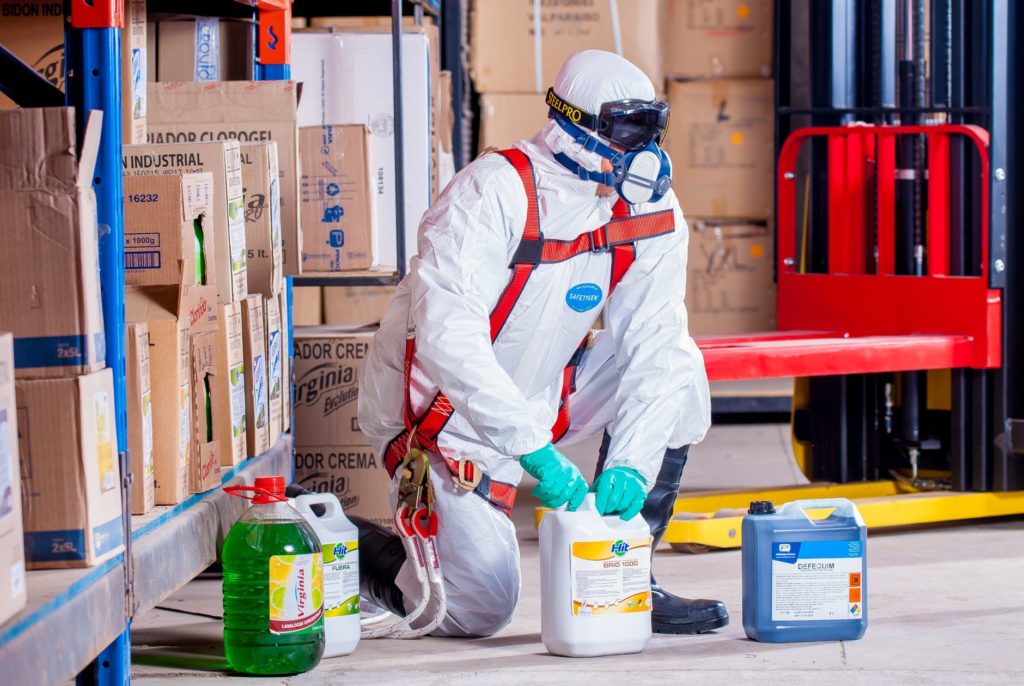
PPE is classified into categories: eye and face protection (plastic shields), hand protection (various types of gloves), body protection (coats), respiratory protection (depending on risk – masks).

Full PPE is only applicable to the health environment. See Circular H35 of 2020 (26 March 2020).

Regarding masks:

• Masks are in general more recommended for health workers.
• The World Health Organisation (WHO) recommends that for public-level control of COVID-19 only symptomatic people or their carers wear a face mask. When masks are worn, they recommend that users follow correct safety procedures.
• If you are healthy and apply the golden rules, and are not caring for someone with COVID infection, you do not need a mask.
• As COVID-19 prevalence may increase in communities, we recommend the consideration of alternatives to surgical masks with careful consideration for usage guideline.
• When travelling in a private vehicle or visiting a supermarket, NO PPE (no mask or gloves) is required. Only apply the golden rules.
• Masks are only effective when used in combination with the other golden rules of prevention listed above.
• Surgical masks do provide sufficient protection against the distribution of droplets that are created by coughing, sneezing, speaking loudly/shouting. As the epidemic unfolds the use of face masks by all people who are at risk of exposure, even if not sick is a recommendation. These areas of risk are captured in the table below.
• N-95 respirators – These are reserved for health care workers at the clinical interface.
• As COVID-19 prevalence may increase in communities, we recommend the consideration of alternatives to medical masks with careful consideration for usage guidelines
• Cloth masks are not ideal, they do provide some protection, yet reduced protection compared to surgical masks. They may be considered when the stage of the epidemic requires extensive measures and surgical masks are in short supply. The handling of cloth masks needs to be done with care due to the risk of it becoming a source of infection. the material and inner lining needs to be different. Denim, calico or similar thick weave cotton should be used and filled with soft cotton. However, to improve the filtration one can use a water-resistant membrane cloth inside to prevent transmission of droplets. Cloth masks to be washed with warm soapy water and dried in the sunlight.
• Technique related to the handling of masks: Before putting on a mask, clean hands and fit mask tightly on the face, covering the nose and mouth. Do not fiddle with the mask. Avoid letting the mask get wet. To remove the mask, remove it from behind (do not touch the front of the mask), and discard immediately in a closed bin and clean hands.

Regarding gloves:

• There is little evidence that gloves are useful as a method of protection for members of the public. It provides a false sense of security, does not prevent the transmission of the virus, lead to sweating of the hands and may cause allergy.
• Gloves have indications as captured in the table below.

SITUATIONS IN WHICH PPE SHOULD BE WORN

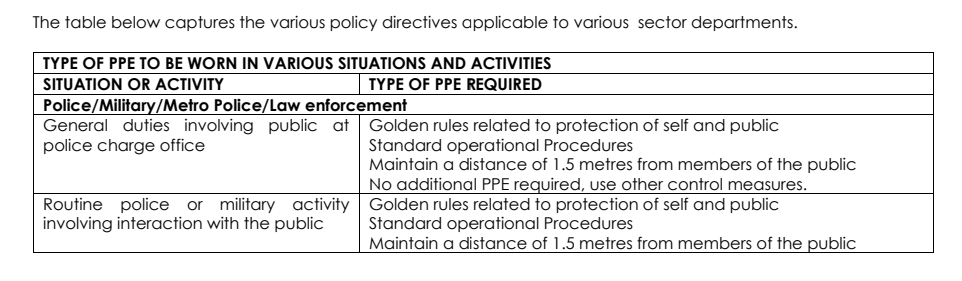
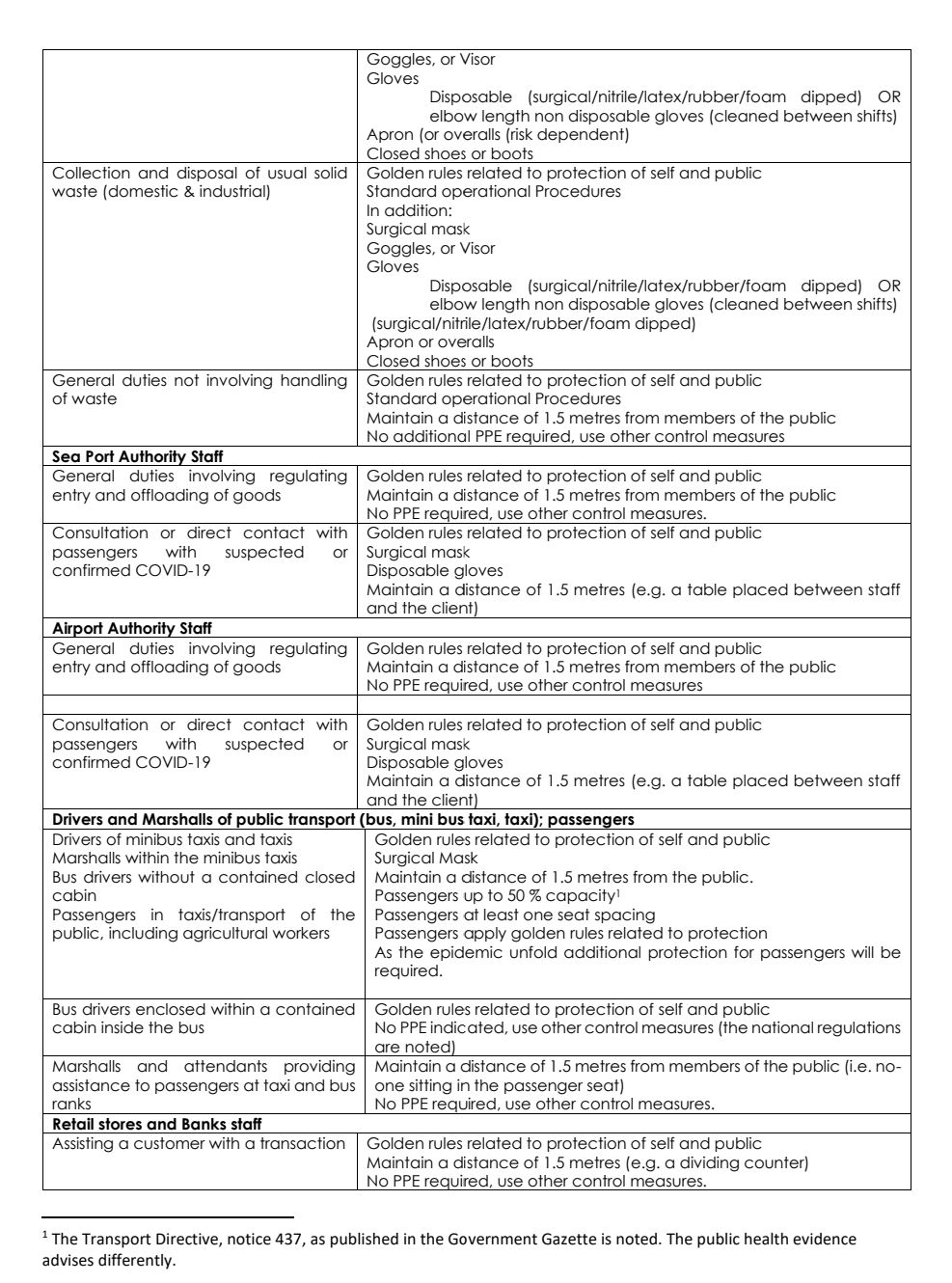
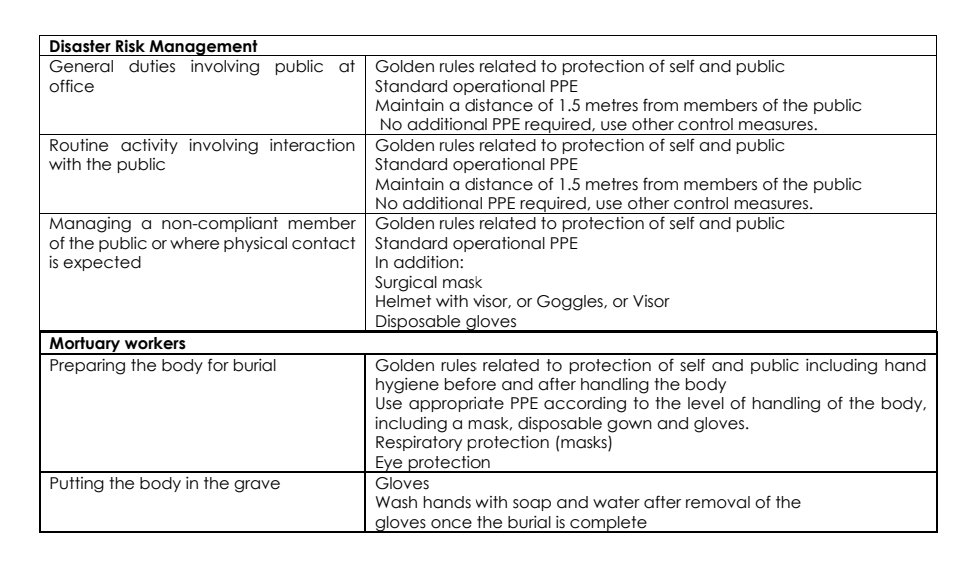
The table below provides recommendations about which PPE is required in various situations and when performing various activities.

• While this is a general guideline, a job specific Hazard identification risk assessment (HIRA) trumps these guidelines if it determines a higher risk despite other control measures resulting in the need for PPE.
• PPE is based on risk assessment of each situation and is ONLY NEEDED where staff are exposed to or the occupation that poses risk of exposure to COVID -19 infected individuals or individuals suspected of having COVID-19.
• Supervisors should monitor that staff are wearing the appropriate PPE for a particular situation, and the adequate safekeeping thereof.
• PPE is a limited resource and should be preserved by using it only when indicated.
• Correct use, necessary hygiene practices and proper disposal of PPE is important to avoid cross contamination from PPE to the users hands or clothes.


CONCLUDING COMMENTS

The Epidemic in South Africa and the Western Cape have specific features that will be studied as the epidemic unfolds. These developments may require refinement and updating of the guidelines contained in tis Policy Circular.
For any further enquiries, please contact Dr Gavin Reagon at Gavin.Reagon@westerncape.gov.za.

Yours sincerely,

Dr Beth Engelbrecht

Head: Western Cape Department of Health

Date: 31 March 2020

Media Alert: Premier Winde to provide update on Western Cape response to Coronavirus in digital press conference.

Media Alert: Premier Winde to provide update on Western Cape response to Coronavirus in digital press conference.

2 April 2020

Premier Alan Winde and Minister of Community Safety, Albert Fritz will today hold a digicon to brief the media on the Western Cape’s response to Coronavirus, as well as issues relating to safety and security during the lockdown.

IMPORTANT DETAILS FOR MEMBERS OF THE MEDIA:

In order to play our part in reducing contact and limiting the spread of the virus, the press briefing will be held online, live on Premier Winde’s Facebook page.

Members of the media wishing to ask questions will be required to send them to a Whatsapp group which will be created specifically for this purpose. To be added to the group, you must RSVP and send your number to Bianca Capazorio on this email address before noon.

Questions can be sent before or during the briefing.

NB: Those who were added to the group for previous digicons need not resubmit their numbers.

Facebook Live details:

Premier Winde will go live at 2.30pm. His Facebook page can be found at https://www.facebook.com/windealan/