Skip to content Skip to left sidebar Skip to footer

Provincial & National

MEDIA ALERT: MINISTER SIMMERS TO CONDUCT OVERSIGHT VISIT AT GRABOUW’S ROOIDAKKE DEVELOPMENT

24 May 2020

Tomorrow, 25 May 2020, Western Cape Human Settlements Minister Tertuis Simmers will visit the construction site of the Rooidake Housing project in Grabouw.

Minister Simmers said: “Since the alert levels of the disaster declaration as instituted by President Cyril Ramaphosa have been relaxed from level 5 to 4 and “critical public works construction,” which includes public human settlements development projects, have been allowed to recommence, we have to ensure that contractors comply with all the health and safety protocols.

My department has issued a directive to contractors and part of my visit is to ensure these are being adhered to.

I also need to establish which final touches are required on the houses, as they are due to be handed over by 7 June.

ALL MEDIA ARE INVITED TO ATTEND. Please note the meeting point from which we will depart at 09:50 to the project site

Details:

Date: Monday, 25 May 2020

Time: 09h45 – 11h00

Meeting Point: Grabouw Municipal Office, 1 Abor Drive, Grabouw (Just behind the hospital)

Media Enquiries:

Marcellino Martin

Spokesperson for Minister Tertuis Simmers

Tel: 021 483 3397 / Mobile: 082 721 3362 / Email: Marcellino.martin@westerncape.gov.za

or

Nathan Adriaanse

Director Communication & Stakeholder Relations

Tell: 021 483 2868 / Mobile: 083 2631720 / Email: Nathan.Adriaanse@westerncape.gov.za

Media Release: Update on the coronavirus by Premier Alan Winde

23 May 2020

As of 1pm on 23 May, the Western Cape has 6146 active cases of Covid-19, with a total of 12947 confirmed cases and 6525 recoveries.

Total confirmed COVID-19 cases 12947
Total recoveries 6525
Total deaths 276
Total active cases (currently infected patients) 6146
Total number of tests 114869
Hospitalisations 557 of which 154 are in ICU or high care

Sub Districts Cape Town Metro:

Sub-district Cases Recoveries
Western 1380 774
Southern 1436 544
Northern 794 419
Tygerberg 2030 1172
Eastern 1153 677
Klipfontein 1533 726
Mitchells Plain 1271 673
Khayelitsha 1741 1007
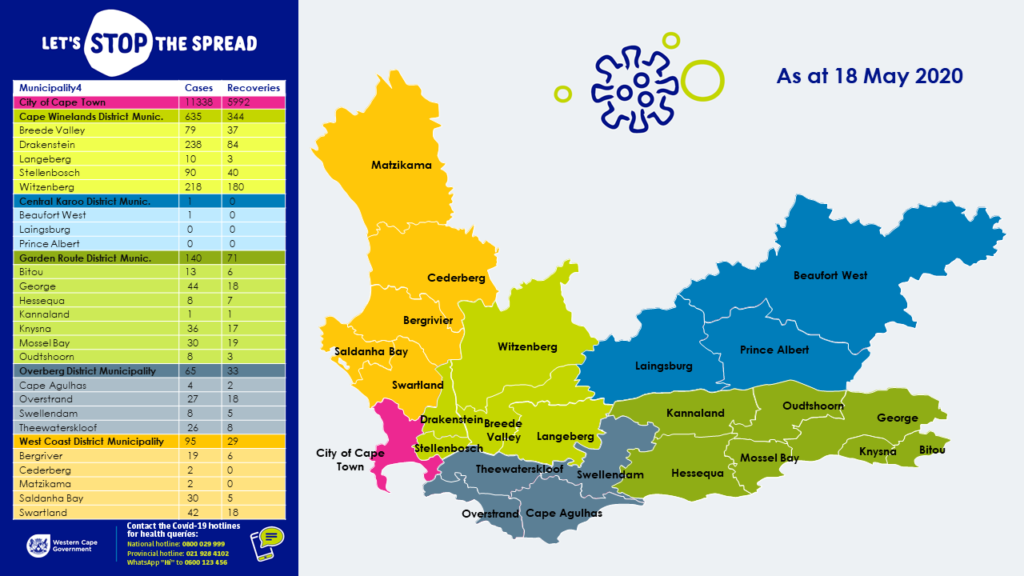
Total 11338 5992

Sub Districts Non-Metro:

District  Sub-district Cases Recoveries
Garden Route Bitou 13 6
Garden Route Knysna 36 17
Garden Route George 44 18
Garden Route Hessequa 8 7
Garden Route Kannaland 1 1
Garden Route Mossel Bay 30 19
Garden Route Oudtshoorn 8 3
Cape Winelands Stellenbosch 90 40
Cape Winelands Drakenstein 238 84
Cape Winelands Breede Valley 79 37
Cape Winelands Langeberg 10 3
Cape Winelands Witzenberg 218 180
Overberg Overstrand 27 18
Overberg Cape Agulhas 4 2
Overberg Swellendam 8 5
Overberg Theewaterskloof 26 8
West Coast Bergrivier 19 6
​West Coast ​Cederberg 2 0
West Coast Matzikama 2 0
West Coast Saldanha Bay Municipality 30 5
West Coast Swartland 42 18
Central Karoo Beaufort West 1 0

Unallocated: 673 (56 recovered)

Additional data can be accessed on the dashboard at www.westerncape.gov.za/coronavirus

The Western Cape has recorded an additional 19 COVID-19 deaths-bringing the total number of deaths from the virus in the province to 276. We extend our condolences to the family and friends of the deceased at this time.

Hospitalisation:

The Western Cape is starting to see increased patients receiving care in our hospitals as we move towards the peak of the infection in the province. At the close of business yesterday, 557 patients were being treated in hospital, with 154 of these in ICU or high care. The Western Cape hospital system has the capacity to deal with the demand for hospital beds at this time.

In our preparedness planning, the province has taken into account all of the available beds in both the public and the private sector.

Our existing public sector capacity can provide 2162 acute beds, which includes 658 additional beds created through expansion.

We are also bringing online 1428 additional intermediate care beds in our temporary or “field hospitals” in the Western Cape. Construction on the hospital facility at the CTICC, which will provide 850 of these beds, is well underway and on track for completion in the first week of June. Another 330 beds will be made available at a temporary hospital at Brakengate, 150 at the Cape Winelands Sonstraal Hospital, 68 at the Khayelitsha Thusong Centre, and 30 additional beds at Tygerberg hospital.

In the critical care space (ICU and high care), we will reach a total of 850 ICU beds in the province, the majority of which already exist. We currently have 150 existing beds at public healthcare facilities. An additional 100 beds are being added. We have also arranged to purchase 300 ICU beds from the private sector for public sector patients. The private sector also has an additional 300 ICU beds available in addition to these.

The vast majority of people who contract COVID-19, will not require hospitalisation which is evidenced by the fact that more than half of our total caseload have now recovered. However, in order to ensure that we are able to offer the appropriate level of care to those who need it, we need every resident to play their part to reduce infections, and more specifically to protect the vulnerable who are at a higher risk of becoming seriously ill. As we have indicated before, even in the best case scenario, and with both private and public beds, we will fall short of ICU beds.

This requires us to take stock of our behaviour and look at ways in which we can make changes to help flatten the curve and reduce the risk of transmission. This includes staying home as much as possible, especially if you are over 60 or have an underlying illness. When leaving home, hygiene measures such as washing or sanitizing your hands, not touching your face and keeping your distance from other people are highly important. Wearing a clean, cloth mask should not replace these behaviours, but they should all be used together, for maximum effectiveness.

Eid:

Tomorrow, our Muslim residents will mark the holy day of Eid. This is a time that is traditionally marked by attending Mosque and visiting with family and loved ones. This year’s Eid celebrations will be markedly different as a result of lockdown in South Africa but I hope that despite not being able to share the day with all of your loved ones in person, that the day does not lose its spirit of kindness, sharing and connectedness. May all of our Muslim residents have a blessed Eid celebration.

Media Release: Update on the coronavirus by Premier Alan Winde-over 6000 recoveries in the Western Cape

22 May 2020

As of 1pm on 22 May, the Western Cape has 6136 active cases of Covid-19, with a total of 12 519 confirmed cases and 6126  recoveries.

Total confirmed COVID-19 cases 12519
Total recoveries 6126
Total deaths 257
Total active cases (currently infected patients) 6136
Total number of tests 107567

Sub Districts Cape Town Metro:

Sub-district Cases Recoveries
Western 1283 709
Southern 1339 507
Northern 733 402
Tygerberg 1918 1113
Eastern 1074 636
Klipfontein 1451 695
Mitchells Plain 1205 606
Khayelitsha 1673 926
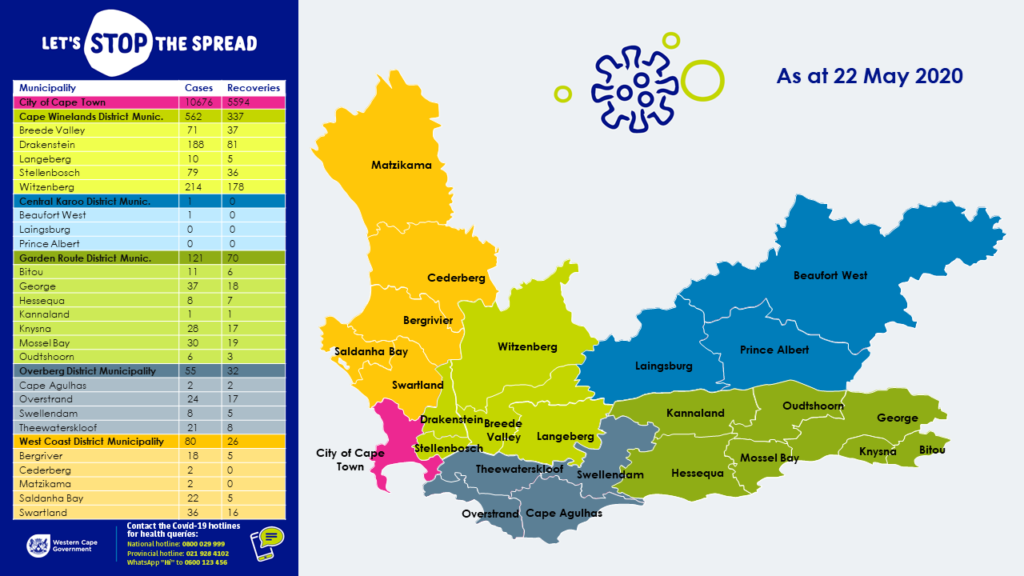
Total 10676 5594

Sub Districts Non-Metro:

District  Sub-district Cases Recoveries
Garden Route Bitou 11 6
Garden Route Knysna 28 17
Garden Route George 37 18
Garden Route Hessequa 8 7
Garden Route Kannaland 1 0
Garden Route Mossel Bay 30 19
Garden Route Oudtshoorn 6 3
Cape Winelands Stellenbosch 79 36
Cape Winelands Drakenstein 188 81
Cape Winelands Breede Valley 71 37
Cape Winelands Langeberg 10 5
Cape Winelands Witzenberg 214 178
Overberg Overstrand 24 17
Overberg Cape Agulhas 2 2
Overberg Swellendam 8 5
Overberg Theewaterskloof 21 8
West Coast Bergrivier 18 5
​West Coast ​Cederberg 2 0
West Coast Matzikama 2 0
West Coast Saldanha Bay Municipality 22 5
West Coast Swartland 36 16
Central Karoo Beaufort West 1 1

Unallocated: 1024 (66 recovered)

Additional data can be accessed on the dashboard at www.westerncape.gov.za/coronavirus

The Western Cape has recorded an additional 22 COVID-19 deaths-bringing the total number of deaths from the virus in the province to 257. We send our condolences to the family and the loved ones of the deceased at this time.

Recoveries:

The province has recorded a number of new recoveries and over 6000 people have recovered. It is also positive to see that only about half of the total number of cases reported in the province, are currently active.

It is important to remember that most people who contract COVID-19 will recover and 90% of cases will not require hospitalisation.

I want to stress though that some people, especially the elderly and those with underlying conditions can get seriously ill, and a person who may not get that sick could pass it to these vulnerable groups. We have to change our behaviour to protect ourselves and the people we love.

It is also very heartening to see that 65% of the healthcare workers in the province who have contracted COVID-19, have recovered. In total, the province has recorded 421 infections in healthcare workers in the province (both public and private sector) and 274 of these have recovered.

We thank all of our healthcare workers for the sterling work they are doing in healthcare facilities in the province, helping to fight this virus on the frontlines. The province has unfortunately recorded six healthcare worker deaths including one doctor, three nurses, and three other healthcare workers. We thank them for their incredible service to the province and send our condolences to their families.

Covid-19 spending and procurement:

Today, Finance Minister David Maynier and the Provincial Treasury team briefed the Western Cape Provincial Parliament’s ad hoc committee on COVID-19 on our COVID-19 spending thus far.

To date, we have committed R1.14 billion to COVID-19 expenditure to be used in order to procure necessary supplies such as PPE, medical equipment and beds as part of our healthcare response, and in our humanitarian response in order to mitigate the impact of the virus and the lockdown on residents.

The R1.14 billion includes spending on:

-R628 million to the Department of Health for personal protective equipment, laboratory tests, hospital beds and ventilators;

-R273 million to the Department of Education for personal protective equipment, 7019 digital infrared non-touch thermometers for schools and, sanitisers and cleaning materials;

-R168 million to the Department of Transport and Public Works for the set-up of quarantine and isolation facilities, including the set-up of the field hospital at the Cape Town International Convention Centre;

-R35 million to the Department of Social Development and R18 million to the Department of Education for an initial humanitarian response which has included to provision on 50 000 food parcels; the re-initiation of school feeding schemes; and the delivery of 10 000 cooked meals per day for one month; and

-R16.2 million to the Department of Local Government in the form of a Local Government Support Grant to strengthen and support the current humanitarian initiatives within municipalities.

The Director-General, Harry Malila and I also had the opportunity to brief the committee on our COVID-19 response plan, including our hotspot plan, which aims to slow the spread in the nine infection hotspots in the province through a targeted, whole of government approach.

The Western Cape Government has been working around the clock to ensure that the health systems are prepared ahead of the peak of the virus in the province. This is a very challenging time for our province and country, and we need to work together to slow the spread the virus and save lives.

We need everyone to take responsibility and make changes that will help us to flatten the curve of infection including:

  • Stay home as much as possible
  • Always wear a clean cloth mask in public
  • Always follow the golden rules of good hygiene (a mask alone is not enough)
  • Keep your distance from people at all times
  • Avoid gatherings of people
  • If you are sick, stay home and call the hotline. If you are having difficulty breathing, seek urgent healthcare.

Media Release: Update on the coronavirus by Premier Alan Winde

21 May 2020

As of 1pm on 21 May, the Western Cape has 5677 active cases of Covid-19, with a total of 11 810 confirmed cases and 5677 recoveries.

Total confirmed COVID-19 cases 11810
Total recoveries 5677
Total deaths 235
Total active cases (currently infected patients) 5898
Total number of tests 104347

Sub Districts Cape Town Metro:

Sub-district Cases Recoveries
Western 1238 665
Southern 1276 482
Northern 706 380
Tygerberg 1845 1022
Eastern 1030 594
Klipfontein 1379 638
Mitchells Plain 1158 564
Khayelitsha 1591 827
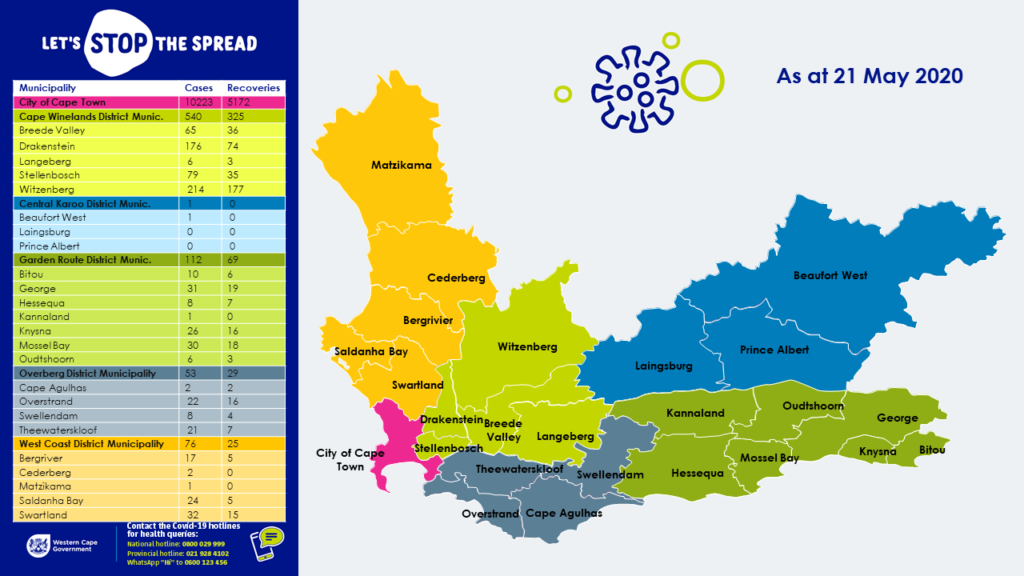
Total 10223 5172

Sub Districts Non-Metro:

District  Sub-district Cases Recoveries
Garden Route Bitou 10 6
Garden Route Knysna 26 16
Garden Route George 31 19
Garden Route Hessequa 8 7
Garden Route Kannaland 1 0
Garden Route Mossel Bay 30 18
Garden Route Oudtshoorn 6 3
Cape Winelands Stellenbosch 79 35
Cape Winelands Drakenstein 176 74
Cape Winelands Breede Valley 65 36
Cape Winelands Langeberg 6 3
Cape Winelands Witzenberg 214 177
Overberg Overstrand 22 16
Overberg Cape Agulhas 2 2
Overberg Swellendam 8 4
Overberg Theewaterskloof 21 7
West Coast Bergrivier 17 5
​West Coast ​Cederberg 2 0
West Coast Matzikama 1 0
West Coast Saldanha Bay Municipality 24 5
West Coast Swartland 32 15
       
Central Karoo Beaufort West 1 0

Unallocated: 805 (57 recovered)

Additional data can be accessed on the dashboard at www.westerncape.gov.za/coronavirus

The Western Cape has recorded an additional 24 COVID-19 deaths-bringing the total number of deaths from the virus in the province to . We send our condolences to the family and the loved ones of the deceased at this time.

Yesterday, the country was shocked to hear about the death of a two-day old baby who had been born prematurely, as a result of COVID-19 infection. We are saddened by this tragic loss of such a young life and send our deepest sympathies to the family at this time. Western Cape doctors are currently investigating the case, to better understand all the details.

Healthcare system preparedness

The Western Cape Government has been working around the clock to make sure that the healthcare system is prepared at the peak. This includes making available additional immediate care, acute care and critical care capacity in our healthcare system.

1428 additional immediate care beds will be provided by temporary “field hospitals” in the Western Cape;

  • This includes the 850 additional beds provided for at the CTICC temporary hospital facility
  • 330 beds at the Brackengate temporary hospital facility
  • 68 beds at the Khayelitsha Thusong Centre
  • 150 beds at the Cape Winelands Sonstraal Hospital
  • 30 additional beds at the Tygerberg Hospital

2162 acute beds will be provided by existing public sector capacity including 658 additional beds through expansion.

We are also looking to make 550 critical care (ICU and High Care) beds available at the peak:

  • 150 beds that already exist in public health facilities
  • 100 additional beds to be added in the public sector (but additional resources are needed for these)
  • We will purchase 300 beds from the private sector for patients from the public sector

There are still an additional 300 ICU beds in the private sector available when this is considered.

This means that we have a potential total of 850 ICU beds available in the Western Cape.

I would like to make clear therefore that the Western Cape Government’s health response planning has taken all of the existing private and public sector ICU or high care beds into account, in an integrated single healthcare system response.

As at close of business on Tuesday, the province had 143 patients in ICU or high care in both the public and private sector.

I must also make clear- while we have sufficient capacity at this time to meet our current critical care needs, as we have indicated before, even in the best-case scenario, we will still fall short of ICU beds.

This is why it is so vitally important that we focus on protecting the most vulnerable. About 90 percent of people who contract COVID-19 will not require hospitalisation, but we have seen from our data that those who are most at risk of becoming seriously ill or dying are the elderly, and those with underlying health conditions.

This is why we will be streamlining our testing and contact tracing to focus on high risk groups such as health workers and vulnerable people. We will also be re-purposing our community screening and testing programme to focus on high risk groups.

We have also provided in excess of 86 000 flu vaccines in the private sector thus far, with over 65 000 of these to vulnerable groups and over 25 000 to healthcare workers.

We need the help of every single person. We simply can’t do this alone. You need to keep yourself safe. When you do this, you interrupt the chain of transmission and slow the virus. You can help us save lives by changing your behaviour:

  • Stay home as much as possible
  • Always wear a clean cloth mask in public
  • Always follow the golden rules of good hygiene (a mask alone is not enough)
  • Keep your distance from people at all times
  • Avoid gatherings of people
  • If you are sick, stay home and call the hotline. If you are having difficulty breathing, seek urgent healthcare.

Minister Mbombo hands over masks in Gugulethu:

Today Minister Mbombo handed over masks to the Ikhaya Loxolo Old Age Home in Gugulethu as part of a public-private initiative coordinated by WoW! (Western Cape on Wellness), in partnership with The Health Foundation, Coconut Jazz and other organisations.

Minister Mbombo said: “The purpose of this initiative is to provide free quality masks to children and adults in vulnerable communities in the Western Cape.
Today we handed over masks at Ikhaya Loxolo Old Age Hometo protect elderly who are deemed as vulnerable from getting the virus. I appeal to the corporates and individuals to assist in this initiative by donating masks to enable us to distribute them far and wide”.

Joint statement by the Western Cape and Eastern Cape Provinces on travel protocols:

This morning, a meeting held to discuss solutions to improve management of traveling, transportation of bodies between the Eastern and Western Cape provinces during the covid19 pandemic resolved that four regulatory protocols must be drafted by the two Premiers and submitted to national government for processing and for consideration by the National Command Council.

The virtual meeting, which took place this morning was attended by Premier Lubabalo Mabuyane and myself, Cooperative Governance and Traditional Affairs Minister, Dr Nkosazana Dlamini Zuma, Health Minister, Dr Zweli Mkhize, Police Minister, Bheki Cele, Health MECs, Sindiswa Gomba, Nomafrench Mbombo, Safety and Liaison MECs Weziwe Tikana-Gxothiwe and Albert Fritz and the Police leadership from both provinces.

The meeting follows a discussion during the Presidential Coordinating Council where the two provinces reported that they were in talks trying to find protocols of cooperation.

The protocols being developed by the two provinces will focus on:

-Joint cooperation on agriculture to specifically manage the movement and employment conditions of seasonal workers between the two provinces.

-Management of funerals with a focus on restricting movement of bodies of COVID-19 related deaths.

– Management of general travelling of people between the two provinces given the easing of restrictions and to manage traveling when schools and universities are opened.

We also discussed collaboration between provincial departments of health and the South African Police Services in both provinces to enforce restrictions around transportation of bodies.

The meeting agreed that the situation affecting these two provinces is not unique to the two and needs national government consideration to better manage travel and the transportation of bodies nationally in a manner that helps to contain the transmission of Covid19.

The two provinces have committed to work together to hold joint operations and cooperate to ensure the proper management of travel, to curb  emerging criminality and ensure the dignified transportation of bodies for funerals of people who die in the Western Cape to be buried in the Eastern Cape.

Premier Mabuyane said: “I must say that on almost every discussion we had during the meeting, we are agreeing. There is a sufficient consensus around such discussions. Some of these discussions are inter-provincial so they need to be done in the context of national regulations, hence the importance of having Ministers participating in that bilateral.”

On the Western Cape’s part, we welcome the opportunity to engage with the Eastern Cape on this matter, as travel between our two provinces by seasonal farm workers returning home or two work, and to attend funerals is common. Regulations and protocols must be designed in such a way that they limit the spread of the virus, but still allow people living and working in the Western Cape who need to return to the Easter Cape to bury loved ones, to grieve appropriately.

21 May 2020 Media Release: Door-to-Door screening to continue

Media Release: Door-to-Door screening to continue

For Immediate Release
21 May 2020

Health Teams in the Garden Route District have screened more than 70 000 people and have referred 404 for testing through the  door-to-door screening and testing program. These community screening and testing outreaches are aimed at finding as many people as possible who might have COVID-19. During the community screening and testing the support of the community is essential for the success in stopping the spread of the virus.

Health teams are identifiable by their badges and clothing/uniform and allow them to screen you (ask questions regarding symptoms). If you are referred for testing, be assured these tests are safe. Testing for coronavirus is done by taking a swab in your nose.  While you await your results, we ask that you please quarantine at home in a separate room, if possible. We appeal to people who need to quarantine to stay home and not have visitors. If you cannot quarantine at home, speak to the health worker who will advise on facilities that are available for isolation and quarantine. Remember that only people who CANNOT isolate/quarantine at home will be advised on available facilities to do so.

Western Cape Government Health cannot do this alone.

“Every single person can help us in our effort, by staying home as much as possible, keeping a distance at all times, avoiding gatherings of people wherever it may occur, by always following the golden rules of good hygiene, and by properly wearing a clean cloth mask whenever out in public”, said Premier Alan Winde.

Members of the public are encouraged to continue practicing the 5 Golden Rules of Good Hygiene and to wear a cloth mask when in public spaces.

The 5 Golden rules of prevention:

  1. Wash your hands regularly with soap and water for at least 20 seconds
  2. Keep surfaces clean
  3. Do not touch your face
  4. Cough and sneeze in your elbow fold
  5. Keep 1,5m away from people when you leave your home.

Teams have tested the following number of people as part of the door-to-door screening and testing program from 8 April to 20 May 2020:

  • Bitou subdistrict: 15 540 of which 37 were referred for testing
  • Knysna subdistrict: 5 134 of which 20 were referred for testing
  • George subdistrict: 14 961 of which 71 were referred for testing
  • Mossel Bay subdistrict: 12 307 of which 143 were referred for testing
  • Hessequa subdistrict: 14 939 of which 119 were referred for testing
  • Kannaland subdistrict: 3 034 of which 5 were referred for testing
  • Oudtshoorn subdistrict: 8 934 of which 9 were referred for testing

Door-to-door screening and testing sites for subdistricts 25 May – 29 May 2020

  • Bitou subdistrict: Crags (Kurland)
  • Knysna subdistrict: Sedgefield
  • George subdistrict: 25 May: Thembalethu Zone 3 / 26 – 29 May: Zone 4 (Lusaka-area)
  • Mossel Bay subdistrict: Alma
  • Hessequa subdistrict: 26 – 28 May: Slangrivier; 28 May: Albertinia; 25 – 26 May: Melkhoutfontein; 25 – 28 May: Riversdal; 27 May: Gouritsmond
  • Oudtshoorn subdistrict: 25 – 26 May: Bridgton; 27 – 28 May: Toekomsrus; 25 – 28 May: Dysselsdorp; 25 – 28 May: De Rust

Note: community screening is not the only place where screening is possible. Other methods of screening for COVID-19 include:

  1. 1.Self-assessment risk tool (https://www.westerncape.gov.za/department-of-health/sars-cov-2-risk-assessment-form)
  2. Any Primary Healthcare facility is able to conduct screening (please be sure to call ahead)
  3. Your local GP and District Hospital (please be sure to call ahead)Caption: Community Health Workers will visit your home to ask you a few questions(screen).

-END-

Nadia Ferreira
Principal Communications Officer
Garden Route and Central Karoo Districts
Western Cape Government Health

COVID-19: Western Cape Provincial Overview 7

20 May 2020

COVID-19: Western Cape Provincial Overview 7

Municipalities in the Western Cape are preparing for a phased re-opening of municipal offices in line with COVID 19 health and safety measures. Community screenings, roadblocks and humanitarian relief driven by municipalities, continue across the province.

The Minister of Local Government, Environmental Affairs and Development Planning in the Western Cape, Anton Bredell, says municipal risk assessments of workplaces are being done and public buildings and offices are being cleaned and sanitised.

“Outside of the public health situation with regards to Covid-19, the ongoing humanitarian challenge is our biggest challenge. To date 134 515 food parcels and nearly 200 000 daily cooked meals have been provided to beneficiaries in the province by a combination of organisations, private donors, government entities, municipalities and private businesses. These efforts continue non-stop.”

Some of the latest efforts being done in some municipalities across the province:

  •  The West Coast District Municipality (WCDM) is assisting the Department of Social Development with the assessment and verification of individuals and households who’ve applied for food parcels. The district municipality will set up a call centre and avail personnel to assist with the backlog of applications which will shorten the waiting period of food parcel deliveries.
  • With the objective of ensuring a more hygienic environment WCDM Fire Services continue with sanitizing of public spaces. Twenty-six spaza shops were sanitized in Darling while the disinfection of reception areas of local police stations continue across the district.
  • The vast distances between towns in the West Coast district remains a big challenge. To assist the local municipalities with their humanitarian relief projects the Executive Mayor of WCDM, Alderman Harold Cleophas, agreed that the district municipality will transport food parcels to the Matzikama- and Cederberg municipal areas. Travel distance to the furthest drop-off point is more than 200 kilometres.
  • Hessequa Municipality: Door-to-door screening took place from 11 – 14 May 2020.  The initial target of approximately 7,500 screenings was exceeded and 12,427 residents were screened during this 4-day period.
  • Stellenbosch Municipality is preparing for its first ever virtual Council Meeting, scheduled for 27 May 2020. All councillors are receiving training to help facilitate this process. Sanitizing of public spaces, offices and depots continue to ensure the safety of our staff and residents.
  • The City of Cape Town has reprioritised R12 million towards targeted food insecurity programs around the metropole, working with public sector institutions in order to ensure residents in need receives a meal.
  • Swartland Municipality: 72 feeding schemes continue to provide meals to the vulnerable in the whole of the Swartland Municipal area.

Bredell has urged all citizens with questions or concerns or who wish to make a contribution in the ongoing struggle to visit the provincial website: www.westerncape.gov.za/coronavirus or to get in touch with their local municipalities for assistance.

“In addition, if you have flu-like symptoms, and may have come into contact with someone who has COVID-19, please contact the provincial hotline on 021 928 4102 for advice on what to do next.”

ENDS.

Media enquiries:

James-Brent Styan

Spokesperson for the Minister of Local Government, Environmental Affairs and Development Planning, Anton Bredell

Mobile: 084 583 1670 / E-mail:  James-Brent.Styan@westerncape.gov.za

Media Release: Statistical Update on the coronavirus by Premier Alan Winde

20 May 2020

As of 1pm on 20 May, the Western Cape has 5967 active cases, 11072 total confirmed cases of Covid-19 infection and 5105 recoveries.

 Total confirmed COVID-19 cases 11072
Total recoveries 5105
Total deaths 211
Total active cases (currently infected patients) 5967
Total number of tests 100 721
Patients in hospital Hospitalizations- 470

High care/ICU- 143

Sub Districts Cape Town Metro:

 Sub-district Cases Recoveries
Western 1167 621
Southern 1157 444
Northern 680 326
Tygerberg 1781 907
Eastern 998 527
Klipfontein 1280 592
Mitchells Plain 1095 504
Khayelitsha 1505 728

Sub Districts Non-Metro:

District  Sub-district Cases Recoveries
Garden Route Bitou 10 6
Garden Route Knysna 25 17
Garden Route George 29 17
Garden Route Hessequa 8 7
Garden Route Mossel Bay 29 19
Garden Route Oudtshoorn 6 3
Garden Route Kannaland 1 0
Cape Winelands Stellenbosch 77 29
Cape Winelands Drakenstein 163 58
Cape Winelands Breede Valley 58 36
Cape Winelands Langeberg 6 4
Cape Winelands Witzenberg 211 171
Overberg Overstrand 22 16
Overberg Cape Agulhas 2 2
Overberg Swellendam 8 3
Overberg Theewaterskloof 18 6
West Coast Bergrivier 17 1
West Coast Saldanha Bay Municipality 21 5
West Coast Swartland 30 14
West Coast Cederberg 1 0
West Coast Matzikama 1 0
Central Karoo Beaufort West 1 0
       

There are currently 680 unallocated cases and 42 recoveries.

Additional data can be accessed on the dashboard at www.westerncape.gov.za/coronavirus

The Western Cape has recorded an additional 28 COVID-19 deaths-bringing the total number of deaths from the virus in the province to 211. We extend our condolences to their loved ones at this time.

Weekly Digital Press Conference with Premier Winde, Minister Nomafrench Mbombo, Director-General Harry Malila, and HOD Dr Keith Cloete

Our weekly press conference was held this afternoon. You can find the full press release here: https://coronavirus.westerncape.gov.za/news/our-priority-protect-vulnerable-and-those-high-risk-our-curve-rises

Media Release: Statement by Premier Alan Winde – Our priority is to protect the vulnerable and those at high risk as our curve rises


20 May 2020

In my briefing to you two weeks ago, the data showed us that community transmission of Covid-19 had become entrenched, with the virus spreading faster in certain geographic areas, mainly in the City of Cape Town and the Witzenberg region.

This was a new phase that we had entered, where the number of infections would climb at a faster rate, pushing our curve up towards a peak.

This is precisely what will continue to happen in the weeks ahead, and which will happen around the country, a few weeks after us.  That is why we have worked around the clock to make sure that our healthcare system is prepared for the peak, and that everyone who needs medical attention can receive it when they need it. (I released a full briefing of our preparedness yesterday, which can be viewed here).

Last week, I set out our Whole of Government Hotspot Strategy, through which we will use the combined impact of all our government departments and resources, including the efforts of other government spheres, to intervene in a targeted manner in areas of higher transmission. These efforts are designed to slow the spread as much as possible, protect vulnerable people who are at high risk, and ultimately, to save lives.

This is our number one mission.

This week, our Provincial Minister of Health, Nomafrench Mbombo and Head of Health, Dr Keith Cloete, set out how our health response will work in this targeted hotspot strategy. Our focus here is to protect vulnerable people who are at high risk, and to prevent deaths. We cannot stop the virus from spreading, and many people will be infected countrywide. Those at high risk need to be protected.

The current status in the Cape Metro is as follows:

  • We are on the upward part of the curve as per the nature of the pandemic and are expecting to see case numbers increase more rapidly, with associated increases in hospitalisation and deaths.
  • The transmission has been concentrated around essential services clusters (which have been permitted to operate under all levels of lockdown), care homes and in geographical areas where people who work in these clusters live and this has mostly been in the poorest communities in Cape Town. Our hotspot intervention strategy focusses our combined efforts in these targeted areas.
  • Testing/ lab capacity is under severe strain. The National Health Laboratory, which is mandated to perform all public tests, simply doesn’t have the capacity to test enough, and return tests quickly enough, for us to intervene with speed as these numbers grow.
  • We are scaling up isolation and quarantine off-site, but this will reach its limit soon as the number of infections rise in line with the ascending curve.
  • The number of undetected cases will continue to grow unless major increases in testing capacity is provided.

The status update for the Cape Winelands is as follows:

  • The Cape Winelands District is showing evidence of multiple clusters and fast spread, which started in Witzenberg 3 weeks ago, and has moved into Drakenstein, Stellenbosch and Breede Valley, in the past 2 weeks.
  • Early clusters have emerged in Overberg (Theewaterskloof and Swellendam), and West Coast (Swartland), during this past week, while there are still many areas with no cases or sporadic cases only.
  • Testing/ lab capacity strain is impacting on the ability of these Rural areas to detect cases early and move to aggressive isolation and quarantine interventions.
  • Ability to isolate and quarantine off-site will be scaled up rapidly across the Rural areas.
  • These areas are projected to have a smaller number of undetected cases, and aggressive testing is still indicated.
  • There is still great value of individual case detection and contact tracing.

Given these observations, resource constraints, and the scientific reality that the virus cannot be stopped, our targeted health hotspot response in the Metro will now be focused on the following initiatives:

  • Streamline testing and contact tracing activities to focus on high risk groups such as health workers and old age homes.
  • Emphasise case management with a view to early detection of deterioration in health status through risk stratification.
  • Increased focus on mass communication and building agency for behaviour change – individuals and organisations (across sectors). We need residents to show greater compliance with the rules and recommendations set out by government through lasting behaviour change.
  • Re-purpose Community Screening and Testing, and Community Health Workers, towards this goal and strengthen workplace/ institutional agency with a focus on prevention through inter-sectoral action.
  • Community Screening and Testing focused on reaching high risk groups such as the elderly and those with co-morbid conditions.
  • Continue to focus on the strength of our health system including utilising testing appropriately in the clinical environment.

What does this mean for the hotspot strategy?

  • The Health Strategy will be aligned to the risk stratified case management approach (where we target those at greater risk), in areas with established community transmission.
  • The identification of appropriate people for admission to designated isolation and quarantine facilities will have to be nuanced, in light of the testing capacity challenges, together with exploration of viable and feasible community-based isolation models (via community initiatives).
  • Behaviour change in terms of social distancing, hand and surface hygiene and universal mask wearing, targeted on all areas of gathering in hotspot areas will be the key drive.
  • Nuanced, agile, pro-active and adaptive responses are required in the local community spaces (in each of the local areas)
  • The rate of increase of transmission per ward and suburb will be carefully tracked over the next 6-8 weeks to assess its effectiveness.

To put it simply, we are going to up our targeted approach. Given the limited testing capacity in South Africa, we are going to utilise a more efficient approach to ensure maximum impact, by community screening and testing in hotspots to quickly identify those who may infected and who are at highest risk.

We will also use our testing to make sure we get results for those patients in hospitals so that we can quickly know whether they have Covid-19. This is important to ensure the correct treatment.

Global data, and our local experience tells us that some 90% of people will not require hospitalisation, only experiencing a mild illness. However, some 10% require hospitalisation, and around 1,8% will die. But remember – and this is important to bear in mind – this also means that 98.2% will survive this.

Of those that die, 96% have an underlying health condition such as HIV, Diabetes, Hypertension and Tuberculosis. We need to protect these people, and those of more advanced age, in the weeks ahead as the virus spreads and we move up the curve, towards the peak.

Indeed, our risk projections for the general population in the Western Cape, based on available data, indicates that those who are older (over 55), and those who have one or more comorbidities are at highest risk. This is where we must focus our attention in the weeks ahead.

This health response will also be combined with interventions by other leading departments in the Western Cape Government, and local government partners such as the City of Cape Town and SAPS, including the following additional responses:

  • Economic Response
  • Safety Response
  • Food security & Humanitarian Response
  • Places and Spaces Response
  • Transport Response
  • Resource management

See Premier Winde’s statement on Hotspot Strategy here for further details.

Behaviour change key for general population to slow the spread

A key component of this plan is the need to effect behavior change, so that people adapt to the “new normal”. Covid-19 is going to be around for some time, and we need to learn to live in ways that slows the spread and protects vulnerable people at highest risk. While many people will only have a mild illness, they could pass it onto someone who could get seriously ill and die.

That is why it is so important to treat every individual, small business and community group as a partner. We must work with them, not against them, together towards a shared objective of slowing the spread and protecting vulnerable and high-risk individuals.

We will therefore also ramp up our communications campaign, using a variety of additional tools, and we will leverage existing community leadership and community networks, available public infrastructure, and faith based organisations to help us land these messages in identified hotspots.

We simply cannot do it alone. Every single person can help us in our effort, by staying home as much as possible, keeping a distance at all times, avoiding gatherings of people wherever it may occur, by always following the golden rules of good hygiene, and by properly wearing a clean cloth mask whenever out in public.

Also, if you get sick, you should stay home because you will end up infecting others if you leave the house. If you however battle to breath you must seek urgent healthcare. You can get advice on our dedicated hotline: 021 928 4102.

Moving to level 3 in conjunction with targeted hotspot plan

We cannot return to “business as usual”, and I will not support that as Premier of this province. We will continue to lead major interventions, as set out above, in hotspot areas to protect vulnerable communities and to save lives. This is our top priority.

However, we cannot look at this response in isolation of the economic devastation and subsequent humanitarian crisis that is already developing. Even if we lift restrictions now, over 200 000 jobs are going to be lost in the Western Cape alone.

If we stay on Alert Level 4, it will be even greater as more and more businesses close and people become unemployed. This will indirectly impact millions of people across our province.

We have no choice but to allow more economic activity over time, in a safe and responsible manner, so that people don’t starve. If we do not do this, lives will be lost in the future.

This does not have to be a zero-sum game. We can care for sick people now and intervene rigorously in areas to slow the spread and save lives, while still allowing for the economy to open over-time so that people can feed themselves and their families.

This is the responsibility of a caring government, and it is a responsibility I take seriously.

Media Alert: Premier Winde to hold digital press conference on WC response to COVID-19

MEDIA ALERT BY ALAN WINDE

PREMIER OF THE WESTERN CAPE

Date: 20 May 2020

Release: immediately

Premier Winde to hold digital press conference on WC response to COVID-19

Today, the Premier of the Western Cape, Alan Winde, will hold a digital press conference over Microsoft Teams which will outline its targeted hotspot strategy being implemented in the Western Cape.

Premier Winde will be joined by Director General Harry Malila, Provincial Minister of Health Nomafrench Mbombo, Head of Health in the Western Cape, Dr Keith Cloete and Dr Melvin Moodley who is the Director of Strategy at the Department of Health.

Date: Today, 20 May 2020

Time: 14:30 – 16:00

Digital platform: Microsoft Teams

 Please confirm your attendance in by 10am and provide your name, surname, the name of your publication and your email address to be added to Microsoft Teams.  We will provide you with a meeting invite to the briefing, upon your confirmation.

Media Release: Update on the coronavirus by Premier Alan Winde – 4363 residents have recovered from Covid-19 in the Western Cape

19 May 2020

As of 1pm on 19 May, the Western Cape has 6195 active cases, 10558 total confirmed cases of Covid-19 infection and 4363 recoveries.

 Total confirmed COVID-19 cases 10558
Total recoveries 4363
Total deaths 183
Total active cases (currently infected patients) 6195
Total number of tests 96991
Patients in hospital Hospitalizations- 440

High care/ICU- 128

Sub Districts Cape Town Metro:

 Sub-district Cases Recoveries
Western 1127 545
Southern 1123 390
Northern 671 289
Tygerberg 1721 760
Eastern 983 478
Klipfontein 1257 514
Mitchells Plain 1068 384
Khayelitsha 1420 603
Total 10558 4363

Sub Districts Non-Metro:

District  Sub-district Cases Recoveries
Garden Route Bitou 9 6
Garden Route Knysna 25 16
Garden Route George 27 16
Garden Route Hessequa 8 7
Garden Route Mossel Bay 27 19
Garden Route Oudtshoorn 5 3
Cape Winelands Stellenbosch 73 28
Cape Winelands Drakenstein 160 40
Cape Winelands Breede Valley 50 35
Cape Winelands Langeberg 6 4
Cape Winelands Witzenberg 210 157
Overberg Overstrand 24 15
Overberg Cape Agulhas 2 2
Overberg Swellendam 11 4
Overberg Theewaterskloof 21 4
West Coast Bergrivier 19 1
West Coast Saldanha Bay Municipality 21 4
West Coast Swartland 29 11
     

Unallocated: 457

Additional data can be accessed on the dashboard at www.westerncape.gov.za/coronavirus

The Western Cape has recorded an additional 18 COVID-19 deaths-bringing the total number of deaths from the virus in the province to 183. We extend our condolences to their loved ones at this time.

The scientific reason for the Lockdown has been to prepare our health system for the peak

Today I provided a detailed updated on our government’s preparations for the Covid-19 pandemic. The scientific reason for the Lockdown, and which has been made clear by experts, was to buy us time to prepare for the peak that will inevitably come. The virus cannot be stopped and will continue to spread throughout the country.

We have been working around the clock to make sure that we are prepared and that every resident that requires healthcare gets it when they need it. This has included:

  • R725.5 million has been committed towards Covid-19 related expenditure across the Western Cape Government.
  • We have established a dedicated Coronavirus Provincial Hotline for residents to call, that has received a total of 28 500 calls since 16 March 2020. On average it receives 500 calls a day.
  • The conversion of the CTICC into a temporary hospital facility that will provide some 850 additional beds at the peak of the pandemic is well underway.
  • In total, this facility will include 4 wards – a mixed staffing model of temporary appointments, temporary re-deployment of staff, agency staff (medical -, infectious disease -, emergency – and internal medicine specialists and volunteers will be applied at the facility).
  • It is estimated that 200 admissions and 200 discharges will be managed per day during the peak.
  • We will open additional temporary hospitals along the R300 in the Metro, in Khayelitsha and in the Cape Winelands that collectively provide an additional 616 beds.
  • This is in addition to the Western Cape’s 2 162 (includes 658 through expansion) general care beds and 150 ICU beds that exist in Central and Regional Hospitals across the province.
  • We have opened 18 testing and triage centres (12 are already operational) to provide additional support at these facilities.
  • We have 3888 Community Health Workers operating across our province, with a further 464 due to start work soon
  • We have increased the number of tests from 7 975 on 1 April to 94 275 on 18 May. This is an increase of 1182%. This represents a testing ratio of 1347.27 per 100 000, the highest in the country.
  • Using our targeted hotspot approach, we have screened 473 348 people, and referred 12 095 people for testing.
  • We launched an online screening tool which has assisted in screening 62 200 people.
  • We have recruited 1 645 volunteers to support our healthcare workers when this peak arrives.
  • We have ordered R350 487 835.00 million worth of PPE so that our healthcare workers have the protection they need to care for every sick person. We aim to procure R550 million worth of PPE over the course of the pandemic.
  • In the public sector we have provided 86 129 flu vaccinations thus far – 65 670 vaccinations to vulnerable groups of people and 20 459 vaccinations to healthcare workers.
  • Since the pandemic, we have de-escalated non-essential operations at our healthcare facilities in the Western Cape, which has freed up existing ward capacity in these hospitals (Central and Regional – in relation to the 2 162 general beds and 150 ICU beds) to care for Covid-19.
  • We have 432 ventilators and have ordered an additional 100 ventilators to be used at the peak and use our current piped medical gas for high-flow oxygen treatment.
  • We have 19 Quarantine and Isolation facilities available offering 2365 beds.
  • We are activating an additional 9 facilities which will realise an additional 2292 beds.
  • We have launched the Red Dot Transport Service, that through 100 minibus taxis, will transport healthcare workers home when their shift ends at 19h00, given the limitation on the public transport system to operate after 19h00.
  • The Red Dot Transport Service will also safely transport those who test positive for Covid-19 to facilities if they cannot isolate safely at home and others to quarantine facilities should they need it.

For more information on what we have done across government departments, visit the following link: https://coronavirus.westerncape.gov.za/news/western-cape-has-prepared-its-healthcare-system-peak-and-must-move-level-3-conjunction-targeted

This is precisely why, that given our robust healthcare system preparation and that we will continue to rigorously intervene in hotspots, we must open more of our economy over time. Not allowing this to happen will threaten lives in the future as an unpreceded humanitarian crisis unfolds, and this cannot be ignored by any level of government.

I want to again reiterate that this cannot be done alone. We need the help of every single person in our team effort to slow the spread, and “flatten the curve”. When you keep yourself safe, through practicing good hygiene, keeping your distance, and wearing a mask properly, you help keep vulnerable people who are at higher risk safe too. Your actions can save lives, and we need every person to continue to be our partner in this Covid-19 response.