Skip to content Skip to left sidebar Skip to footer

Covid-19

2 July 2020 Media Release: Adhere to COVID-19 quarantine and isolation rules to limit the spread

Media Release: Adhere to COVID-19 quarantine and isolation rules to limit the spread

For Immediate Release
2 July 2020

The rate of community-based transmissions are on the rise. Provincial Government and Garden Route District Municipalities appeal to Garden Routers who have tested positive for COVID-19, or who have been identified as a close contact by the Department of Health to behave responsibly in order to limit the spread to others. The Garden Route has seen an increase of 197% of COVID-19 positive tests over the past 7 days.

The GRDM calls on residents who test positive for COVID-19 or suspect that they may have been exposed to the virus to please do their part in limiting further transmission.

Apart from health and hygiene protocols in place to avoid healthy persons from getting sick, there are also strict protocols set out for persons who contracted COVID-19. According to Mr Johan Compion, GRDM Manager: Municipal Health and Environmental Services, “GRDM Environmental Health Practitioners (EHP) conduct routine visits to those in self – quarantine or self – isolation to ensure that they adhere to the regulated COVID-19 protocols.” “

“There is an obligation on persons who have been exposed to the virus to ensure that they behave in a manner that limits the risk to those around them,” said Compion.

Mr Gerhard Otto, Chairperson of the Garden Route Command Centre and Head of Disaster Management at GRDM, said: “If a person who tested positive for COVID-19 is found in the public, he or she can be prosecuted for attempt to murder”.

“During April 2020, a 52-year-old salon owner in Ladysmith, KwaZulu-Natal, was charged with attempted murder for intentionally spreading the coronavirus after he exposed 27 people to the virus following his refusal to isolate after testing positive,” said Otto. “The Police arrested the man, who was escorted to hospital for treatment while under detention. If convicted, he could face 10 years or more in jail.”

Persons are required to go into quarantine if they have no symptoms, but had close contact with someone who has COVID-19. Isolation is required where a person is not feeling well with suspected or confirmed COVID-19. If someone is unable to go into self- quarantine or isolation, the person will be referred to the official government sponsored PetroSA West Campus facility that has been equipped to provide persons placed in quarantine or isolation with the full basket of services i.e. food, health services, laundry services etc.

CONTINUED AWARENESS

‘Much of the awareness by local municipalities is on the behaviour required to avoid transmission or to limit the spread of COVID-19 when out in public. This is done by making use of radio, loud hailing, social media, WhatsApp groups, Municipal apps, the distribution of newsletters, flyers and posters.

District and Local municipal communicators urge the general public to please:

  • Avoid contact with other people as much as Do not receive visitors. Open windows and doors. If in same room as others, keep at least 1.5 – 2 meters apart.
  • Clean and disinfect frequently touched objects and surfaces at work (phones, counters, table, doorknobs, bathroom surfaces).
  • Cover your mouth and nose with a tissue or your sleeve/elbow (not your hands) when coughing/sneezing. Immediately discard used tissues and wash your hands.
  • Frequently wash hands with soap and water for 20 seconds or more at a time. Do this especially before handling food/after using toilet or coughing/sneezing. Avoid touching face, eyes, nose or mouth.
  • Avoid sharing dishes, drinking glasses, cups, eating utensils, towels, or bedding – after using these, wash them well.
  • Continue to wear a face mask when leaving home.

Any person who requires assistance with accessing such a facility should contact the Provincial Hotline on 021 928 4102.

Garden Routers are also reminded that, in line with the new risk-stratified strategy adopted in the Western Cape, only persons who are deemed high risk are being tested.

This includes

  • persons with known co-morbidities and those older than 55, as they are more likely to develop complications that require hospitalisation
  • healthcare workers
  • persons admitted to hospital with COVID-19 symptoms to ensure that we are able to manage appropriately
ENDS

Media Queries
Herman Pieters | Senior Communicator
Garden Route District Municipality
E-mail: communications@gardenroute.gov.za

Media Alert: Premier Winde to hold digital press conference

1 July 2020

Today, Western Cape Premier Alan Winde will hold a digital press conference over Microsoft Teams which will provide an update on the epidemic in the Western Cape and the health system’s response.

Premier Winde will be joined by Health Minister Nomafrench Mbombo ,Health HOD Keith Cloete and Professor Andrew Boulle.

Members of the media must please note the time change from the regular time slot for tomorrow’s digicon.

Date:  2 July 2020

Time:  12.30pm

Digital platform: Microsoft Teams

 Please confirm your attendance by 9am tomorrow and provide your name, surname, the name of your publication and your email address to be added to Microsoft Teams.  We will provide you with a meeting invite to the briefing, upon your confirmation. Only those who have confirmed attendance will be admitted.

Media Release: Update on the coronavirus by Premier Alan Winde

1 July 2020

As of 1pm on 1 July 2020, the Western Cape has 17 019 active cases of COVID-19, with a total of 63 816 confirmed cases and 44 938 recoveries.

Total confirmed COVID-19 cases 63816
Total recoveries 44938
Total deaths 1859
Total active cases (currently infected patients) 17 019
Tests conducted 308497
Hospitalisations 1742 with 309 in ICU or high care

Sub Districts Cape Town Metro:

Sub-district Cases Recoveries
Western 5331 4023
Southern 5604 4208
Northern 3870 2947
Tygerberg 8082 6290
Eastern 5781 4165
Klipfontein 6316 4777
Mitchells Plain 5398 4067
Khayelitsha 6605 5327
Total 46987 35804

Sub-districts:

District  Sub-district Cases Recoveries
Garden Route Bitou 78 23
Garden Route Knysna 196 92
Garden Route George 652 198
Garden Route Hessequa 27 17
Garden Route Kannaland 8 3
Garden Route Mossel Bay 221 73
Garden Route Oudsthoorn 75 26
Cape Winelands Stellenbosch 1060 656
Cape Winelands Drakenstein 2591 1814
Cape Winelands Breede Valley 1608 888
Cape Winelands Langeberg 490 204
Cape Winelands Witzenberg 665 467
Overberg Overstrand 629 297
Overberg Cape Agulhas 51 27
Overberg Swellendam 61 24
Overberg Theewaterskloof 438 246
West Coast Bergrivier 199 153
​West Coast ​Cederberg 44 14
West Coast Matzikama 64 33
West Coast Saldanha Bay Municipality 640 353
West Coast Swartland 569 354
Central Karoo Beaufort West 31 2
Central Karoo Laingsburg 1 0

Unallocated: 6431 (3170  recoveries)

Data note: As the province moves closer to the peak and the Department of Health is recording over 1000 new cases daily, it is not possible to check and verify that the address data supplied for each new case is correct, within the time frames required to provide regular and timely updates. This means that in some instances, cases could be allocated to the wrong sub-districts. We are working with the sub-districts to clean and verify the data and where errors are picked up locally, cases will be re-allocated to the correct areas.

More data is available here: https://coronavirus.westerncape.gov.za/covid-19-dashboard

The Western Cape has recorded an additional 35 deaths, bringing the total number of COVID-19 related deaths in the province to 1859. We send our condolences to their loved ones at this time.

Today’s online dashboard reflects 1854 deaths- however this is an error due to a data feed issue. The correct number is 1859 as reflected above.

Brackengate:

Premier Alan Winde expresses his gratitude to some of the healthcare workers and Western Cape Government staff involved in the completion of the Brackengate hospital.

Today, I went on a site inspection of the Brackengate temporary hospital, which has officially been handed over from the Department of Transport and Public Works to the Department of Health.

All construction is now complete, and the Department of Health team are busy installing beds, and ensuring that all the systems are functioning and in place to receive their first patients on 10 July.

This 330 bed intermediate facility will provide medical care including oxygen, x-rays, and sonar for patients who are on the way to recovery but still need medical care. It also contains eight beds where high flow oxygen treatment can be administered.

The design flow of the facility, its paperless systems and its waste management system are all designed to reduce the risk of infection on site.

The IT system will also allow patients to video call their families and loved ones as visitors are not allowed.

This will be the province’s third completed field hospital- after the Khayelitsha Thusong hospital and the CTICC Hospital of Hope.

The facilities allow us to still provide care to those who need it, while opening up acute care beds in our hospitals.

While the other two are not close to reaching capacity, opening up these sites allows us to also ensure that we are able to spread out the patient load, and ensure that the staff in any one facility do not become overwhelmed.

Today, the Department of Health also launched its Bed Bureau- an online bed management tool which allows them to track how many beds are available in any of our facilities and ensure that we are able to effectively and efficiently manage admissions and patient transfers.

I would like to extend my thanks to all of the people involved in bringing this project to fruition, who have worked long hours, with tight deadlines to ensure that we are able to provide hospital beds and care when they are needed.

I also want to send my thanks to the healthcare workers, from the doctors and the nurses to the technicians, pharmacists, porters, cooks and cleaners who will be working to make this hospital, and all of our other hospitals and healthcare facilities, beacons of hope and recovery. Your selflessness and your service to the people of this province must be applauded.

First Thursday:

Tomorrow, I will be back in studio at Bush Radio for a live First Thursday Q and A between 6 and 7pm.

When I became Premier, I committed to an open government with regular opportunities to engage me and members of my executive. While COVID-19 means it will be a while before we can host events again, our regular radio slot still allows me the opportunity to engage with members of the public and respond to questions and issues.

I invite everyone to listen in- either on Bush Radio or one of the simulcast stations, or to the live stream on my Facebook page.

You can call in on 021 448 6266, WhatsApp on 061 862 1065 or SMS keyword Covid-19 to 32158 followed by your question, name and area. Each SMS costs R1.00.


Media Release: Update on the coronavirus by Premier Alan Winde

30 June 2020

As of 1pm on 30 June, the Western Cape has 15 819 active cases of COVID-19, with a total of 62 157 confirmed cases and 44 514 recoveries.

Total confirmed COVID-19 cases 62 157
Total recoveries 44 514
Total deaths 1824
Total active cases (currently infected patients) 15 819
Tests conducted 303 067
Hospitalisations 1819 with 322 in ICU or high care

Sub Districts Cape Town Metro:

Sub-district Cases Recoveries
Western 5252 4002
Southern 5504 4170
Northern 3805 2930
Tygerberg 7991 6236
Eastern 5642 4131
Klipfontein 6231 4742
Mitchells Plain 5323 4037
Khayelitsha 6561 5302
Total 46309 35550

Sub-districts:

District  Sub-district Cases Recoveries
Garden Route Bitou 69 23
Garden Route Knysna 175 92
Garden Route George 571 188
Garden Route Hessequa 24 17
Garden Route Kannaland 8 3
Garden Route Mossel Bay 205 73
Garden Route Oudsthoorn 73 25
Cape Winelands Stellenbosch 1026 646
Cape Winelands Drakenstein 2530 1806
Cape Winelands Breede Valley 1540 879
Cape Winelands Langeberg 466 198
Cape Winelands Witzenberg 656 462
Overberg Overstrand 613 295
Overberg Cape Agulhas 50 27
Overberg Swellendam 59 24
Overberg Theewaterskloof 418 241
West Coast Bergrivier 192 154
​West Coast ​Cederberg 41 14
West Coast Matzikama 63 28
West Coast Saldanha Bay Municipality 617 348
West Coast Swartland 542 353
Central Karoo Beaufort West 25 2
Central Karoo Laingsburg 1 0

Unallocated: 5884 (3066  recoveries)

Data note:  As the province moves closer to the peak and the Department of Health is recording over 1000 new cases daily, it is not possible to check and verify that the address data supplied for each new case is correct, within the time frames required to provide regular and timely updates. This means that in some instances, cases could be allocated to the wrong sub-districts. We are working with the sub-districts to clean and verify the data and where errors are picked up locally, cases will be re-allocated to the correct areas.

More data is available here: https://coronavirus.westerncape.gov.za/covid-19-dashboard

The Western Cape has recorded an additional 49 deaths, bringing the total number of COVID-19 related deaths in the province to 1824. We send our condolences to their loved ones at this time.

Donation from the Chinese Consul General:

Today, I received a donation of personal protective equipment (PPE) from the Chinese consul General, Mr Lin Jing (see attached photo).

The donation consists of:

30,000 surgical masks;

5000 N95 masks;
500 isolation gowns and​

500 face shields

This donation will help to bolster our available stocks of PPE, ensuring that we have even more supply for the healthcare workers who are fighting COVID-19 on our frontlines.

We thank the Chinese Consulate, and the Chinese government for partnering with us in our fight against COVID-19 and for their ongoing relationship with the Western Cape.

Masks for the elderly:

The Department of Social Development has distributed 105 000 donated masks to various old aged homes in the province. The Department has so far been able to distribute a total of 120 000 masks to homes in the province.

The donations have supplemented the extra support given by the Department of Social Development to facilities, to assist in the fight against COVID-19.

We thank the many generous donors who have made these donations to the Western Cape Government and the Department of Social Development, which has allowed us to provide additional protection to this high risk group.

Fake news:

A number of new fake news messages are once again circulating on social media networks, which are designed to spread fear and confusion among members of the public and parents of children returning to school.

COVID-19 is a serious pandemic which should be treated as such, however, using false information that creates panic, or which is designed to take advantage of vulnerable citizens, is irresponsible and does not help in the fight against this virus.  Information coming from unknown or unnamed sources should be carefully checked and verified before sending it on.

Use official government channels, such as the Western Cape, and the South African Government websites and social media channels, and trusted news websites for information.

You can also report fake news by Whatsapping it to 067 966 4015.

Media Release: Minister Kubayi-Ngubane to urgently confirm accommodation for leisure can open

MEDIA RELEASE BY DAVID MAYNIER
WESTERN CAPE MINISTER OF FINANCE AND ECONOMIC OPPORTUNITIES

Date: 30 June 2020
Release: immediately

Minister Kubayi-Ngubane to urgently confirm accommodation for leisure can open

The Minister of Tourism, Mmamoloko Kubayi-Ngubane, needs to urgently confirm that accommodation for leisure at licensed and accredited establishments is permitted under Alert Level 3.

At a press conference on Friday, 26 June 2020, Minister Kubayi-Ngubane stated that “accommodation for leisure is not yet allowed”. However, a careful reading of the amended Alert Level 3 regulations makes it clear that licensed and accredited accommodation establishments are allowed to operate for intra-provincial (within province) travel and are no longer restricted to only accept business travellers or persons requiring quarantine and isolation, and that travel for leisure purposes within one’s province is permitted.

This view is also shared by industry bodies, Tourism Business Council of South Africa (TBCSA) and Southern African Tourism Services Association (SATSA). (Read related statement)

The tourism sector has been one of the hardest hit by the Covid-19 crisis and allowing accommodation for leisure to open safely under Alert Level 3 will help to minimise further job losses and will accelerate industry recovery in the Western Cape.

We cannot afford the confusion, and so we call on the Minister of Tourism, Mmamoloko Kubayi-Ngubane, to urgently clarify and confirm that the regulations do indeed permit accommodation for leisure purposes.

The tourism sector has already done a great deal of work to develop health and safety guidelines and protocols aimed at ‘de-risking’ the sector.

We also firmly believe that there are further aspects of the sector that can open safely under Alert Level 3, such as parks, beaches and other open-air and outdoor tourism attractions, and so we will continue to engage actively with the sector to assist them to put these safety measures in place.

Notes for media:
To read the statement online visit: https://www.westerncape.gov.za/news/minister-kubayi-ngubane-urgently-confirm-accommodation-leisure-can-open

Media Queries:
Francine Higham
Spokesperson for the Provincial Minister of Finance and Economic Opportunities
(Responsible for the Provincial Treasury and the Department of Economic Development and Tourism)
Tel: 021 483 4327 / Cell: 071 087 5150 / Email: francine.higham@westerncape.gov.za

Media Release: Update on the coronavirus by Premier Alan Winde

29 June 2020

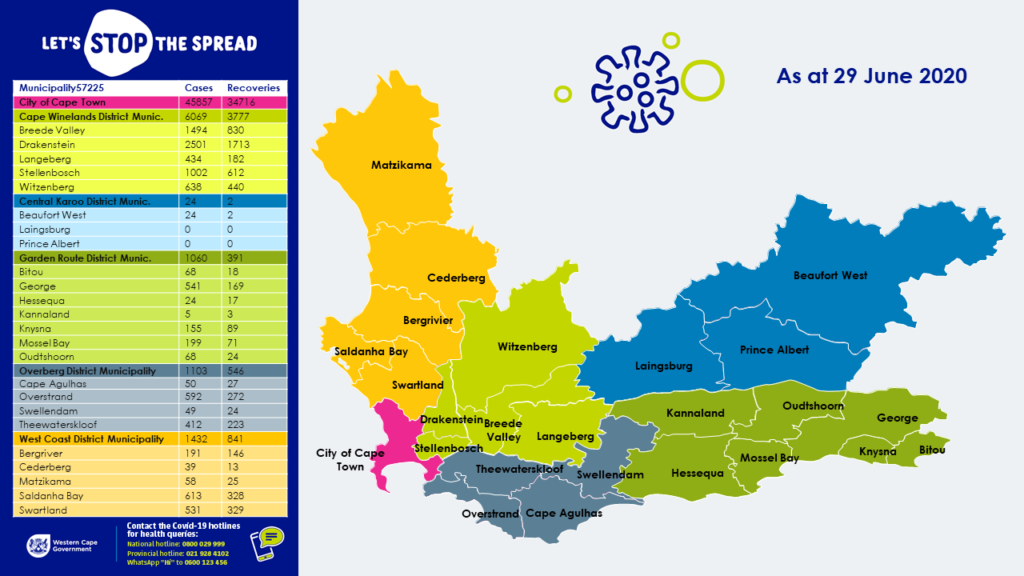
As of 1pm on 29 June, the Western Cape has 16 550 active cases of COVID-19, with a total of 61 445 confirmed cases and 43120 recoveries

Total confirmed COVID-19 cases 61 445
Total recoveries 43120
Total deaths 1775
Total active cases (currently infected patients) 16550
Tests conducted 300 251
Hospitalisations 1787 with 318 in ICU or high care

Sub Districts Cape Town Metro:

Sub-district Cases Recoveries
Western 5212 3915
Southern 5449 4074
Northern 3782 2858
Tygerberg 7946 6080
Eastern 5340 3939
Klipfontein 6139 4632
Mitchells Plain 5265 3928
Khayelitsha 6518 5208
Total 44748 34451

Sub-districts:

District  Sub-district Cases Recoveries
Garden Route Bitou 68 18
Garden Route Knysna 155 89
Garden Route George 541 169
Garden Route Hessequa 24 17
Garden Route Kannaland 5 3
Garden Route Mossel Bay 199 71
Garden Route Oudsthoorn 68 24
Cape Winelands Stellenbosch 1002 612
Cape Winelands Drakenstein 2501 1713
Cape Winelands Breede Valley 1494 830
Cape Winelands Langeberg 434 182
Cape Winelands Witzenberg 638 440
Overberg Overstrand 592 272
Overberg Cape Agulhas 50 27
Overberg Swellendam 49 24
Overberg Theewaterskloof 412 223
West Coast Bergrivier 191 146
​West Coast ​Cederberg 39 13
West Coast Matzikama 58 25
West Coast Saldanha Bay Municipality 613 328
West Coast Swartland 531 329
Central Karoo Beaufort West 24 2

Unallocated: 5900 (2847 recoveries)

Data note:  As the province moves closer to the peak and the Department of Health is recording over 1000 new cases daily, it is not possible to check and verify that the address data supplied for each new case is correct, within the time frames required to provide regular and timely updates. This means that in some instances, cases could be allocated to the wrong sub-districts. We are working with the sub-districts to clean and verify the data and where errors are picked up locally, cases will be re-allocated to the correct areas.

More data is available here: https://coronavirus.westerncape.gov.za/covid-19-dashboard

The Western Cape has recorded an additional 38 deaths, bringing the total number of COVID-19 related deaths in the province to 1775 . We send our condolences to their loved ones at this time.

Temporary hospital update:

The Western Cape has, as part of its COVID-19 preparedness strategy, built temporary hospitals which will increase the number of  hospital beds available in the province.

Work is well-underway at the Brackengate temporary hospital, and the 330 bed temporary hospital is on track to receive its first patients on 10 July (see photo attached).

Much like the CTICC hospital, this site will provide intermediate hospital care to patients, and has been designed with infection prevention in mind- with a state of the art waste management facility in place to destroy infectious waste.

We have invited national Health Minister Zweli Mkhize to visit the Western Cape again on Wednesday and will be showcasing the facility to him before the hospital becomes fully functional.

Work on the Sonstraal facility in the Cape Winelands is also underway with the first phase, creating an additional 63 beds, set to start accepting patients in the first week of July.

These are in additional to two already completed and functional facilities- the Hospital of Hope at the CTICC and the Thusong hospital in Khayelitsha, operated by Medicins sans Frontiers, in partnership with the provincial government.

Breaking Barriers Community Outreach in Athlone

Today I had the opportunity to visit the Breaking Barriers Community Outreach centre in Athlone. This centre provides an amazing resource to the surrounding community, relying mostly on donations to do the work that they do. They offer sewing and welding skills training for young people, and every day, prepare massive pots of soup that feed thousands of people in the community.

I was also able to meet some of the young people who are not only learning at the outreach, but also volunteering, helping to prepare meals and giving back.

This organisation has been operational in Athlone for a number of years, but as COVID-19 has exacerbated the need for humanitarian aid, is now playing an important role helping the people in their community.

iStock.com/ra2studio

29 June 2020 Media Release: Garden Route Health Platform Update

Media Release: Garden Route Health Platform Update on 29 June 2020

For Immediate Release
29 June 2020


GARDEN ROUTE HEALTH PLATFORM UPDATE

As Covid-19 cases are increasing in the Garden Route, we should all do our part and adhere to the 5 Golden Rules:

• Keep 1,5 meters away from others (social distancing) and wear a cloth mask when you go out
• Wash your hand often with water and soap or handsanitiser
• Do not touch your face
• Cough and sneeze in the fold of your arm or in a tissue
• Stay home when sick

Garden Route cases and recoveries per subdistrict.

Bitou 55 cases; 18 recoveries
Knysna 142 cases; 89 recoveries
George 460 cases; 168 recoveries
Hessequa 20 cases; 17 recoveries
Kannaland 5 cases; 3 recoveries
Mossel Bay 175 cases; 68 recoveries
Oudsthoorn 58 cases; 23 recoveries

The Garden Route has recorded 20 Covid-19 deaths.

Hessequa 1
Mossel Bay 2
George 12
Knysna 4
Bitou 1

Hospitalisation

There are currently 44 patients admitted in public and private hospitals with 5 in ICU.

Community Testing and Screening

The approach to active Covid-19 case finding within the rural areas remain that of community testing and screening with a focus on people > 55 years, the vulnerable and those of high risk (people with co-morbidities). To date 121 095 people have been screened and 635 referred for testing.

Isolation and quarantine

Isolation facilities are for patients with mild to moderate symptoms where they can recover from Covid-19 (usually 14 days) and quarantine facilities are for those awaiting test results. These facilities are safe and comfortable and you will receive free transport, meals, and a laundry service. People who cannot isolate or quarantine safely at home, can be referred to a isolation or quarantine facility.

PetroSA (West Camp) is currently the only activated isolation and quarantine facility in the Garden Route. More facilities will be announced, if and when the need arises or capacity is exceeded at PetroSA. We currently have 53 people in isolation.

What should I bring with me to a quarantine or isolation facility?

Favourite snack or treats, clothes and pyjamas, toothbrush, toothpaste and other toiletries, towels, face cloths and soap. A phone charger if you have a phone, chronic medication something that reminds you of your loved ones e.g family photo, books magazines or crafts.

What can I expect?

• Transport to and from the facility
• A room and access to a bathroom
• Regular meals
• To monitor and report your symptoms
• To stay in touch with your loved ones using your own phone
• To clean your own room
• Laundry facility
• Rules to protect other guests and staff e.g. not leaving your room
• No visitors will be allowed
• No alcohol or drugs will be allowed
• Advice from your health and social worker on returning home

Primary healthcare

Although we urge patients to only visit their nearest clinic for essential services we remind parents and caregivers that services such as immunisations are still rendered. It is important to attend all your confirmed appointments. Services such as women’s health(family planning, antenatal and post-natal care), child health(immunisations) and TB, are still rendered. Stable chronic care patients must collect their chronic medicine at the chronic off-sites. “should you require guidance or advice around your current treatment or scheduled appointment, please contact your clinic/hospital.
-END-

Nadia Ferreira
Principal Communications Officer
Garden Route and Central Karoo Districts
Western Cape Government Health
Town Clinic, Plettenberg Bay
Tel: 044 5333846

Picture credit: iStock.com/ra2studio

26 June 2020 Media Release: Home visits to those who tested positive for COVID-19 – First contact counselling and tracing

Media Release: Home visits to those who tested positive for COVID-19 – First contact counselling and tracing

For immediate release
26 June 2020

Home visits to those who tested positive for COVID-19 – First contact counselling and tracing

As previously explained, the Garden Route District Municipality (GRDM) Environmental Health Practitioners (EHPs) are frontline officers and critical role-players in fighting the spread of COVID-19 in the Garden Route District.  Statistics on the total number of tests undertaken, new positive cases identified and total recoveries are daily being reported by the Outbreak Response team (provincial & private hospitals) to the GRDM Municipal Health Services in the district. To act rapidly, a Standard Operating Procedure (SOP) was developed by the different local Outbreak Response teams in collaboration with the GRDM EHPs.

In other words, when a person tested positive for the Coronavirus, the EHPs in the district and officials from the Western Cape Department of Health makes contact with that person and in most cases, are able to trace those who have been in close contact with the infected person. The following procedures are what individuals can expect when an EHP of the GRDM visits their home.

After receiving a notification from the Provincial National Institute of Communicable Disease (NICD ) regarding a COVID-19 positive case, the EHP must verify the information and particulars of the patient before commencing with the interview.  It is of utmost importance  that the officials wear the correct PPEs, including the N95 mask and the relevant glasses during the home visit.

Both parties need to adhere to and maintain the social distancing protocol.  The patient must be addressed outside his house or in an open area. Officials must also be discreet in their approach and conversation, not to alert the surrounding neighbours.

At the moment of arrival, the EHP must identify him/herself and explain the purpose of the visit. During the interview, the patient has to wear a mask or a mask must be supplied should the affected person not have one. The conversation starts with the first contact counselling procedure (including giving him/her results /informing him or her about the disease and precautionary measures to take to stop the spread).

The first contact counselling and tracing are done by determining the contact a patient has with close and casual contacts (household and work contacts).  It is imperative that counselling is given to all occupants of the affected household. The suitability of the COVID-19 positive tested person’s home for isolation purposes is also determined at this time.

The importance of self-isolation and adherence to the prescribed 14 days isolation period must be emphasised during the visit. In conclusion, the patient may request to be provided with a letter to confirm the last day of isolation from the Western Cape Government Department of Health or a local GP.

Media Release: Update on the coronavirus by Premier Alan Winde

25 June 2020

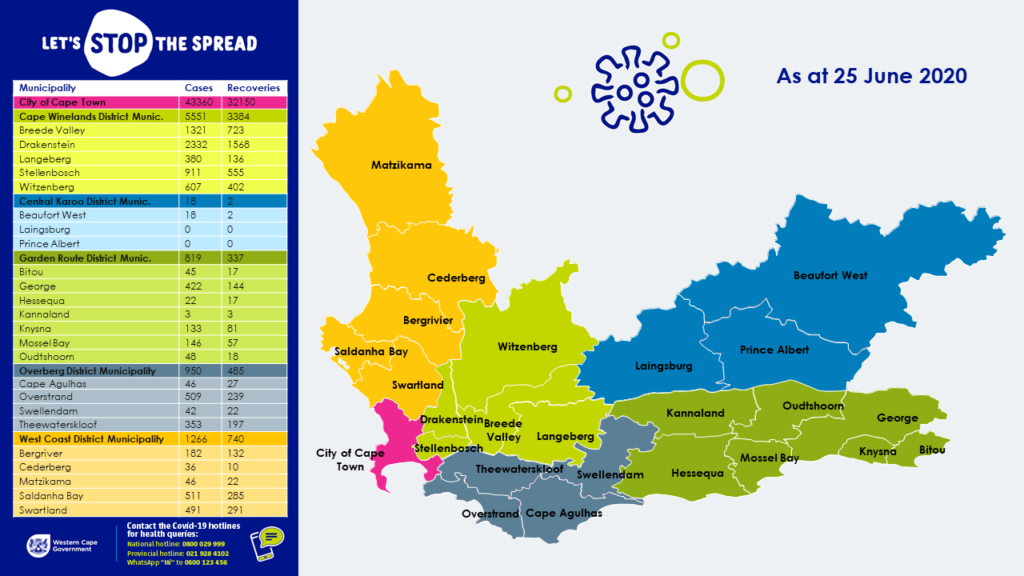
As of 1pm on 25 June, the Western Cape has 15 251 active cases of COVID-19, with a total of 56 345 confirmed cases and 39 475 recoveries.

Total confirmed COVID-19 cases 56345
Total recoveries 39475
Total deaths 1619
Total active cases (currently infected patients) 15251
Tests conducted 284 064
Hospitalisations 1799 with 319 in ICU or high care

Sub Districts Cape Town Metro:

Sub-district Cases Recoveries
Western 4947 3621
Southern 5100 3685
Northern 3588 2637
Tygerberg 7582 5730
Eastern 5110 3627
Klipfontein 5858 4265
Mitchells Plain 4957 3629
Khayelitsha 6218 4956
Total 43 360 32150

Sub-districts:

District  Sub-district Cases Recoveries
Garden Route Bitou 45 17
Garden Route Knysna 133 81
Garden Route George 422 144
Garden Route Hessequa 22 17
Garden Route Kannaland 3 3
Garden Route Mossel Bay 146 57
Garden Route Oudsthoorn 48 18
Cape Winelands Stellenbosch 911 555
Cape Winelands Drakenstein 2332 1568
Cape Winelands Breede Valley 1321 723
Cape Winelands Langeberg 380 136
Cape Winelands Witzenberg 607 402
Overberg Overstrand 509 239
Overberg Cape Agulhas 46 27
Overberg Swellendam 42 22
Overberg Theewaterskloof 353 197
West Coast Bergrivier 182 132
​West Coast ​Cederberg 36 10
West Coast Matzikama 46 22
West Coast Saldanha Bay Municipality 511 285
West Coast Swartland 491 291
Central Karoo Beaufort West 18 2

Unallocated: 4381 (2377 recovered)

Data note:  As the province moves closer to the peak and the Department of Health is recording over 1000 new cases daily, it is not possible to check and verify that the address data supplied for each new case is correct, within the time frames required to provide regular and timely updates. This means that in some instances, cases could be allocated to the wrong sub-districts. We are working with the sub-districts to clean and verify the data and where errors are picked up locally, cases will be re-allocated to the correct areas.

More data is available here: https://coronavirus.westerncape.gov.za/covid-19-dashboard

The Western Cape has recorded an additional 54 deaths, bringing the total number of COVID-19 related deaths in the province to 1619. We send our condolences to their loved ones at this time.

Western Cape Government encourages people to take up comfortable Q and I:

Earlier today, I held a digicon with Minister of Transport and Public Works, Bonginkosi Madikizela and Minister of Health, Nomafrench Mbombo to provide an update on quarantine and isolation facilities in the province.

The Western Cape Department of Transport and Public Works has brought online 3760 isolation and quarantine facility beds by 24 June. We will soon have 4766 beds available for residents who are not able to isolate or quarantine at their own homes.

Our approach to activating these facilities is as follows:

  • All clients with severe symptoms, as well as those at high risk of Covid morbidity and mortality are assessed for the need of hospitalization.
  • All those who are symptomatic and not requiring hospitalization are currently offered assisted Quarantine (with or without testing). Once the facility is filled, we then move to activate the next facility.
  • The same process is followed for isolation facilities (for those confirmed to have Covid-19).

This ensures that we are not incurring costs for facilities not in use at any point.

Our strategy has been to proactively identify sites across the province, and to prepare them for activation should the need arise. This can be done quickly, as the demand for these facilities emerges.

However, we are experiencing serious challenges in filling these facilities as residents would rather stay in their own homes. There are currently 1006 people in these facilities. While this is an increase from last month, it represents a 21.11% occupancy rate of those beds that have been made available currently.

Some of the questions that are being asked by people who are unwilling to take up the offer to isolate or quarantine in these facilities are:

  • Can I bring my own food?
  • Who will look after my house?
  • Can I leave to visit my family?
  • Can I drink alcohol at the facility?

There are also concerns that people will be identified in their communities as having Covid-19 if they make use of these facilities. The fear of discrimination and rejection by communities is therefore an additional concern.

The Western Cape Government is responding to this challenge by mobilizing all sectors and civil society. In line with our existing hotspot strategy, we are adopting context sensitive approaches for each area. This includes:

  • Communication strategies
  • Engagement with local community leaders
  • Public messaging by local personalities, and
  • Behaviour change strategies

Community health workers, who are respected in their communities, also pursue engagements with households – especially with vulnerable persons at risk.

We have also re-purposed the Western Cape’s contact centre to make outbound calls to confirmed cases and contacts of these cases to encourage them to take up these facilities.

The centre has already made hundreds of calls and offers the opportunity to make use of these facilities three times, allowing for a more personal explanation of why it is worthwhile to do so.

This evening, I will be joined by Minister Madikizela on Zibonele FM as part of a series of engagements where we will discuss the benefits of making use of Q&I facilities. This is part of our ramped-up communications to help explain the benefits of Q&I.

I am also pleased that Red Dot Lite transport service is operational, safely transporting residents to these facilities.

My message to you today is to please make use of these facilities if you are unable to do so at home. These facilities are comfortable and safe.

It is understandably a difficult thing to do, and I understand leaving home is tough: but if you do so, you can make sure that you don’t spread the virus to anyone else in your home or community.

We need to think of the ones we love right now and make small sacrifices to keep them safe. Let’s do it for our grans, aunties and best friends.

To those residents who don’t require to isolate or quarantine because you do not have Covid-19 or because you are not a close contact of someone who has Covid-19, be a voice of kindness and support. Praise your friends, colleagues, family members and fellow members of the community who take up this offer.

Be compassionate and caring and reject discrimination when you encounter it. Any person can get infected -we all deserve love during this challenging time.

Modelling and provisioning in the Western Cape

The Western Cape has over 1700 patients who have tested positive with Covid-19 in hospitals. This includes both public and private facilities. Of this total, over 300 people are in ICU or high care facilities in these hospitals.

This is the highest number of Covid-19 hospitalisations to date, and we are anticipating and planning for a further increase in demand in our services.

The additional capacity provided for by the Hospital of Hope at the CTICC has already provided significant support, recording 230 admissions by 24 June. 176 people have been discharged from this field hospital to date.

Our health care system planning and provisioning is guided by modelling, which is done in conjunction with the National COVID-19 Epi Model consortium, which is the same model used by the National Government.

As a caring and responsible government, we prepare against a range of possible scenarios as guided by this technical work, including those which anticipate limited mitigation of the epidemic.

We believe it would be irresponsible to plan for an optimistic scenario, and we are then not able to provide services to those who need it.

However, I must stress that modelling is never perfect. It is based on a number of assumptions on how the virus might spread through our communities, and who might get infected. We therefore need to continuously re-assess the model by putting in new data from what is happening “on the ground” in our context.

We currently cannot be certain whether we have started approaching our peak or whether it has been pushed out, and we are therefore undertaking an additional calibration of the model using latest data and trends. We will make this new calibration public as soon as it is completed.

Health System Preparation Update:

Testing and Triage Centres

The Western Cape Government continues to open new testing and triage centres across the province.

We currently have 19 of these facilities operational, including 4 facilities outside of the Metro (Paarl, George, Worcester and Ceres).

An additional 15 facilities will be completed by the first week of July, including:

  • Stellenbosch Hospital
  • Robertson Hospital
  • Gustrouw
  • Kleinvlei
  • Macassar
  • Khayelitsha (Site B)
  • Bothasig
  • Durbanville
  • Reed Street
  • Symphony Way
  • District Six
  • Gugulethu
  • Retreat
  • Elsie’s River
  • Du Noon
  • Van Guard CHC

Further to this, some 24 testing and triage facilities will be opened in rural areas of the Western Cape, including:

  • Bella Vista
  • De Doorns
  • Klapmuts
  • Op die Berg
  • Laingsburg
  • Nieuveldpark
  • Sandhills
  • Asia Park
  • Crags
  • Ladismith
  • Hawston
  • Kleinmond
  • Railton
  • Citrusdal
  • Diazaville
  • Klawer
  • Piketberg
  • Riebeek West and Velddrif Clinics
  • Beaufort West
  • Alan Blyth and Harry Comay Hospitals
  • Slangrivier Satellite Clinic
  • Hermanus

Field Hospitals:

Our third temporary field hospital at Brackengate is on schedule and is expected to take its first patient on 10 July 2020. The field hospital will have 330 beds and will provide intermediate care.

The Sonstraal Hospital in the Cape Winelands will accommodate approximately 150 beds and will be undertaken in phases. 63 beds will become available in the first week of July.

Fatality Management:

The Western Cape is also making sure it is adequately prepared to manage increased fatalities. A temporary facility for this purpose is being constructed at Tygerberg Hospital and will be completed by first week of July. This is being done in conjunction with the City of Cape Town.

The use of steroids in treatment:

The use of steroids has been approved for use on our clinical platform in line with international recommendations and the MAC recommendations. This will have a positive impact on the clinical outcomes of patients infected with Covid-19. These steroids will be used for ventilated patients and those on high flow nasal oxygen.

The use of oxygen:

Oxygen has shown to have a significantly positive impact on the clinical outcomes of patients, and we are using oxygen in our facilities to manage ill patients.

An oxygen calculator has been developed that facilities can use to access their daily oxygen requirements. We have also adopted a predictive model that shows that our current average consumption is 12 tons a day and at the peak will require approximately 40 tons of oxygen daily. We have engaged with suppliers, and we have been assured of this supply.

Update on Private Sector cooperation:

A Call for Service has been issued to all Licensed Private Hospital Groups to purchase bed capacity in terms of palliative care, general, High Care and ICU. The National Department of Health has negotiated the tariffs and hospital groups have confirmed their commitment, with each nominating their chosen Admin Intermediary. The parties are busy concluding and signing SLAS and addressing operation requirements. The first few patients have been referred and admitted to test the systems.

Our heroes on the frontline:

I want to again thank every single person in our health system working tirelessly on the frontline. You are heroes and we salute you.

Staffing remains a very real challenge in our health response, because all new facilities need people to make them effective. This is happening at a time when more people are filling ill – as we have seen globally.

We have introduced a number of mitigation steps to address this, including the use of volunteers, bursar nurses and the Cuban doctor contingent.

I also very pleased that our department of health has implemented a training course to upskill nurses in intensive care management. These are skills that can be used beyond the crisis and will be of personal benefit to both the nurses and our communities.

I want to again call on all our residents to join me in celebrating our healthcare workers and other frontline staff. This is a very stressful and anxious time for them as they work tirelessly to save lives. Show your appreciation in whatever way you can – and let them know that the Western Cape is behind them.

Stay Safe. Save Lives.

During this difficult time for our province and country, the most important thing we can do is to keep ourselves safe. When we do this, we slow the spread of the virus, and help protect the ones we love.

I again call on all our residents to play their part in saving lives, by:

​-Regularly washing your hands, keeping surfaces clean and coughing or sneezing into a tissue or your arm

-Staying home as much as possible, especially if you fall into one of the risk groups

-Wearing a clean, cloth mask whenever you leave home

-Ensuring that you keep a distance of 1.5 metres between yourself and any other person

-Staying home if you are experiencing symptoms or feel unwell

-Seek medical attention if you are experiencing shortness of breath

Media Release: Supporting the Long Street Kiosks during the COVID-19 crisis

MEDIA RELEASE BY DAVID MAYNIER

Date: 24 June 2019

Release: immediately

Supporting the Long Street Kiosks during the Covid-19 crisis

Businesses in the Western Cape have been hard hit during the Covid-19 crisis, and so we are doing everything we can to support them, especially entrepreneurs of small to medium enterprises and those in the informal sector. On Wednesday (24 June 2020), we handed over a number of small assets and marketing collateral, together with our Covid-19 Business Safety Kits, to some of the businesses operating in the Long Street Kiosks to assist them during this difficult time.

Since 2016, the Long Street Kiosks project has offered 10 Small and Micro Enterprises (SMEs) formal trading spaces within the City of Cape Town Central Business District (CBD) so provide them with access to new market opportunities. During Covid-19 these businesses have shown great resilience by diversifying their products to include hand sanitisers and masks or selling their products through e-commerce..

To determine how best we can assist the Long Street Kiosk businesses, the Department of Economic Development and Tourism (DEDAT) assessed these businesses’ current challenges and needs. This assessment identified the type of support or intervention needed for each business which included items such as blenders, coffee grinders, fridges and branded marketing materials.

In some cases, the needs identified resulted in DEDAT connecting the businesses with our partner organisations such as Productivity South Africa to provide production layout and manufacturing advice, the Small Enterprise Development Agency (Seda) to assist with marketing and promotional material and an application to finance equipment, the Cape Peninsula University of Technology to provide a knitting production specialist to support one of the beneficiaries and with Clotex to onboard the business as part of the SMME Booster Fund programme.

Zaida Abrahams from Zee Zees Halal Foods expressed her thanks to DEDAT for the donation of a stove, “Currently I can do 36 pies at a time, but this allows me to do 100 pies at a time. So my time will be managed more effectively. I can take on bigger orders, and push out more meals, so this will really help me going forward. Thank you so much.”

While, Nokuthula “Teddy” Luthuli from Smoothie On The Go, also thanked DEDAT for the donation of an industrial blenders and refrigerator, adding that “these things that we’re getting today will definitely help us a lot going forward.”

Entrepreneurs in the Western Cape have shown great resilience during the Covid-19 crisis, and we remain fully committed to supporting them to open up safely and responsibly during the Covid-19 crisis.

Media Queries:

Francine Higham

Spokesperson for the Provincial Minister of Finance and Economic Opportunities

(Responsible for the Provincial Treasury and the Department of Economic Development and Tourism)

Tel: 021 483 4327 / Cell: 071 087 5150 / Email: francine.higham@westerncape.gov.za