Skip to content Skip to left sidebar Skip to footer

Covid-19

17 July 2020 Media Statement: IDP Manager for Garden Route District Municipality passes away

Media Statement: IDP Manager for Garden Route District Municipality passes away

For Immediate Release
17 July 2020

He will be remembered as a ‘humble, kind, calm and collected’ colleague

“It is with shock and broken hearts that we learned of the passing of one of our own employees yesterday to COVID-19,” said Alderman Booysen, Executive Mayor for the Garden Route District Municipality (GRDM). Integrated Development Planning (IDP) Manager, Mr Mzukisi Cekiso is no longer with the GRDM. “Our prayers go out to his wife, child, family and friends – the District will never be the same again,” said Alderman Booysen. “The sun went down during the day.”

‘Mzu’, as he was fondly referred to by everyone, brought a breath of fresh air to the institution with his appointment on 1 February 2018. Part and parcel of his responsibilities were to manage and coordinate the IDP, Public Participation and Intergovernmental Relations functions for the district.

During a Zoom meeting today, 17 July 2020, with employees at GRDM, Alderman Booysen described Mzu as a man who often “presented his strong side to others”, who was also in contrast “a light-hearted person with a lot of ambitions”. Mayor Booysen said when Mzu bought a new vehicle he requested permission from Mzu to take it for a drive. Mzu jokingly responded: “my vehicle starts with only my own fingerprint”. Employees all have fond and happy memories of their engagements with Mzu.

Sadly, Alderman Booysen recalled one of the last messages Mzu sent to his wife Elethu in which he stated that “this COVID-19 nonsense is painful”. A scary and mind-opening fact about the seriousness of the virus.

GRDM Municipal Manager Mr Monde Stratu encouraged all Councillors and employees to be vigilant during this period because the COVID-19 Coronavirus is “vicious and knows no boundaries”. He also pleaded to employees, especially men, not to think that by avoiding to admit oneself to the hospital a person would be perceived as “brave at hearted”. He said: “You should seek medical assistance should the need arise”.

Mr Lusanda Menze, GRDM Executive Manager for Planning and Economic Development when asked to share his thoughts about Mzu, said: “A great son of the soil! Mzu’s passing came as a shock to many of us. I was in daily contact with him and he never showed any signs of apprehension. Having known him for close to 10 years, the Department is incomplete without him. I am really saddened by the loss of this kind, caring and gentle person who had an affable demeanour. He had the equanimity of dealing with complex issues and was [also] self-driven”.

Ms Mercy James, GRDM IDP Officer, was his right hand at work. She describes her time reporting to him by saying, “I was blessed to work with Mzu from 1 March 2018. Since the onset of my duties, he made it clear that the IDP unit was not about him, but that we needed to work as a team. Over time Mzu got to know not only my strengths, the areas of my skill set where I were not that strong.  He was determined to see me develop my strengths, rather than revealing my weaknesses. A true leader, who walked in front but close enough to his supporting team. I experienced him as humble, kind, calm and collected person, and he could easily handle my ‘differently tempered’ personality. I’m deeply saddened by his passing, but grateful that I had the privilege of working with a noble man like him.”

Mzu was involved in many government structures, well known to those working inside and outside the organisation, including premiers, mayors, municipal managers, IDP managers and the like. His sudden passing has left a void in the municipality. His colleagues and friends were not able to say goodbye before he left because everything happened so fast.

The municipality is in contact with Mzu’s family to provide the necessary assistance and support during this difficult period.  “This was too sudden, especially for those who were close to him
there are no words to explain the grief that all of us are observing even from afar,” Mr Stratu concluded.

May his soul rest in peace.

ENDS


iStock.com/ra2studio

17 July 2020 Media Release: Garden Route Health Platform Update – 17 July 2020

Media Release: Garden Route Health Platform Update 

17 July 2020
For Immediate Release

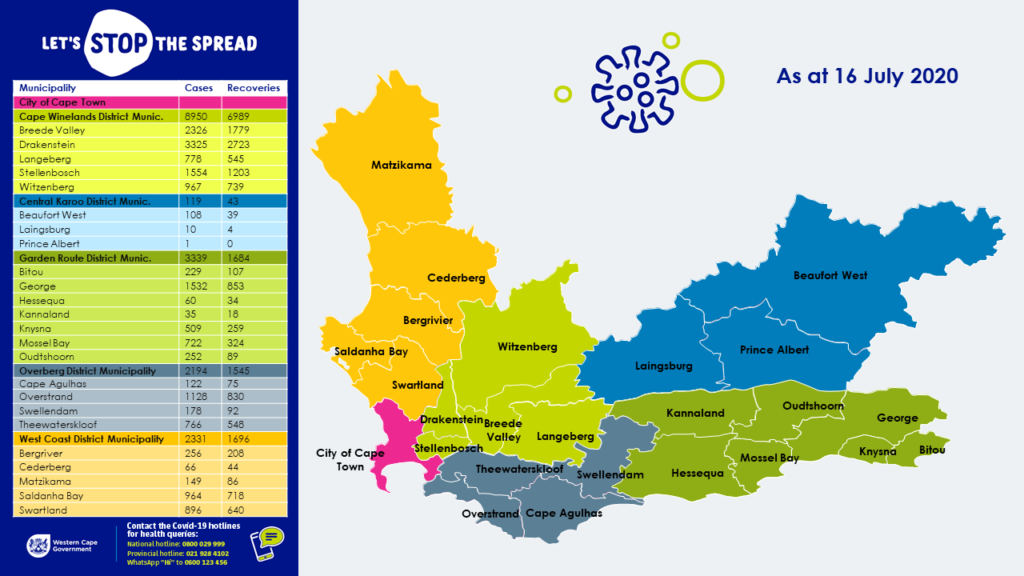
 As of 17 July 2020, the Garden Route District has 3339 confirmed cases of Covid-19.

Cases 

Garden Route cases and recoveries per subdistrict.

Bitou 229 cases; 107 recoveries
Knysna 509 cases; 259 recoveries
George 1532 cases; 853 recoveries
Hessequa 60 cases; 34 recoveries
Kannaland 35 cases; 18 recoveries
Mossel Bay 722 cases; 324 recoveries
Oudsthoorn 252 cases; 89 recoveries

The Garden Route has recorded 73 Covid-19 deaths.

Hessequa 2
Mossel Bay 9
George 35
Knysna 11
Bitou 8
Oudtshoorn 8

Hospitalisation

There are currently 88 patients admitted in public and private hospitals with 17 in High Care/ICU.

Community Testing and Screening

The approach to active Covid-19 case finding within the rural areas remain that of community testing and screening with a focus on people > 55 years, the vulnerable and those of high risk (people with co-morbidities). To date 137 385 people have been screened and 1007 referred for testing.

Isolation and quarantine

Isolation facilities are for patients with mild to moderate symptoms where they can recover from Covid-19 (usually 14 days) and quarantine facilities are for those awaiting test results. These facilities are safe and comfortable and you will receive free transport, meals, and a laundry service. People who cannot isolate or quarantine safely at home, can be referred to a isolation or quarantine facility.

PetroSA (West Camp) is currently the only activated isolation and quarantine facility in the Garden Route. More facilities will be announced, if and when the need arises or capacity is exceeded at PetroSA. We currently have 80 people at West Camp.

Primary healthcare                  

Our Primary Health Care platform is an important vehicle to support our health system, so that our patients are well cared for to prevent hospitals from being overwhelmed. Although we advise patients to only visit their nearest clinic for essential services we remind parents and caregivers that services such as immunisations are still rendered. It is important to attend all your confirmed appointments. Services such as women’s health(family planning, antenatal and post-natal care), child health(immunisations) and TB, are still rendered. Stable chronic care patients must collect their chronic medicine at the chronic off-sites. Should you require guidance or advice around your current treatment or scheduled appointment, please contact your clinic/hospital.

Shielding the vulnerable

Persons over the age of 55 or have a chronic condition are at risk for severe COVID-19 illness and should take extra precautions to protect themselves by following these steps:

  1. Avoid getting the virus by staying home, wear a mask (when you have to go out), wash hands regularly and disinfect surfaces
  2. Look after your health by following a healthy lifestyle and take your medication regularly
  3. Get help immediately if you do not feel well
  4. If you develop COVID-19 symptoms, go for immediate testing, do not delay

The Department has implemented an action plan for Diabetics with COVID symptoms which includes expanding testing for diabetics who represent a high risk group. Our current data suggests that these patients are presenting or are being admitted too late in a very sick conditions, which has dire outcomes.

Next 100 days

The Department has identified the next 100 days as crucial to refocusing the health system and health services while still managing the pandemic with continued interventions to increase immunisation coverage, TB treatment and ART uptake.

We urge all citizens to remain careful in observing the essential 5 Golden Rules of hygiene and safety. It remains important to take particular care of persons with underlying conditions and particularly Diabetes, who are at significantly increased risk of severe COVID-19. We urge these people to really take special care and to shield themselves from exposure where possible.

The protection of our most vulnerable loved ones remains in our collective hands.

-ENDS-

Nadia Ferreira
Principal Communications Officer
Garden Route and Central Karoo Districts
Western Cape Government Health
Town Clinic,Plettenberg Bay
Tel: 044 5333846
Email: Nadia.Ferreira@westerncape.gov.za 
Website: www.westerncape.gov.za

Picture credit: iStock.com/ra2studio

17 July 2020 Media Release: Hygiene services enhanced at the GRDM – have yours?

Media Release: Hygiene services enhanced at the GRDM – have yours?

For Immediate Release
17 July 2020

The Department of Employment and Labour issued guidelines which require employers, ‘to ensure, as far as reasonably practicable, that all persons who may be directly affected by the activities of others (such as customers, clients or contractors and their workers who enter their workplace or come into contact with their employees) are not exposed to hazards to their health or safety. This obligation also applies to self-employed persons whose working activities bring them into contact with members of the public’.

In order to comply with these guidelines, the Garden Route District Municipality (GRDM) put measures in place to prevent the spread of infections in the workplace.  Some of these measures include placing hand sanitising dispensers at entry points; the daily screening of employees for symptoms of COVID-19 when they report for work; providing face masks to be worn in the workplace and conducting virtual meetings to adhere to social distancing protocols.

The value and welfare of hygiene officials are critical, especially during the COVID-19 pandemic.  Therefore, it is vital that these officials are well equipped and looked after. As an additional safety measure, the hygiene officials were each furnished with personal protective equipment to wear.

It is a known fact that regular cleaning routines are a simple, yet effective way to ensure a hygienic environment and prevent the spread of germs and infections caused by contact of surfaces, communal spaces and offices.

Daily workplace cleaning routines have been ‘sharpened’ and cleaning times were altered. Hygiene officials start their workday at 07:30 and knock off at 16:00, whereas administrative officials start at 08:00 and finished at 16:30. The reason behind this arrangement is that when administrative officials arrive at work, their workstations are clean and safe when they start their daily operations. Hygiene officials’ routine starts with the sanitising and disinfection of all offices.

The following areas were identified as ‘hotspots’ in offices that should be cleaned to reduce the possibility of bacterial or viral infection.

  • The immediate workstations of officials
  • Keyboards and telephones
  • Chair seats and handles
  • Door handles
  • Light switches

Before and after meetings, committee rooms and venues are sanitised and disinfected; however, the responsibility of hygiene staff to serve coffee and tea was temporarily discontinued in order for them to focus on hygiene functions.

The health and safety of officials and visitors are of paramount importance to the GRDM, and for this reason, officials and visitors are requested to work together, to take control and practice safe hygiene habits in order to promote a healthy workplace.

16 July 2020 Media Release: George Airport open for business travel under Alert Level 3

Media Release: George Airport open for business travel under Alert Level 3

For Immediate Release
16 July 2020

We welcome the announcement by Minister of Transport, Fikile Mbalula, that George Airport will open to receive business travellers and cargo under Alert Level 3. As a critical transport link for providing access to the Garden Route District for many business travellers across South Africa, this decision provides much-needed support to jobs and the economy in the Western Cape.

That is why we have been working hard, together with the Airports Company of South Africa (ACSA), the George Airport management, George Municipality and our provincial Department of Health, to find a solution that will allow the George Airport to meet the criteria required for the airport to open.

Thanks to the effort of all involved, the Western Cape Department of Health will partner with ACSA to ensure that Covid-19 screening is conducted at the George Airport.

We are confident that George Airport is ready to welcome businesses travellers to the Garden Route.

Read full statement: https://www.westerncape.gov.za/news/george-airport-open-business-travel-under-alert-level-3

16 July 2020 Media Release: Update on the coronavirus by Premier Alan Winde

16 July 2020

As of 1pm on 16 July, the Western Cape has 14 241 active cases of COVID-19, with a total of 82 264 confirmed cases and 65 530 recoveries.

Total confirmed COVID-19 cases 82264
Total recoveries 65530
Total deaths 2493
Total active cases (currently infected patients) 14241
Tests conducted 365009
Hospitalisations 1634 with 317  in ICU or high care

Sub Districts Cape Town Metro:

Sub-district Cases Recoveries
Western 6877 5696
Southern 7164 5852
Northern 4736 4015
Tygerberg 10255 8501
Eastern 7454 6129
Klipfontein 7561 6242
Mitchells Plain 6520 5420
Khayelitsha 7359 6425
Total 57926 48280


Sub-districts:


District  Sub-district Cases Recoveries
Garden Route Bitou 229 107
Garden Route Knysna 509 259
Garden Route George 1532 853
Garden Route Hessequa 60 34
Garden Route Kannaland 35 18
Garden Route Mossel Bay 722 324
Garden Route Oudsthoorn 252 89
Cape Winelands Stellenbosch 1554 1203
Cape Winelands Drakenstein 3325 2723
Cape Winelands Breede Valley 2326 1779
Cape Winelands Langeberg 778 545
Cape Winelands Witzenberg 967 739
Overberg Overstrand 1128 830
Overberg Cape Agulhas 122 75
Overberg Swellendam 178 92
Overberg Theewaterskloof 766 548
West Coast Bergrivier 256 208
​West Coast ​Cederberg 66 44
West Coast Matzikama 149 86
West Coast Saldanha Bay Municipality 964 718
West Coast Swartland 896 640
Central Karoo Beaufort West 108 39
Central Karoo Laingsburg 10 4
Central Karoo Prince Albert 1 0

Unallocated: 7405 (5293 recovered)

Data note:  As the province moves closer to the peak and the Department of Health is recording over 1000 new cases daily, it is not possible to check and verify that the address data supplied for each new case is correct, within the time frames required to provide regular and timely updates. This means that in some instances, cases could be allocated to the wrong sub-districts. We are working with the sub-districts to clean and verify the data and where errors are picked up locally, cases will be re-allocated to the correct areas.

More data is available here: https://coronavirus.westerncape.gov.za/covid-19-dashboard

The Western Cape has recorded an additional 38 deaths, bringing the total number of COVID-19 related deaths in the province to 2493. We send our condolences to their loved ones at this time.

Earlier today, I held a digicon in which we detailed the work that we have done in the province to provide medical care to those affected by COVID-19, and the specific risks to diabetic patients. More information can be found in the press statement here: https://coronavirus.westerncape.gov.za/news/statement-premier-alan-winde-weekly-digital-press-conference-16-july

16 July 2020 Media Release: Statement by Premier Alan Winde at the Weekly Digital Press Conference


16 July 2020

“We are noticing a gentle easing of pressure in the Metro, but continued vigilance is essential”

The Western Cape Government understands that the hard lockdown was an important intervention to slow the spread of the virus and therefore to buy the time needed to prepare our health system for the peak of infections that were to come.

This was essential so that every single person receives the medical care that is needed, when it is needed. Our teams therefore worked around the clock to ensure that we have enough staff, supplies and additional temporary care facilities (or ‘field hospitals”) available to provide this care.

They have faced, and continue to face, enormous pressures. This is an unprecedented crisis, that has pushed our systems, finances and capacity.

I know it has not been easy for our frontline staff, be it nurses, teachers or police officers. I therefore want to thank all the officials, across our government departments, for their hard-work and dedication displayed during this challenging time.

I also want to say a big thank you to every single resident, wherever you are, for playing the most important “lead” role in our Covid-19 response.

I know that millions of people across our province are following the golden rules, wearing a mask, washing their hands, and keeping a safe distance. Yes, there are still some who are not – but the overwhelming majority of people are playing their part. Thank you for leading from the front and being role models for other members of our community to follow.

Early indication of pressure easing, but we cannot let our foot off the pedal

From the first digital press conference, that I hosted months ago, I set out that our response to Covid-19 would be evidence based and data-led. We would follow the best scientific advice in making projections on what was needed from our health platform, so that we were as prepared as possible.

We have done this to the best of our ability – planning for the very worst, but always intervening to get the best possible outcome. This has happened in the context of inevitable uncertainties, as our scientists learn about the virus and how it impacts our communities.

We have thus far undertaken an early provisioning scenario, and two additional calibrations with the National Covid-19 Modelling Consortium. We are now working towards a third calibration with this grouping, using the latest available data as we seek to continuously re-assess our projections and provisioning scenarios. We will make this public when it is received.

However, I can reveal that we are starting to see a gentle easing of pressure in the Metro in particular, with a possible decline. This is noticed in the most robust data available to us: hospitalisations and deaths.

But let me be crystal clear: it is simply too early to say the worst is over. We simply do not know enough about the virus to claim so. We are still in the midst of a serious health pandemic.

So, if anything, we must be even more vigilant and alert than before so that we can continue to flatten the curve and save lives in the Western Cape.

Our health platform is managing

The Western Cape Department of Health manages its health platform in an integrated manner, allowing us to closely monitor capacity at any given point. This allows patients to be moved between different facilities, if capacity is reached.

We note the following observations regarding Covid-19 in the Western Cape:

  • The hospital admissions for Covid-19 have stabilised over the last 10 days, across public and private hospitals.
  • The critical care bed occupancy rate reached a daily maximum of 320 patients. It is currently at 270-280 patients.
  • Total Covid-19 admissions reached a daily maximum of 1900 patients, and now currently stands at 1600-1700 patients.

In the Cape Metropole, the most populous district in the Western Cape and which accounts for the sub-districts with the most infections, our acute care hospital capacity, including all patients (Covid-19 and non Covid-19) is as follows:

Groote Schuur Hospital 71%
Red Cross War Memorial Children’s Hospital 47%
Tygerberg Hospital 64%
Mowbray Maternity Hospital 74%
New Somerset Hospital 72%
Eerste River Hospital 95%
False Bay Hospital 33%
Helderberg Hospital 52%
Khayelitsha Hospital 86%
Karl Bremmer Hospital 79%
Mitchell’s Plain Hospital 74%
Victoria Hospital 74%
Wesfleur Hospital 23%
TOTAL 69%

This means our acute care capacity has not yet exceeded 70%.

Our intermediate care facilities or “field hospitals” have provided an enormous support in alleviating this pressure:

  • The Hospital of Hope has admitted 1069 patients over time, as of 14 July 2020, and has discharged 751 people since opening.
  • The Thusong Centre in Khayelitsha has admitted 198 patients and discharged a total of 138 patients so far.
  • The 330-bed Brackengate Field Hospital is set to come online on 20th July.
  • The Sonstraal Hospital, which will have a total capacity of 150 beds, is expecting the first 63 beds online soon.
  • Additional beds will be provided in Hermanus (32 beds), Vredendal (20 beds) and George (20 beds).

We also continue to open new testing and triage centres at health facilities across the Western Cape:

  • We have 19 such facilities operational
  • Construction is completed at an additional 7 facilities, and they will become operational soon
  • Testing and triage centres are under construction at 15 facilities

To ensure that we can provide the best possible care to our residents when they need it, we have also made sure that we have the right supplies available in our facilities:

  • We had a significant platform of medical equipment assets available prior to the pandemic, including 324 ICU ventilators, and 94 transport ventilators
  • 25 additional ventilators have been added to our health platform
  • A decision support tool was developed to optimally manage key processes (needs assessment, procurement and allocation) on an ongoing basis
  • Approximately R250 million has been invested in health technology to strengthen our response. This ensures our health facilities can provide different levels of care and helping ensure effective screening, testing/diagnosis, referral and treatment of Covid-19 patients
  • We have thus far employed 620 people at our field hospitals
  • We have piloted a National Track and Trace system, and look forward to the launch of it by the National Government
  • We have finalised key agreements with private sector, to access their services should the need arise
  • We have ensured adequate supplies of oxygen to our facilities, and currently utilising 60% of our total capacity.
  • We have made use of High-Flow Nasal Oxygen Devices at our facilities, which has proven to an effective, life-saving support intervention for Covid-19 patients.

The Western Cape to start process of scaling up non-Covid health services from 1 August 2020

Our Department of Health will now be working on plans to scale-up non-Covid health services and responses, which has been negatively impacted by the pandemic.

This includes:

  • Scaling up chronic disease management (Diabetes, Hypertension), HIV and TB management, and Child and Women’s health services. This is done via Community Health Workers and primary care services.
  • The systematic re-introduction and scaling up of elective surgery, over the next 8 months, considering the Covid reality over the next 12-18 months.
  • The recovery of the health care delivery system to reach pre-Covid levels of performance.

Diabetics at high risk of severe illness, must present for testing as soon as any symptoms develop

I was very pleased to welcome endocrinologist, Associate Professor Joel Dave, to today’s digital press conference. He discussed his research on the impact of Covid-19 on diabetic patients. This is something very close to my heart because I am type 2 diabetic.

The research found that while diabetics are not at higher risk of contracting the virus, they are at higher risk of developing a severe illness from Covid-19. That is why the Western Cape Government’s Department of Health has developed a specific action plan on diabetes.

A key pillar of this action plan is that diabetic residents who develop Covid-19 symptoms must get tested immediately. We are also making some space in our intermediate care facilities available for diabetic residents who get ill with Covid-19.  The clinical outcomes for those who are identified early are much better than those who wait until they are severely ill.

My message to our diabetic residents today, as a fellow diabetic, is to please take every precaution possible to protect yourself. And if you do start developing any symptoms to urgently get tested for Covid-19. We have the healthcare available to support you, please make use of it. Also remember to take your medication and to live a healthy lifestyle with a balanced diet. This makes a major difference.

The virus is going to be with us for some time, so behaviour change is our best long-term defence

The Western Cape Government has been engaging with behavioural science experts on how best to get the behaviour change needed in our communities.

The reality is that the virus is going to be with us for some time and we need every single person to play their part in keeping themselves and their families safe in the months ahead. If we don’t do this, we could risk new outbreaks emerging.

I want to make an important point here: behaviour change is not easy. We are asking residents to act in ways that are not normal in our cultures and communities. This will require lots of innovation by government, and this is a challenge we are taking seriously.

I want every resident in our province to know that I am extremely grateful for the changes you have made in your lives already. I know it has not been easy. I want you to share the same gratitude and praise with fellow members of the community when you see them wear a mask or follow the other golden rules.

This praise, I believe, will be more effective in creating role models and encouraging emulation than scolding. So always be kind and say thank you to someone when they act in a way that keeps you and your family safe.  Let’s create a movement of behaviour change in our communities in this way, with care and in the spirit of solidarity.

[ENDS]

16 July 2020 Media Release: “My sister and I tested positive for COVID-19 after attending a funeral”

Media Release: “My sister and I tested positive for COVID-19 after attending a funeral”

For Immediate Release
16 July 2020

Amanda (38), an employee of Garden Route District Municipality (GRDM), recently shared her and her sister’s COVID-19 experience. “We have no comorbidities and experienced flu-like symptoms,” she said.

Still in self-isolation, Amanda says that she and her sister attended a funeral in Graaff-Reinet on 20 June. They both developed a dry cough a few days after returning to George. By 29 June they suspected that they contracted COVID-19 after their cousin, who also attended the funeral, alerted them on 25 June that she had tested positive for it.

“We went for tests on 2 July and got our ‘positive results’ back on 6 July.”

“I was shocked and immediately called my doctor to ask for advice on what to do.” The doctor informed them to stay at home and isolate themselves from others. “Thankfully I stay with my sister. Neither of us even considered going out after suspecting that we had COVID-19, because nowadays coughing in public is met with glares from strangers and friends,” said Amanda.

A picture of Amanda before the COVID-19 pandemic in South Africa.

The sisters were frustrated at times as they were confined to their flat and not even allowed to go for a walk. Amanda said that she continued with work duties from home and was available to assist the municipality with work when requested.

When sharing some of the support she received, Amanda explained: “My HR Manager, Ms Nontobeko Klaas, also tested positive a while back and she was the first one to call and comfort me. She shared some home advice on what home remedies worked for her including ginger, garlic, lemon, honey, and inhaling peppermint or eucalyptus vapour my chest felt tight or heavy.”  Her colleagues, family and friends were in constant contact with her. “I also held daily video calls with my cousin.”

Amanda pleads “for those suspecting of having COVID-19 to go into quarantine and for those who tested positive to isolate, because it protects others from contracting the virus.” She added: “other people might not experience the same symptoms and I think that those with comorbidities are more prone to serious complications.” Amanda shared that they only experienced minor body aches and a persistent dry cough.

Her COVID-19 experience taught her to not only look at the negative side of any disease, but also to read up and listen to experiences of others who had survived. “People should not stigmatise those who tested positive for a disease because it helps no one. Those who tested positive need support more than anything else,” she added.

Amanda urges the public to be more proactive and to go into quarantine when they experience a cough, runny nose or body aches. “Live as healthy as you can and avoid gathering in large groups. Stick to the rules. COVID-19 is real and ignoring this fact might cost you your own or another person’s life.”

15 July 2020 Media Release: Tourism Product Development Fund launched

MEDIA RELEASE BY DAVID MAYNIER

WESTERN CAPE MINISTER OF FINANCE AND ECONOMIC OPPORTUNITIES

Date: 15 July 2020

Release: immediately

Tourism Product Development Fund launched

We are excited to announce the launch of the Tourism Product Development Fund which commits a total of R5 million to support new or existing tourism products and experiences in the Western Cape.

The Tourism Product Development Fund is one of the many ways we are working hard to support the tourism sector, which has been hard-hit by the Covid-19 pandemic and is facing significant job losses in the Western Cape.

Innovation and adaptability through product and market diversification is more important now than ever as tourism businesses and destinations try to build resilience during these tough times, and prepare new products for visitors to enjoy when we are ready to open again in the Western Cape.

Offering travellers tourism experiences that differentiate the Western Cape from other destinations will be important to our economic recovery and how we will market our tourism offering both domestically and internationally.

And so, the Tourism Product Development Fund aims to support those products and experiences that are most unique, such as cultural and heritage experiences or hyperlocal food and dining attractions that can only be experienced in the Western Cape.

Tourism is a major contributor to the economy and employment in the Western Cape. Since the start of the Covid-19 crisis in the Western Cape, the Department of Economic Development and Tourism and I have been engaging actively with the tourism industry to understand the impact of Covid-19 and to work with them to prepare the industry to be able to open safely and responsibly.

I would like to encourage all interested tourism businesses and organisations to apply. We look forward to receiving your submissions.

For more information on the Tourism Product Development Fund please visit https://www.westerncape.gov.za/general-publication/tourism-product-development-fund

The closing date for submissions is Friday, 14 August 2020 at 16:00.

Notes for media:
Please find soundbyte from Minister David Maynier attached.

To read the statement online visit: https://www.westerncape.gov.za/news/tourism-product-development-fund-launched

Media Queries:

Francine Higham

Spokesperson for the Provincial Minister of Finance and Economic Opportunities

(Responsible for the Provincial Treasury and the Department of Economic Development and Tourism)

Email: francine.higham@westerncape.gov.za


15 July 2020 Media Release: Do not lease or sell your state subsidised home

DO NOT LEASE OR SELL YOUR STATE SUBSIDISED HOME

15 July 2020

I am deeply concerned at the increased reports from various stakeholders about residents who have received a fully subsidized home from Government, who have either rented or sold the property. This information tells us that there was never a need for a home, which means Government is being defrauded.

In fact, I regard the action of anyone that embarks on this route as unethical, as they’re denying one of the almost 600-thousand people that are currently on the Western Cape Housing Demand Database (HDD), a housing opportunity, and their families who in the future could benefit from this asset.

A fully subsidized house costs the state close to R500 000.

Between May and the end of June 2020, we’ve received 11 official complaints about houses in Forest Village, Delft, Blue Downs, Eersteriver, Langeberg Municipality and Beaufort West Municipality either being rented or which might have been sold. In one report, a couple in Forest Village is being accused of currently renting two properties. This excludes the informal reports that’s being highlighted on social media.

The law is clear that every South African citizen who receives a government housing subsidy when buying or receiving a property, will be subject to a pre-emptive condition in their Title Deed, meaning the individual cannot sell the property within the prescribed 8 -years of receiving the subsidized house, unless it has received permission from the Provincial Department of Human Settlements to do so.

For the sale to occur, the beneficiary needs to submit an application to the Provincial Department to have the pre-emptive clause waived and removed from the title deed.

It is further critical to note that the property can be sold when:

  • Beneficiaries, who wish to improve their dwellings, need to apply for funding at a financial institution, and need to register a mortgage bond over the property.
  • Beneficiaries need to relocate (proof will be requested) to a better area or another city/town.
  • Loss of employment, they often take up employment in locations that make daily commuting impossible and the only alternative is to relocate permanently to the new place of employment.
  • Beneficiaries find themselves and their family’s victims of crime.

It is further important to note that Approval will be on condition that:

  • The purchaser is a SA citizen;
  • The purchaser is competent to contract;
  • The purchaser does not own and has never owned fixed property before;
  • The seller lived on the property for at least 2 years after the effective date of sale
  • The seller must be improving on his/her current living standards, or prove that it is a matter of extreme detriment to the applicant, if not approved
  • The municipality supports the sale if the property is being sold within the first 5 years of the effective date of sale.

My department is currently investigating all the reports and pursuant to the conclusion of the investigation the necessary and relevant action will be taken. I’ve also requested a legal opinion on the steps that can specifically be instituted against those who are renting their properties.

We will not hesitate to act against those who have defrauded the State in this manner. I’d like to call on all state beneficiaries not to be tempted to engage in this unethical and quite frankly illegal practices, particularly since the state has ensured that your housing need, which you declared is being met.

I also encourage those who are aware of a beneficiary that’s involved in these practices to formally inform the Department so that an investigation can be launched.

As the Western Cape Government, we remain committed to accelerating human settlement delivery, while promoting social inclusion through the development of integrated, resilient, safe and sustainable human settlements in an open opportunity society.

Media Enquiries:

Marcellino Martin

Spokesperson for Minister Tertuis Simmers

Marcellino.martin@westerncape.gov.za

021 483 3397 (o) / 082 721 3362 (m)

Or

Nathan Adriaanse

Director Communication & Stakeholder Relations

Tell: 021 483 2868 / Mobile: 083 2631720 / Email: Nathan.Adriaanse@westerncape.gov.za

14 July 2020 Media Release: Update on the coronavirus by Premier Alan Winde

14 July 2020

As of 1pm on 14 July, the Western Cape has 15 160 active cases of COVID-19, with a total of 79 332 confirmed cases and 61 756 recoveries.

Total confirmed COVID-19 cases 79332
Total recoveries 61756
Total deaths 2416
Total active cases (currently infected patients) 15 160
Tests conducted 356153
Hospitalisations 1636 with 300 in ICU or high care

Sub Districts Cape Town Metro:

Sub-district Cases Recoveries
Western 6698 5391
Southern 6985 5600
Northern 4615 3860
Tygerberg 9995 8169
Eastern 7293 5834
Klipfontein 7418 6016
Mitchells Plain 6359 5237
Khayelitsha 7269 6291
Total 56632 46398

Sub-districts:

District  Sub-district Cases Recoveries
Garden Route Bitou 193 83
Garden Route Knysna 444 213
Garden Route George 1359 744
Garden Route Hessequa 53 34
Garden Route Kannaland 30 16
Garden Route Mossel Bay 627 254
Garden Route Oudsthoorn 242 68
Cape Winelands Stellenbosch 1483 1105
Cape Winelands Drakenstein 3233 2581
Cape Winelands Breede Valley 2217 1658
Cape Winelands Langeberg 740 490
Cape Winelands Witzenberg 906 673
Overberg Overstrand 1085 737
Overberg Cape Agulhas 110 65
Overberg Swellendam 153 71
Overberg Theewaterskloof 738 474
West Coast Bergrivier 247 199
​West Coast ​Cederberg 68 42
West Coast Matzikama 135 68
West Coast Saldanha Bay Municipality 917 665
West Coast Swartland 858 583
Central Karoo Beaufort West 81 32
Central Karoo Laingsburg 9 3
Central Karoo Prince Albert 1 0

Unallocated: 6777 (4500 recovered)

Data note:  As the province moves closer to the peak and the Department of Health is recording over 1000 new cases daily, it is not possible to check and verify that the address data supplied for each new case is correct, within the time frames required to provide regular and timely updates. This means that in some instances, cases could be allocated to the wrong sub-districts. We are working with the sub-districts to clean and verify the data and where errors are picked up locally, cases will be re-allocated to the correct areas.

More data is available here: https://coronavirus.westerncape.gov.za/covid-19-dashboard

The Western Cape has recorded an additional 49 deaths, bringing the total number of COVID-19 related deaths in the province to 2416. We send our condolences to their family and friends at this time.

Health update:

I have been following the advice of my doctor and have been resting at home as much as possible. I am feeling significantly better today, and both my blood sugar levels and my temperature are down. I am still isolating at home and taking all the necessary precautions because I fall into a high risk group.

It is incredibly important that if you are a diabetic, you take all measures possible to protect yourself from contracting COVID-19. The most effective way to do this is to stay home as much as possible, and to ensure that you take extra care when leaving home- including regular hand washing, wearing a mask and social distancing.

If you are diabetic, it is important that you continue to take your medication, as diabetics who do not have their blood glucose controlled are at the highest risk of becoming seriously ill.

If you experience symptoms, such as a sore throat, fever, cough and loss of smell or taste , it is important that you get tested. If you develop a tight chest or struggle to breathe, seek medical attention.

Oxygen supply:

The Western Cape is currently using approximately 29 tonnes of medical grade oxygen in our facilities daily, with the biggest consumption occurring at Tygerberg and Groote Schuur hospitals. We are currently using approximately 60 percent of the available oxygen supply, so have sufficient supply margins available in the province.

Before the start of the pandemic, the Western Cape and the City of Cape Town put measures in place to ensure that the facility where medical grade oxygen is manufactured in the province is not impacted by loadshedding. It is especially important during this pandemic to ensure that production interruptions do not occur.