18 March 2023 Public Notice: Closure of Garden Route District Municipal Offices, 20 March 2023
18 March 2023 Public Notice: Closure of Garden Route District Municipal Offices, 20 March 2023


For immediate release
17 March 2023
An Environmental Impact Assessment (EIA) with regards to the process of establishing a Regional Waste Management Facility for the Garden Route District Municipality (GRDM) was completed during 2012.
Following the finalization of the EIA process, the GRDM was issued with an Environmental Authorisation by the Department of Environmental Affairs & Development Planning (DEA&DP) and a Waste Management Licence (WML) (no. 12/9/11/L1395/9). This was issued by the Department of Forestry, Fisheries & the Environment (DFFE). The licence was issued to GRDM (Eden DM at the time) on 05 February 2014.
A condition of the WML is that the activity i.e., construction of the Regional Waste Management Facility, is to commence within a period of two (2) years from the date of issue of the WML. Due to the various delays in the establishment of the facility, including the inconclusive Public Private Partnership process that did not come to fruition largely because of the Covid-19 pandemic, GRDM had to apply to DFFE for an extension of the commencement date on a bi-annual basis. The last approved extension of the commencement date was to expire on 24 May 2023, and another application for an extension of the commencement date was submitted on 07 December 2022.
The WML is only valid for a period of ten (10) years from the date of issue (05 February 2014); meaning the validity period of the WML was to expire on 05 February 2024. Therefore, together with the application for an extension of the commencement date, GRDM further applied for an extension of the validity period of the WML.
Approval of the commencement date was granted for a further two years, and an extension of the validity period of the WML was extended with ten (10) years. The extension was issued by the DFFE on 06 March 2023.
ENDS
For immediate release
16 March 2023
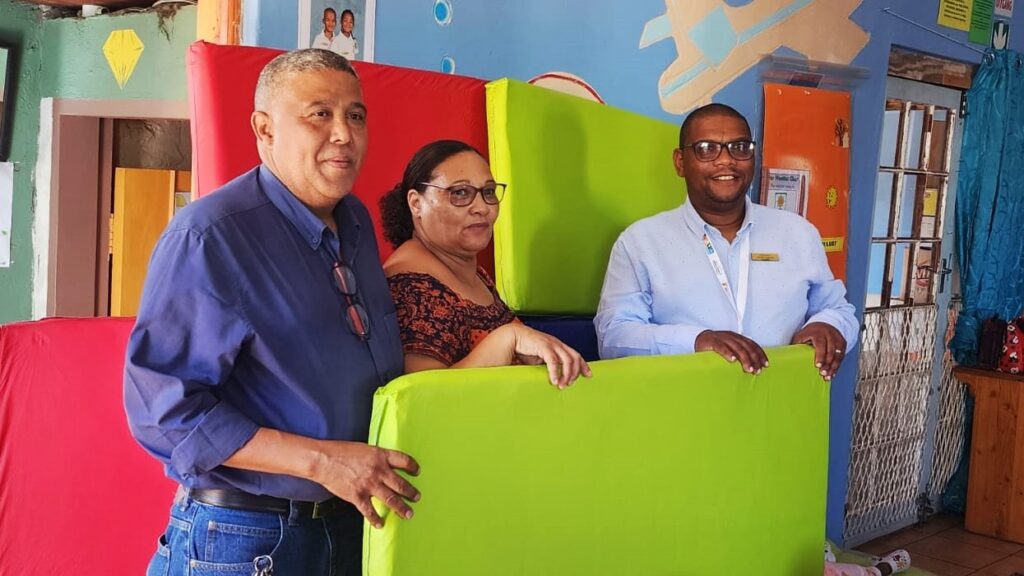
During the Mattresses Handover campaign on 02 March 2023 Garden Route District Municipality’s (GRDM) Municipal Health officials responsible for the Hessequa area, assisted the GRDM Portfolio Chairperson for Property Management and Development, Cllr Jobieth Hoogbaard, to distribute and donate mattresses to three crèches in the Hessequa region – Kleine Diamandjies, Neskuikentjie in Heidelberg and Groenie die Drakie crèche in Slangrivier.

Cllr Hoogbaard, during the handover ceremony, explained the importance of the overall wellbeing of children. He said: “It is hoped that this donation will further promote the development of the future leaders of our communities”. In addition, Cllr Hoogbaard stressed that “donating these mattresses will create a safe sleep environment because they are waterproof and easy to clean/disinfect”. He also highlighted that “we, the Garden Route District Municipality, further hope that mattresses can be donated to all the early childhood facilities across the Hessequa region”.
Sleep is a critical part of a healthy childhood and while children are at a crèche, they need a comfortable and safe sleeping surface, especially during naptime.
In closing Cllr Hoogbaard handed over the mattresses to the creche principals and educators. These educators in turn extended their appreciation to Garden Route District Municipality for their generous act towards Early Childhood Development facilities, especially the children, in the area.
Feature Image: GRDM Portfolio Chairperson for Property Management and Development, Cllr Jobieth Hoogbaard (right) and Chief: Municipal Health for the Hessequa Region, Heamish Herwels, hand over the mattresses to the principal of the Kleine Diamantjies Creche, Petro Josephs (middle).
ENDS

For immediate release
14 March 2023
Oudtshoorn Municipality in collaboration with Garden Route District Municipality recently hosted the launch of the Community Safety Forum as well as the Municipal Safety Plan Review workshop, where role players and stakeholders formed a partnership to establish a platform for the coordination, integration and implementation of multi-sectoral prevention and community safety initiatives.
The workshop aimed to establish a forum with key role players that are a community-based initiative which aims to reduce crime, build awareness, and develop communities into safer places to live and work. Key role players included the Western Cape Government Department of Community Safety, Department of Social Development and South African Police Service (SAPS), as well as different sectors of Government Departments, Non-Governmental Organisation and many more.

The purpose of the launch of the Community Safety Forum and the Review of the Safety Plan was to clearly outline the Municipality’s role as well as the role of the other stakeholders in relation to Community Safety and to identify key priority areas and strategic actions to undertake.
The Constitution of the Republic of South Africa, Act 108 of 1996 states “that a municipality must ensure a safe and healthy environment for its community within its financial capacity” and within the discussions by various speakers, Brigadier Crafford who represented SAPS stated that safety is not the sole responsibility of SAPS, but a collective effort. Community safety is about more than just the level of crime that exists but also about the community’s perceived level of safety. Crafford mentioned a few practical examples of offences that takes place within the community ranging from murders to gender-based violence and challenges that SAPS are dealing with on a day to day basis.
During the two-day session, different sectors offered valuable contributions through presentations on how the different sectors are linked together when it comes to the safety of the community and affirmations and collective commitments to make the established Community Safety Forum a success by identifying strategies for the forum, including functional infrastructure, supporting growing service delivery demand, the increased ability to create value for customers, streamlining processes, the human capacity to deliver and functional leadership team.
Mr Luyanda Fatuse, acting director of Community Services said “We must be mutually committed to serving and supporting the community to sustain a safe living environment that ensures safety, peace and justice through our working in partnerships with all other stakeholders to enhance a safe living and working environment through commitment.
Fatuse added that strategies for community safety include an integrated approach towards combating crime, the responsibility of community safety is not only the responsibility of the police and municipal law enforcement but that of organised businesses, other government institutions and non-governmental organisations. “We must work together with community partners within all wards across the municipal area to effectively modify the model of this collective initiative to best suit our various sector, ward needs and resources”.
Mr Mzwandile Hewu, Chief Director of the Department of Social Development from the Western Cape Government, said during his presentation that the reason that all stakeholders must collaborate is “to deliver quality government services to all South Africans, to have uniform standards in the delivery of services; and to deliver services informed by the respective professional codes of ethics”. Hewu further stated that the vision of the Western Cape Government is to continually improve the lives of the people of South Africa through a transformed public service, which is representative, coherent, transparent, efficient, effective, accountable and responsive to the needs of all.
The attendees of the Community Safety Summit split into groups on the final day to brainstorm on the importance of law enforcement, social cohesion, open spaces and urban design when it comes to community safety. After the review of the Community Safety Plan, measures are being put in place now to finalize it to make the plan well-drafted and consultative. A well-executed safety plan is crucial as it put mechanisms in place for proactive planning and response.
As a collective, the attendees agreed that there is too much vandalism, too many deaths, and too much substance abuse for these sectors not to take a stand and show the community that they are serious with this task at hand, with the help of the community.
Part of the task of the Community Safety Forum is to make sure that law enforcement, police and traffic are visible. If people see that traffic is all around town, there would be less driving under the influence, and if police and law enforcement are regularly visible, people would find it very hard to steal and assault. The community therefore would be more cautious and you will find less crime will be committed.
The motto of the Community Safety Forum is Prevention, Protection, Preparedness. And Partnership. The slogan is “Partnering with our Community to prevent the predictable, protect where vulnerable and prepare for the unpredictable with our other partners”.
Issued by Oudtshoorn Municipality


For immediate release
07 March 2023
Donating breast milk is one of the greatest acts of generosity and kindness. It is an expression of standing in solidarity with other moms who don’t have enough breast milk to feed their babies and for those moms who simply can’t produce any breast milk.
March 1 to 7 is Human Milk Banking Week and is dedicated to imploring breastfeeding women to donate their breast milk.
Breast milk plays an important role in the health journey of the new-born, especially premature babies, and as part of the First Thousand Days Initiative it is important that all babies reap the benefits of breast milk.
Beaudine Kennedy (28) gave birth to her premature baby girl, Mileah Kennedy, with a weight of 850 g at George Hospital. Mom Beaudine has been struggling to produce her own milk and the little she can produce is mixed with donor breast milk to feed her baby. It has been an emotional journey for Beaudine knowing her baby is receiving milk from another mom. ‘It is something I struggled to come to terms with. I am her mom and I should be able to breastfeed her,’ she added. With the emotional and physical support from the staff at George Hospital, Beaudine soon realised that there are many benefits to providing her baby with donor breast milk. These benefits include a healthy digestive system, protects her baby from diseases and infections and healthier weight as she grows.
The amount of donor milk received at George Hospital monthly varies. ‘There are times when we have a specific donor who donates for three months providing our unit with a lot of milk, and then there are times that we have to request for moms to donate milk either from moms in our Neonatal Unit, staff or the public,’ said Sr Thomas.
According to nurse Joseline Thomas (George Hospital, Neonatal Unit) ± 50 babies are born prematurely every month and are admitted to their unit.
Babies born with a weight below 1 kg receive 0.1 ml of milk every 4 to 6 hours, and babies who weigh more than 1 kg receive 50 ml of milk every 3 hours or 12 ml every two hours, all dependent on the weight, health, and age of the baby.
Moms who would like to freely share their love and donate breast milk, can contact George Hospital and arrange a time to come in, get tested for HIV or any other underlying conditions, and give consent in order to donate. This involves a process of screening, and donor milk is tested and pasteurized to ensure donor milk is safe for medical use. ‘For first-time donors, it is standard procedure for moms to come in and get tested. After their breast milk has been tested and they qualify to become one of our donors, they get a donor number,’ Sr Thomas added. By donating breast milk to families who need it the most, you are making a difference in the lives of others and making an immeasurable difference in the lives of infants and children.
‘I am extremely grateful and proud that other moms are helping my baby. I’m really thankful to you because you are saving my baby’s life and many other infants’ too,’ mom Beaudine said.
Photo Caption: Baby Mileah and Mom Beaudine Kennedy are thankful to breast milk donor moms.
ENDS

For immediate release
03 March 2023
Loadshedding was introduced to South Africa in 2007, the country’s communities and various sectors have had to adjust to its inconvenient nature and effects.
The impact of loadshedding can be seen daily. Loadshedding also has an impact that we cannot see. It has a direct impact on Municipal Services, specifically water and sanitation. Garden Route District Municipality’s (GRDM) Municipal Health Services is responsible to monitor the water quality in terms of one of their Key Performance areas within their Scope of Practise.
GRDM Municipal Health Services monitor water bodies and water sources on a routine basis to ensure compliance with the relevant legislation.
The impact of load shedding on water quality and associated risk to human health
Pumping water, treating water, and distributing drinkable water all require electricity. It is also used for the collection and treatment of wastewater. Authorities may have backup systems that can help with the aforementioned during load shedding periods; however, these systems may break down for extended periods. With load shedding the procedures, become more labor intensified with associated risks.
Water purification systems
In the case where no sufficient amount of water is treated, water might not be available for drinking and hygienic purposes.
This includes:
Cleaning households or very importantly food premises. The communities will be reminded to the term “water is life”, if taps run dry due to load shedding and not being able to drink treated water, or even not being able to flush your toilet. Untreated water can expose communities to various infectious bacteria that could be harmful to your health. The most known bacteria is Escherichia coli.
Agricultural sector
Water quality is of crucial importance for this sector in our communities. Premises like abattoirs and dairy farms depend on hygiene during all the related processes and the availability of potable water plays an important part during all these processes. Pollution can occur in rivers used for agricultural purposes. This can lead to accumulation of microbiological and chemical pollutants in crops and vegetation destined for the consumer.
Sanitation
Electricity is used in all the processes of sanitation from pump station until the final process of disinfection of sewerage. Pump stations pump sewerage to the wastewater treatment plant. High-risk areas and priority areas might have backup system to ensure that the pump station does not overflow.
The overflowing of pump stations can have a detrimental effect on the environment and cause severe environmental health nuisances. Pump stations near recreational areas or rivers can pollute the nearby water source that is utilised by the communities. Communities using these recreational areas could be exposed to skin conditions, gastroenteritis or even cholera.
The possibility of untreated sewage entering our water bodies is much higher during load shedding, especially with the increase of the load shedding stages.
Please report all overflowing manholes to your local municipality.
Report all vandalism of infrastructure during loadshedding – compromised infrastructure leads to compromised water quality.
Herewith the details for each regional office within the Garden Route District:
Klein Karoo & Kannaland
Desmond Paulse
Chief: Municipal Health (Klein Karoo)
Tel: 044 272 2241 / 083 678 6530
Address: 94 St John Street, Oudtshoorn
Mossel Bay
Monique Anthony
Acting Chief: Municipal Health (Mossel Bay)
Tel: 044 693 0006
Address C/O Sampson & Marlin Street, Ext 23, Mossel Bay.
George Outeniqua
Emmy Douglas
Chief: Municipal Health (Outeniqua)
Tel: 044 803 1501 / Fax: 044 803 1566
Address: Mission Street, Industrial Area, George, 6530
Knysna Region
James McCarthy
Municipal Health Chief: Knysna
Tel: 044 382 7214 / 082 805 9417
Address: 26A Queen Street, Knysna
Bitou Region
Gawie Vos
Municipal Health Chief: Lakes (Bitou)
Tel: 044 501 1600 / 083 557 1522
Address: 7 Gibb Street, Plettenberg Bay
Hessequa Region
Haemish Herwels
Municipal Health Chief: Hessequa
Tel: 028 713 2438 / 083 678 6545
Address: 23 Michell Street, Riversdale, 6670
Johan Compion
Manager: Municipal Health & Environmental Services
E-mail: info@gardenroute.gov.za
Tel: 044 803 1300
ENDS

Notice is hereby given that the Garden Route District Municipal Council’s Fourth Adjustment Budget for the period 2022/2023-2024/2025, was compiled in accordance with the Local Government: Municipal Finance Management Act 2003 (Act 56 of 2003).
This document was approved by the Garden Route District Municipality at a District Council meeting held on Monday, 27 February 2023.
This documents are available for public inspection and comments on the GRDM municipal website at www.gardenroute.gov.za from 27 February 2023.
Members of the public are invited to submit written comments or representations to the municipality in respect of this document. All comments and inputs must be directed to “The Municipal Manager, Garden Route District Municipality, 54 York Street, George 6530”.
For any enquiries, please contact the Budget Manager (Ms Louise Hoek) at 044 803 1300.
Click here to open the official notice.
M G Stratu
Municipal Manager
Garden Route District Municipality