Skip to content Skip to left sidebar Skip to footer

Author: Marlene Nqumse

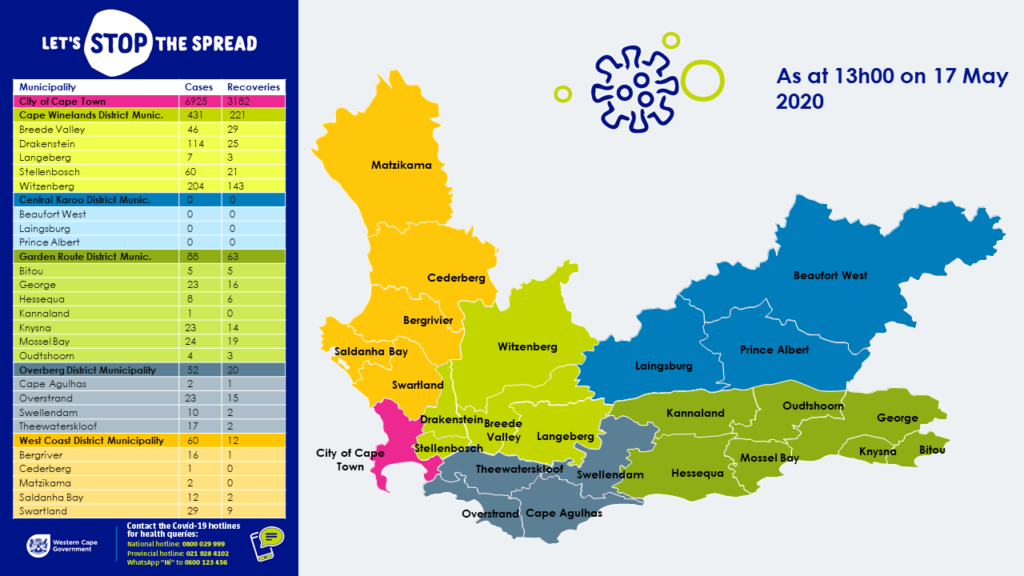
COVID-19: Western Cape Provincial Overview 9

27 May 2020

COVID-19: Western Cape Provincial Overview 9

Municipalities in the Western Cape continue to implement wide ranging steps to address the ongoing Covid-19 pandemic.

The Minister of Local Government, Environmental Affairs and Development Planning in the Western Cape, Anton Bredell, says the onset of winter further complicates the work being done and will bring additional challenges.

“Mass sanitising of public spaces is taking place on an ongoing basis, as is feeding schemes including soup kitchens, and all basic municipal services. Our emergency services and disaster centres remain fully operational and are on standby in the event of an emergency.”

Some of the latest efforts being done in some municipalities across the province includes:

  • Mossel Bay Municipality is supporting private initiatives in distributing donated cloth face masks made to fit young children and taxi passengers.
  • Cape Winelands District Municipality has partnered with Santam to develop Hotspot specific communication for the next 3 -6 months that will encompass various platforms. CWDM delivered 12 tons of agricultural produce to the local municipalities for distribution to the needy. This is the second distribution as a result of the partnership between, CWDM,  LG, Agri-Western Cape and Overberg District Municipality.
  • From 1 June 2020, the Drakenstein Municipality Traffic Department will open its doors for licence renewals and registrations. From 1 July 2020 onwards, the system will be open for new applications. During June, the Municipality will attend to the backlog that was created by the national lockdown.
  • Knysna Municipality has appointed a committee to consider ad hoc applications for payment relief received from local businesses and accommodation establishments in an effort to assist these entities during the ongoing crisis. Delaying rates and services charges as well as a possible reduction in municipal property rentals is also being considered.
  • As part of the West Coast District Municipality’s COVID-19 Mitigation Strategy the disinfection of public spaces continues which include National, Provincial and Private owned buildings in support of interventions already in place by the building occupants. WCDM Executive Mayor, Alderman Harold Cleophas, and Council approved a financial contribution of R250 000 (R50 000 per local municipality in the district) to be utilized for humanitarian aid by the local municipalities. WCDM has procured the necessary PPE as prescribed in the direction issued by the Minister of Employment and Labour for all personnel.

Bredell has urged all citizens with questions or concerns or who wish to make a contribution in the ongoing struggle to visit the provincial website: www.westerncape.gov.za/coronavirus or to get in touch with their local municipalities for assistance.

“In addition, if you have flu-like symptoms, and may have come into contact with someone who has COVID-19, please contact the provincial hotline on 021 928 4102 for advice on what to do next.”

ENDS.

Media enquiries:

James-Brent Styan

Spokesperson for the Minister of Local Government, Environmental Affairs and Development Planning, Anton Bredell

Mobile:  084 583 1670 / E-mail:  James-Brent.Styan@westerncape.gov.za

Media Release: Update on the coronavirus by Premier Alan Winde

26 May 2020

As of 1pm on 26 May, the Western Cape has 7555 active cases of Covid-19, with a total of 15 756 confirmed cases and 7844 recoveries.

Total confirmed COVID-19 cases 15756
Total recoveries 7844
Total deaths 357
Total active cases (currently infected patients) 7555
Total number of tests 128 558
Hospitalisations 665 of which 178 are in ICU or high care

Sub Districts Cape Town Metro:

Sub-district Cases Recoveries
Western 1640 882
Southern 1854 661
Northern 969 518
Tygerberg 2421 1405
Eastern 1375 782
Klipfontein 1934 902
Mitchells Plain 1550 779
Khayelitsha 2004 1231
Total 13 747 7160

Sub Districts Non-Metro:

District  Sub-district Cases Recoveries
Garden Route Bitou 14 6
Garden Route Knysna 45 20
Garden Route George 60 21
Garden Route Hessequa 12 9
Garden Route Kannaland 1 1
Garden Route Mossel Bay 30 22
Garden Route Oudtshoorn 9 3
Cape Winelands Stellenbosch 125 49
Cape Winelands Drakenstein 353 103
Cape Winelands Breede Valley 132 40
Cape Winelands Langeberg 11 4
Cape Winelands Witzenberg 230 190
Overberg Overstrand 33 19
Overberg Cape Agulhas 5 2
Overberg Swellendam 10 6
Overberg Theewaterskloof 40 10
West Coast Bergrivier 25 13
​West Coast ​Cederberg 2 0
West Coast Matzikama 2 0
West Coast Saldanha Bay Municipality 42 9
West Coast Swartland 48 23
Central Karoo Beaufort West 2 0

Unallocated: 778 (134 recovered)

Data notes:

Cases previously allocated to Mossel Bay, Oudtshoorn, Langeberg and Cederberg have been re-allocated due to address data being updated.

A third case has been allocated to Beaufort West which is reflected on the online dashboard today but is not reflected in this media release. A Beaufort West address was supplied, however, the contact tracing team has determined that the patient is in the Northern sub-district. The dashboard will update to reflect the change tomorrow. Beaufort West therefore currently has two confirmed cases and the northern sub-district has 969.

The Western Cape has recorded an additional 39 COVID-19 deaths-bringing the total number of deaths from the virus in the province to 357. We extend our condolences to their family and friends at this time.

Alert level 3:

Earlier today, National Health Minister Zweli Mkhize briefed the National Council of Provinces on the COVID-19 response. In his presentation, he indicated that some hotspots could remain on Alert Level 4 when the rest of the country moves to Alert Level 3 on 1 June.

I will seek clarity from the President on this matter as he was very clear in his address on Sunday that the whole country would move to level 3, with the hotspots being re-evaluated every two weeks.

The province has not received any direct indication from national government that this was not the case.

In any province, it would be very difficult to enforce some areas remaining on level 4, while others drop down to level 3. In the Western Cape for instance, neighbouring towns could find themselves in different alert levels, complicating matters for people commuting for work. It could also result in people breaking the rules to go to areas where the alert level is lower. It would require significant policing resources to enforce, and this should rather be used on ensuring physical distancing and implementing the response strategy in specific hotspots.

For the Western Cape, remaining on alert level four in the Cape Town Metro and other identified districts such as the Cape Winelands, West Coast District and Overberg District, will further exacerbate the economic and humanitarian disaster that has resulted from the lockdown. Already, we anticipate the province will see over 200 000 job losses as a result of the lockdown, and any further delays in easing the levels will result in more people losing their jobs and an even greater need for humanitarian relief. This should be taken seriously because it will cost lives in the future too.

That is why we support the President’s decision on Sunday that the entire country move to level 3, in conjunction with the targeted hotspot strategy. This is what we presented to both the President and Minister Mkhize, and we look forward to working with all levels of government in implementing it.

Chronic medication supply:

The Western Cape Department of Health, has since the lockdown was first instituted, been delivering medication to vulnerable, chronic patients at their homes. So far, over 132 000 chronic medicine parcels have been delivered by community health workers across the province, in a partnership with Uber.

This was part of our strategy to ensure that people, especially those with underlying illnesses, are able to stay at home, while at the same time, reducing the number of people visiting our healthcare facilities to allow for social distancing.

A further 278 282 patient medicine parcels were also issued by the Chronic Dispensary Unit, which are pre-packed, and delivered to facilities and alternate collection sites for collection on a scheduled date.

Our focus in the healthcare space is on protecting the vulnerable such as the elderly and those with underlying conditions. By ensuring that a large number of these people do not need to go out to collect medication at a healthcare facility on a monthly basis, we are able to reduce their risk of becoming infected.

Media Release: Welcoming Alert Level 3 and opening of the construction sector to save jobs

MEDIA RELEASE BY DAVID MAYNIER

WESTERN CAPE MINISTER OF FINANCE AND ECONOMIC OPPORTUNITIES

Date: 25 May 2020

Release: immediately

Welcoming Alert Level 3 and opening of the construction sector to save jobs

We welcome the announcement by President Cyril Ramaphosa last night that the whole of South Africa will be moving to Alert Level 3 from 1 June 2020, and that all economic activity will resume except for certain sectors.

We are particularly glad to hear that the construction sector will be allowed to resume activity under Alert Level 3 as this is critical to saving jobs and the economy in the Western Cape. This sector is already under enormous strain and an estimated 100,000 direct and indirect jobs could be lost due to the impact of Covid-19. And so, we will be working closely with the sector to help them implement the necessary health and safety measures on construction sites ahead of Alert Level 3.

More details on which sectors will not be allowed to open are likely to be confirmed with the release of the Alert Level 3 regulations by the Minister of Cooperative Governance and Traditional affairs, Nkosazana Dlamini-Zuma. As we have with the Alert Level 4 regulations, and in particular for the e-commerce and construction sectors, where we think that further consideration can be made for these sectors to safely open we will make further submissions to national government to do so.

We remain concerned about the tourism sector which is a major contributor to jobs and the economy in the Western Cape, and at present is only looking likely to open under Alert Level 2. This sector has already been hard-hit and could cost the Western Cape around 104 504 direct and indirect jobs in 2020. And so, where we think there are opportunities for tourism to open up safely and responsibly under Alert Level 3 we will request that national government allow this.

We firmly believe that if done responsibly, the economy in the Western Cape can open up while preventing the spread of Covid-19, and we are committed to supporting businesses through this crisis.

To avoid a return to a hard lockdown, it is imperative that every business that is operating now, or which opens under the new alert level, plays by the rules, and implements the necessary health and safety measures as instructed by national government to avoid further negative impacts on their respective sector.

It is just as important that every person returning to the workplace always adheres to the safety guidelines that are put in place by their employer, even when taking a break in a communal area.

If any employee feels that their employer is not following the health guidelines in place to stop the spread of Covid-19, they can report it using this online form: coronavirus.westerncape.gov.za/covid-19-business-safety-complaint-form

Every employer and employee has a responsibility to ensure that our economy stays open in the Western Cape.

We all need to stay safe in order to save jobs.

We will all have to pull together, and we will all have to work together, in the coming days, and weeks, and months because, in the end, it is up to all of us to stop the spread of Covid-19 in the Western Cape.

Notes for media: 

Media Queries:

Francine Higham

Spokesperson for the Provincial Minister of Finance and Economic Opportunities

(Responsible for the Provincial Treasury and the Department of Economic Development and Tourism)

Cell: 071 087 5150 / Email: francine.higham@westerncape.gov.za

Dam levels and Weather update in the Western Cape

25 May 2020

The first cold front for the winter made landfall early this morning in Cape Town. It has brought stormy, cold and wet weather reinforced by gale force winds across large parts of the province. The South African Weather Services has advised that the conditions can be expected into the rest of the week with snowfall expected in the mountain passes in the province.

Anton Bredell, the minister of Local Government, Environmental Affairs and Development Planning in the Western Cape, has urged the public to use caution when traveling outdoors over the next few days.

“We’re happy to see some wet weather in the Western Cape because it means our dam levels will get a much needed boost. At the moment the dam levels across the province are 35.1%. Last year at this time the level was 33.5%. We hope to see more rainfall especially in our Karoo and Upper West Coast regions. At the same time, the rain comes with very cold weather and that brings new challenges for the public as well as the emergency services.”

Provincial as well as Municipal Disaster Management Centres are already activated for the ongoing COVID-19 situation and remain fully operational and able to assist with any emergency.

“The easiest number to remember to call in an emergency is 112. This number can be dialled toll-free from any cell phone.”

Major Dam statistics

Voëlvlei dam – 49.9% full this week (2019: 55.5%. Last week: 50.5%)

Bergriver Dam 64.2% full this week (2019: 70%. Last week: 64.8%).

Theewaterskloof dam – 49.5% full this week (2019: 35.5%. Last week: 49.9%)

Clanwilliam Dam 5.2%. (2019: 9.5%. Last week: 5.2%)

Media Release: Update on the coronavirus by Premier Alan Winde – 400% increase in tests since 25 April, but national backlog is growing

25 May 2020

As of 1pm on 25 May, the Western Cape has 7439 active cases of Covid-19, with a total of 14 978 confirmed cases and 7221 recoveries.

Total confirmed COVID-19 cases 14978
Total recoveries 7221
Total deaths 318
Total active cases (currently infected patients) 7439
Total number of tests 124079
Hospitalisations 554 of which 139 are in ICU or high care

Sub Districts Cape Town Metro:

Sub-district Cases Recoveries
Western 1581 833
Southern 1771 615
Northern 934 479
Tygerberg 2311 1293
Eastern 1314 725
Klipfontein 1858 822
Mitchells Plain 1478 727
Khayelitsha 1940 1147
Total 13187 6641

Sub-districts:

District  Sub-district Cases Recoveries
Garden Route Bitou 14 6
Garden Route Knysna 45 17
Garden Route George 55 20
Garden Route Hessequa 12 9
Garden Route Kannaland 1 1
Garden Route Mossel Bay 31 20
Garden Route Oudtshoorn 10 3
Cape Winelands Stellenbosch 111 45
Cape Winelands Drakenstein 312 93
Cape Winelands Breede Valley 124 39
Cape Winelands Langeberg 12 3
Cape Winelands Witzenberg 224 185
Overberg Overstrand 33 20
Overberg Cape Agulhas 5 2
Overberg Swellendam 10 7
Overberg Theewaterskloof 40 9
West Coast Bergrivier 20 8
​West Coast ​Cederberg 3 0
West Coast Matzikama 2 0
West Coast Saldanha Bay Municipality 40 5
West Coast Swartland 47 19
Central Karoo Beaufort West                                       2 0

Unallocated: 638 (69 recovered)

Additional data can be found on the dashboard at www.westerncape.gov.za/coronavirus.

The Western Cape has recorded an additional 18 COVID-19 deaths-bringing the total number of deaths from the virus in the province to 318. We extend our condolences to the family and friends of the deceased at this time.

Testing backlogs:

A total of 124 079 tests have been completed in the Western Cape- representing a 400% increase in the number of tests conducted in the province since 25 April. This increase in testing in the Western Cape and in other provinces has resulted in a considerable backlog in the processing of these tests and in the release of their results by the National Health Laboratory Services.

The NHLS is a national entity, and the Western Cape has previously written to both President Cyril Ramaphosa and Health Minister Dr Zweli Mkhize regarding the backlogs which are creating considerable delays in people receiving their test results back. During his recent visit to the Western Cape, Minister Mkhize indicated that the delays were due to shortages of reagents and test kits which are being experienced world-wide.

The backlog in the Western Cape has now grown to approximately 18 000 tests.

In the absence of a rapid-test solution, the decision is to prioritise healthcare workers, those in hospital and those at high risk including the elderly and those with underlying conditions in order to ensure the most efficient way of managing the curve of the disease in this phase of community transmission.

We once again call on both the President and Minister Mkhize to move as quickly as possible to ensure that the NHLS is provided with the resources it so urgently requires and that testing across the country can continue unhindered.

Alert level 3:

Today marks one week until the entire country will move to Alert Level 3. This will be done in conjunction with our targeted hotspot plan.

We welcome this move which will allow many more people to be able to put food on the table. We are facing a very serious humanitarian crisis, which must be averted if we are to save lives in the future too.

But we must be absolutely clear- this does not mean life must go back to normal. It will not be business as usual in the Western Cape.  We will all need to work much harder to protect ourselves and to protect our loved ones.

For those businesses that will be re-opening, it is up to you to ensure the safety of your staff and of your customers. Use the next week to prepare your plans and ensure that everything is in place so that there is social distancing in place at all times, hygiene measures and cleaning routines are in place and risks are removed. Businesses can find a list of workplace protocols and sector specific steps here (LINK)

There is also greater responsibility on every single person returning to work next week. Make sure that you are washing your hands regularly, that you are wearing your mask and that there is always distance between you and other people. You must stay home if you feel ill so that you don’t make others around you ill. Please also remember that if you have any difficulty breathing, you must seek urgent healthcare.

The Western Cape Government is working around the clock to make sure that all our healthcare responses are in place, and that our hotspot plan is being efficiently and effectively executed. But we cannot fight this Covid-19 pandemic alone. We need everyone to help us by taking responsibility for themselves, and for their loved ones, so that we can protect the vulnerable from infection.

We have not yet reached the peak yet, and the situation is going to get worse before it gets better. So please keep safe, keep your loved ones safe, and save lives.

Donations for healthcare workers:

Today, Minister of Cultural Affairs and Sport, Anroux Marais, Health Minister Nomafrench Mbombo and I received a donation of over 2700 pairs of shoes and warm tops from Adidas, which will be distributed to healthcare workers in Cape Town, Gauteng and Kwa Zulu Natal.

Healthcare workers are at the frontline of our response to COVID-19 and comfortable shoes are important as they spend long hours on their feet. With winter weather starting to descend on the Western Cape, warm tops for our health-workers working early morning or late-night shifts, will be most welcome. We extend our gratitude to Adidas for their generous donation.

I would also like to thank all of those individuals, businesses and organisations who have stepped up to help us in the response to this pandemic. Whether it is through donations for our healthcare workers, providing meals for the hungry or volunteering time to make a difference at a time when many are experiencing difficulty, your assistance and your kindness are deeply valued.

Media Release: Premier Winde welcomes move to Alert Level 3 in conjunction with targeted hotspot plan

24 May 2020

The Western Cape Government welcomes the announcement by President Cyril Ramaphosa that the entire country will move to Alert Level 3, in conjunction with the targeted hotspot plan.

This targeted hotspot plan will utilise our combined government resources to slow the spread of the virus, to protect vulnerable people, and to save lives. We look forward to working with all levels of government in implementing this plan.

We are facing a very serious situation in the Western Cape and the rest of South Africa. The lockdown did not stop the virus, it only bought us time. It will continue to spread, and more and more people will be infected over the coming weeks.

To put it simply: things are going to get worse before they get better. We cannot let our foot off the pedal now, and in fact, we must work harder than ever before to slow the spread of this virus.

That is why it will not be business as usual in the Western Cape. We must all change our behaviour to keep safe and to save lives.

Every single one of us has a role to play in doing this. When you keep yourself safe – by wearing a cloth mask when in public, by keeping your distance, by following the golden rules of hygiene and by staying home as much as possible – you keep your loved ones safe too.

While most people will recover after being infected, some of the people we love the most, who might be older or have an underlying health condition, may not. We must change the way we live so that they are protected too.

I know that if we all work together in this way, with this common goal, we can get through this difficult time for our province and country. The responsibility on all of us has never been greater. So please keep safe and help us save lives.

[ENDS]

The details of the Western Cape’s targeted hotspot plan can be viewed here:  https://coronavirus.westerncape.gov.za/news/western-cape-s-whole-government-targeted-hotspot-plan-we-need-save-lives-present-and-future

The details of how the Western Cape’s health response has been adapted to protect high risk and vulnerable people can be viewed here: https://coronavirus.westerncape.gov.za/news/our-priority-protect-vulnerable-and-those-high-risk-our-curve-rises

The interventions taken by the Western Cape Government to prepare the province for the peak of infections can be found here: https://coronavirus.westerncape.gov.za/news/western-cape-has-prepared-its-healthcare-system-peak-and-must-move-level-3-conjunction-targeted

The details of how the Western Cape Government is working with business to ensure they open safely and responsibly: https://coronavirus.westerncape.gov.za/news/helping-businesses-open-safely-and-responsibly

Severe Weather Alert

The South African Weather Services has issued the following severe weather alert:

Hazard: Storm surges
Alert Level: Warning
Valid From (SAST): 25/05/20 10h00
Valid To (SAST): 26/05/20 00h00

Storm surge is expected along the south coast, between Cape Agulhas and Plettenberg Bay as well as in the False Bay region tomorrow (25/05/2020).

Description: Storm surges

Generally storm surges are a result of strong winds blowing over a large area called a fetch combined with low pressure systems. Dangerous waves or surges may also be caused by storms and/or tsunami’s resulting in widespread coastal damage and loss of life.

Precautions: Storm surges

All recreational beach activities should be suspended. People with beach side properties should be aware of the possibility of being flooded by a rise in sea level and wave surges that could cause damage to their property.

If possible relocate valuable assets to higher ground and be vigilant especially during high tide. If the surge is associated with a Spring High Tide then significant inundation is possible and one should be aware of the times of occurrence of the High tide.

Listen to the radio or TV for warnings and obey the instructions from disaster management officers.

Description: Storm surges / High Seas

Generally heavy seas or damaging waves are a result of strong winds blowing over a large area called a fetch combined with low pressure systems. Long period swells are often very dangerous to tankers as they may literally snap them in half. Dangerous waves or surges may also be caused by storm surges and tsunami’s resulting in widespread coastal damage and loss of life.

In oceanography, a sea state is the general condition of the free surface on a large body of water—with respect to wind waves and swell—at a certain location and moment. A sea state is characterized by statistics, including the wave height, period, and power spectrum. The sea state varies with time, as the wind conditions or swell conditions change.

Precautions: Storm surges / High Seas

Ships should “idle” into the swell and wind so that the bow of the ship always faces the oncoming swell. If in a small sailing vessel reduce the sail area and steer into the oncoming swell. If along the shore-line stay well back from the highest high water mark as Secure all hatches, doors, windows and ports. Secure all loose items in the interior.
Pump the bilge’s dry and keep pumping them dry at regular intervals. Stow away all loose gear and lash down any large items that cannot be stowed. Break out your life preservers and inform your crew that everyone will be putting them on well in advance of their necessity.
Break out emergency gear like flares and first aid kit, sea anchor, safety harnesses, etc.
Check your position and update your course as plotted on your chart. Prepare alternative routes to more protected areas. If you think you will be in for relatively long haul prepare some hot soup, coffee or stew freak waves may run up beyond the normal high water mark.

If the sea recedes exposing rock and sea bed normally not exposed immediately seek higher ground at least 50m above your current position. Do not try swimming or fishing or other marine recreation during these events. Only extremely experienced surfers will temp their fate under these conditions.

Listen to the radio or TV for warnings and obey the instructions from disaster management officers.

Media Release: Update on the coronavirus by Premier Alan Winde

24 May 2020

As of 1pm on 24 May, the Western Cape has 6719 active cases of Covid-19, with a total of 13 696 confirmed cases and 6950 recoveries.

Total confirmed COVID-19 cases 13969
Total recoveries 6950
Total deaths 300
Total active cases (currently infected patients) 6719
Total number of tests 121072
Hospitalisations 569 of which 151 are in ICU or high care

Sub Districts Cape Town Metro:

Sub-district Cases Recoveries
Western 1479 802
Southern 1538 583
Northern 869 453
Tygerberg 2196 1246
Eastern 1239 709
Klipfontein 1709 772
Mitchells Plain 1365 707
Khayelitsha 1853 1122
Total 12248 6394

Sub Districts Non-Metro:

District  Sub-district Cases Recoveries
Garden Route Bitou 14 6
Garden Route Knysna 38 17
Garden Route George 47 18
Garden Route Hessequa 10 7
Garden Route Kannaland 1 1
Garden Route Mossel Bay 31 19
Garden Route Oudtshoorn 9 4
Cape Winelands Stellenbosch 98 41
Cape Winelands Drakenstein 282 89
Cape Winelands Breede Valley 111 38
Cape Winelands Langeberg 10 3
Cape Winelands Witzenberg 221 184
Overberg Overstrand 30 18
Overberg Cape Agulhas 5 2
Overberg Swellendam 9 6
Overberg Theewaterskloof 31 8
West Coast Bergrivier 20 8
​West Coast ​Cederberg 2 0
West Coast Matzikama 2 0
West Coast Saldanha Bay Municipality 36 5
West Coast Swartland
 46  19
Central Karoo Beaufort West 1 0

Unallocated: 667 (63 recovered).

Additional data can be accessed on the dashboard at www.westerncape.gov.za/coronavirus

The Western Cape has recorded an additional 24 COVID-19 deaths-bringing the total number of deaths from the virus in the province to 300. We extend our condolences to the family and friends of the deceased at this time.

President Ramaphosa’s address:

President Cyril Ramaphosa is expected to address the nation this evening where we hope he will announce a move to alert level three for the whole country. During the most recent President’s Coordinating Council meeting, the Western Cape presented on its hotspot strategy, which is focused on limiting the number of new infections in the areas where infections are highest, and responding to the impact of the coronavirus and the national lockdown through an all of government, data driven approach. Our health response includes identifying those most at risk, including healthcare workers, and repurposes our community screening and testing efforts to make sure that more can be done quicker, to save lives.

This targeted approach, which enables more of the economy to open up while intervening rigorously in hotspots to slow the virus, also takes into consideration the very severe humanitarian crisis which is unfolding in South Africa today. This cannot be ignored. It will impact the lives of the most vulnerable in our communities who will no longer be able to put food on the table. We must do everything we can to save lives now, and we must do it in a way that also saves lives in the future. This must be based on the best available scientific advice at all times. This has been the Western Cape Government’s position.

Recoveries:

The Western Cape continues to record recoveries across the province, now approaching 7000.

In Witzenberg, where our targeted hotspot plan was first piloted, over 80% of the total number of COVID-19 positive patients, have now recovered. In Khayelitsha, 60% of the total case load to date has recovered, and in the Tygerberg region, 56% of the total number of cases have already recovered.

The role of citizens:

We are working around the clock to make sure that we can provide care to every person who needs it. But we simply cannot do it alone. We need every single person to help us slow the spread, and in doing so, to save lives.

While you may not get seriously ill, those who are older, and those with underlying health conditions are at great risk. When you protect yourself, you protect these vulnerable groups too.

How can you help?

  • If you are sick, stay home and first call our hotline for advice. If you are battling to breath, seek urgent healthcare.
  • Stay home as much as possible.
  • Follow the golden rules of hygiene at all times, including regularly washing your hands and coughing into a tissue or the corner of your arm.
  • Always wear a clean cloth mask when you go out in public. A mask alone will not protect you so always follow the golden rules of good hygiene too.
  • Avoid all gatherings of people – this is where the virus spreads.
  • Keep your distance from others – at least 1.5 metres. It is completely respectful and polite to tell someone to keep their distance if they are standing too close to you.If we all act in this way, we can interrupt the chain of transmission, slow the spread of the virus, and protect those we love. This is how we can all contribute to saving lives.

Cuban doctors:
Today, Western Cape Health Minister Nomafrench Mbombo and the HOD for the Department of Health, Dr Keith Cloete welcomed a cohort of Cuban doctors to the Western Cape. They form part of a group of over 200 doctors and medical specialists who came to South Africa from Cuba to assist in the response to COVID-19 as part of an agreement between Cuba, and the national Department of Health. We wish them well during their stay in the province. They will join the thousands of dedicated and skilled doctors, nurses and healthcare workers already working on the frontline response to the pandemic in the province. The province has also issued a call for people with medical experience to volunteer, and has received over 1000 applications. We will be calling on them to bolster our healthcare response as needed over the coming weeks and months.

24 May 2020 Western Cape – Severe Weather Alert

24 May 2020

Western Cape – Severe Weather Alert

The Western Cape Disaster Management Centre has been alerted by the South African Weather Service that severe adverse weather conditions are expected across large parts of the Western Cape starting late this evening.

Members of the public are advised that heavy rain and localised flooding can be expected in the following regions:

–  The City of Cape Town,

–  Overberg

–  Cape Winelands

In addition the SAWS has advised that disruptive snowfalls leading to temporary closure of mountain passes can be expected in the Cape Winelands District on Monday evening, spreading to the Little Karoo mountains overnight into Tuesday.

The Minister of Local Government, Environmental Affairs and Development Planning, Anton Bredell says the predictions indicate that winter has arrived in the Western Cape.

“While we welcome the wet weather given our drought situation, the concern is that the conditions may cause further challenges during this time of lockdown. We want to urge the public to take extra precautions and to contact the emergency services in the event of any emergency.”

The SAWS further predicts gale force winds and high seas with wave heights up to 9m between Cape Columbine and Plettenberg Bay from Monday morning, subsiding by early Tuesday morning. The winds are expected to move into the Central Karoo region by Tuesday.

“Provincial as well as Municipal Disaster Management Centres are already activated for the ongoing COVID-19 situation and will remain fully operational. The easiest number to remember to call in an emergency is 112. This number can be dialled toll-free from any cell phone. We are also calling on communities to cooperate with local authorities and emergency response personnel in the event of any emergency.”

In case of emergency other relevant numbers to call are:

Cape Winelands Municipality                               021 888 5837

Garden Route District:                                            044 805 5071

Central Karoo:                                                          023 414 2603

West Coast:                                                               022 433 8700

Overberg:                                                                 028 271 8111

City of Cape Town:                                                 107 landline or 021 480 7700

Flooding related Tip Sheet

How Can I Prepare for a Flood?

–  Identify the risk in your local area.

–  Prepare a home emergency plan, and identify risks around your home.

–  Remove leaves (from downpipes or gutters) or any other items that can increase the risk of flooding in your area.

–  Have an evacuation plan. Everyone in your family has to know where to go to find shelter.

–  Prepare an emergency toolkit. This should include a first aid kit, torch and portable radio with batteries, candles and waterproof matches, drinking water, a multi-tool, whistle and emergency contact numbers.

What Should I do during a flooding?

–  Monitor current flood warnings. Listen to the radio for emergency warnings, evacuation advice and weather updates.

–  Avoid entering floodwater unless it is necessary, and never underestimate the strength of floodwater, even if you are inside a vehicle.

–   Follow all instructions from emergency authorities.

–  Turn off all electricity and water and take your cellphone with you.

–  Assist elderly and disabled neighbours.

What Should I do after the flood?

–  Before entering your house, wait until the water has dropped below floor level.

–  Check with electricity and water authorities to know whether it is safe for you to use these resources.

–  Be aware of contamination if water sources have been flooded; this could be unsafe to drink.

Further tips provided by the SAWS:

–  (When moving around outdoors) dress in warm brightly coloured wet weather clothing.

–  If caught unawares by strong wind, barricade windows with wooded panels or strips (or furniture if needs be).

–  If ordered to evacuate do so immediately and in an orderly fashion. Listen to the radio or TV for warnings and obey the instructions from disaster management officers.

ENDS.

Media enquiries:

James-Brent Styan

Spokesperson for the Minister of Local Government, Environmental Affairs and Development Planning, Anton Bredell

Mobile:  084 583 1670 / Telephone: 021 483 2820 / E-mail:  James-Brent.Styan@westerncape.gov.za

MEDIA ALERT: MINISTER SIMMERS TO CONDUCT OVERSIGHT VISIT AT GRABOUW’S ROOIDAKKE DEVELOPMENT

24 May 2020

Tomorrow, 25 May 2020, Western Cape Human Settlements Minister Tertuis Simmers will visit the construction site of the Rooidake Housing project in Grabouw.

Minister Simmers said: “Since the alert levels of the disaster declaration as instituted by President Cyril Ramaphosa have been relaxed from level 5 to 4 and “critical public works construction,” which includes public human settlements development projects, have been allowed to recommence, we have to ensure that contractors comply with all the health and safety protocols.

My department has issued a directive to contractors and part of my visit is to ensure these are being adhered to.

I also need to establish which final touches are required on the houses, as they are due to be handed over by 7 June.

ALL MEDIA ARE INVITED TO ATTEND. Please note the meeting point from which we will depart at 09:50 to the project site

Details:

Date: Monday, 25 May 2020

Time: 09h45 – 11h00

Meeting Point: Grabouw Municipal Office, 1 Abor Drive, Grabouw (Just behind the hospital)

Media Enquiries:

Marcellino Martin

Spokesperson for Minister Tertuis Simmers

Tel: 021 483 3397 / Mobile: 082 721 3362 / Email: Marcellino.martin@westerncape.gov.za

or

Nathan Adriaanse

Director Communication & Stakeholder Relations

Tell: 021 483 2868 / Mobile: 083 2631720 / Email: Nathan.Adriaanse@westerncape.gov.za