Skip to content Skip to left sidebar Skip to footer

Author: Marlene Nqumse

8 July 2020 Media Release: Western Cape Premier Alan Winde has tested positive for Covid-19, has mildflu-like symptoms, and is in self-isolation at home


8 July 2020

I received a positive test result for Covid-19 this morning, and I am in self-isolation at home for 14 days.

On Sunday, I started to develop mild flu-like symptoms. As I am Diabetic (type 2) and over 55 years of age, I know I am at a higher risk of developing a more serious illness. I, therefore, went to be tested to determine the cause of the symptoms on Monday.

I have stayed at home as soon as I started feeling sick and can confirm that I am only experiencing mild symptoms. It feels like I have a cold.

However, given my risk category I will be carefully monitoring my health to make sure that any change is picked up quickly.

I will still be taking all meetings to coordinate our Covid-19 response in the Western Cape. The Western Cape has been working around the clock to ready our healthcare system for the increase in cases expected over this time, and we will not let our foot off the pedal. The fight continues.

Based on medical advice, I am also contacting my previous contacts from three days prior to my first symptoms. This is an important responsibility that we must all undertake when we test positive. ‘Close contacts’ must self-quarantine. This means that you must stay at home and not come into contact with other people.

Tomorrow, I will host my weekly Digital Press Conference (“DigiCon”) and will be available to answer more questions from members of the press. You can also watch this live on my social media channels. I will also use the opportunity to share medical expertise on Diabetes as a high-risk category during Covid-19. As I am Diabetic, this is something very close to my heart.

I also look forward to meeting with President Ramaphosa online during the scheduled President’s Coordinating Council meeting on Thursday afternoon, and will be chairing our second cabinet meeting of the week on Friday morning, which takes place on MS Teams.

My message to the people of the Western Cape at this time is to take Covid-19 seriously. Anyone can get it. So, please keep yourself safe, and your loved ones safe. Follow the 5 golden rules at all times, including wearing a cloth mask, cleaning surfaces regularly and washing or sanitizing your hands often. And, please be kind, and compassionate at all times.

To those residents who have also tested positive for Covid-19, I wish you strength and speedy recovery. This is a difficult time for all of you and your families, and I want you to know that the Western Cape Government is doing everything it can to make sure we beat this pandemic.

8 July 2020 Western Cape Severe Weather Alerts : Veld Fire Conditions/ High Seas/ Damaging Winds

The Cape Town Weather Office has issued the following severe weather alerts:

HAZARD: Veld Fire Conditions
Alert Level: Warning
Valid From (SAST): 08/07/20 – 09h00
Valid To (SAST): 09/07/20 – 18h00

Are expected over Beaufort West (W.Cape) today (08/07/2020), including eastern parts of Cape Winelands and Overberg as well as Central Karoo and Garden Route Districts (W.Cape) tomorrow (09/07/2020).

HAZARD: High Seas
Alert Level: Watch
Valid From (SAST): 09/07/20 – 12h00
Valid To (SAST): 11/07/20 – 00h00

With wave heights from 6m to 7m are expected between Lambert’s Bay and Cape Agulhas on Thursday afternoon into the evening (09/07/2020), but again between Cape Point and Alexander Bay Friday afternoon into Saturday morning (09-11/07/2020), spreading to Plettenberg Bay by the afternoon, subsiding by the evening.

HAZARD: Damaging Winds
Alert Level: Watch
Valid From (SAST): 09/07/20 – 00h00
Valid To (SAST): 12/07/20 – 00h00

1. Gale to strong gale force north-westerly winds (70-100km/h) are expected over Western Cape interior including the Cape Metropole on Thursday but (65-75km/h) over Central Karoo and northern parts of the West Coast Districts (W/Cape) on Friday (09-10/07/2020).

2. Gale to strong gale force north-westerly winds (70-100km/h) are expected along the coastal areas between Cape Columbine and Cape Agulhas on Thursday into Friday morning, but north-westerly to westerly (65-75km/h) between Cape Columbine and Alexander Bay from Thursday late afternoon and Friday (09-10/07/2020). It will become south-westerly winds (70-100km/h) along the coastal areas between Lambert’s Bay and Plettenberg Bay on Saturday (11/07/2020) morning, moderating by the afternoon.

7 July 2020 Media Release: Update on the coronavirus by Premier Alan Winde

Media Release: Update on the coronavirus by Premier Alan Winde

For Immediate Release
7 July 2020

Total confirmed Covid-19 cases 71 272
Total recoveries 52 175
Total deaths 2 139
Total active cases (currently infected patients) 16 958
Tests conducted 331 377
Hospitalisations 1 735 with 315 in ICU or high care
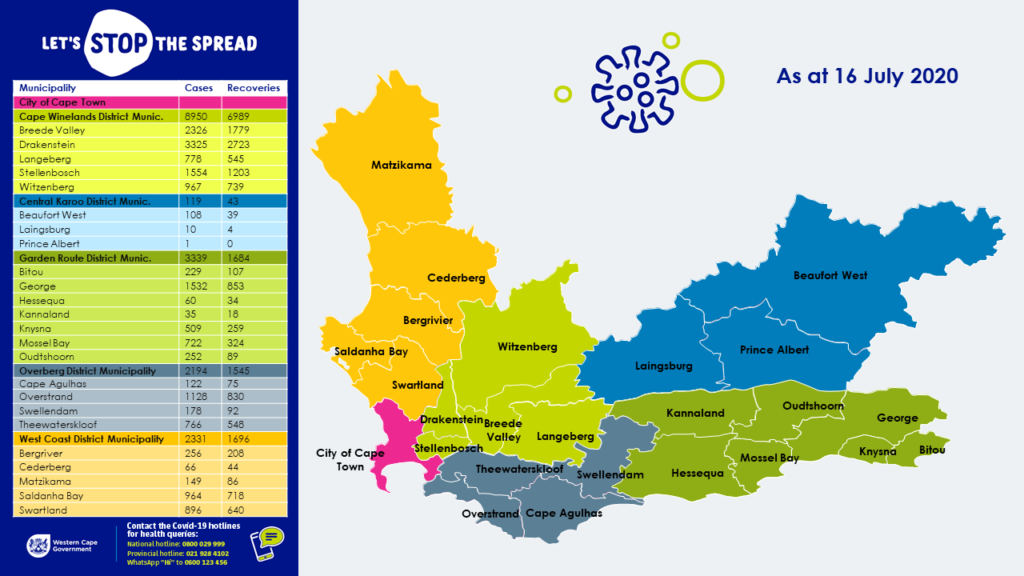
Municipality Cases Recoveries
City of Cape Town  52 085  40 811
Cape Winelands District Municipality  7 511  5 159
Central Karoo District Municipality  54  15
Garden Route District Municipality 1 984 761
Overberg District Municipality  1 602  886
West Coast District Municipality  1 866 1 211
Unallocated  6 170 3 332
Total 71 272 52 175

 Sub Districts Cape Town Metro:

Sub-districts Cases Recoveries
Western  6 030  4 646
Southern  6 305  4 835
Klipfontein  6 976  5 370
Mitchells Plain  5 840  4 564
Tygerberg  9 077  7 149
Khayelitsha 6 982  5 862
Eastern 6 618 4 992
Northern 4 257 3 393

Sub Districts Non-Metro:

Municipality Cases Recoveries
City of Cape Town 52 085 40 811
Cape Winelands District Municipality 7 511 5 159
Breede Valley 1 903 1 215
Drakenstein 2 938 2 186
Langeberg 616 348
Stellenbosch 1 269 840
Witzenberg 785 570
Central Karoo District Municipality 54 15
Beaufort West 49 14
Laingsburg 5 1
Prince Albert 0 0
Garden Route District Municipality 1 984 761
Bitou 122 38
George 971 398
Hessequa 34 18
Kannaland 20 10
Knysna 296 128
Mossel Bay 387 129
Oudtshoorn 154 40
Overberg District Municipality 1 602 886
Cape Agulhas 71 37
Overstrand 846 477
Swellendam 105 39
Theewaterskloof 580 333
West Coast District Municipality 1 866 1 211
Bergriver 224 175
Cederberg 61 32
Matzikama 103 44
Saldanha Bay 771 499
Swartland 707 461
Unallocated 6 170 3 332

Data note:  As the province moves closer to the peak and the Department of Health is recording over 1000 new cases daily, it is not possible to check and verify that the address data supplied for each new case is correct, within the time frames required to provide regular and timely updates. This means that in some instances, cases could be allocated to the wrong sub-districts. We are working with the sub-districts to clean and verify the data and where errors are picked up locally, cases will be re-allocated to the correct areas.

More data is available here: https://coronavirus.westerncape.gov.za/covid-19-dashboard

The Western Cape has recorded an additional 40 deaths, bringing the total number of Covid-19 related deaths in the province to 2139. We send our condolences to their loved ones at this time.

Return to school:

Yesterday, Grades R, 6 and 11 returned to school in line with the national Department of Basic Education’s planning.

We understand that for many parents and learners, this is a daunting time and we understand that there is an element of fear and concern. The Western Cape Education Department (WCED) has put in place a number of safety measures to ensure that learners are able to return as safely as possible and that teachers and school staff are safe.

The WCED has spent R450 million so far on cleaning materials, soaps, sanitizers and masks to prepare schools for the phased return of learners to schools, and developed a comprehensive set of guidelines including on how to manage positive cases at schools.

For many learners, the return to school creates a safe space. It also allows for learners to access the school feeding scheme which provides them with nutritious meals that they may not be able to access at home. Most importantly however, those who are most affected by the closure of schools are our poorer learners who may not have access to e-learning resources at homes and those who have parents working on the front line, who cannot home school their children at this time.

We encourage parents to have age-appropriate conversations with their children at this time, to understand their anxiety and to equip them with the knowledge and tools to keep themselves safe, both at the school and elsewhere outside of the home.

Those parents who have concerns about sending their child to school can apply for an exemption. This however requires parents to take responsibility to oversee their child’s learning at home and to collect and drop off the child’s work at the school. Application to do so can be done through the school.

Surface cleaning:

Coronavirus spreads through respiratory droplets. These droplets can be spread through sneezing and coughing, but also by touching our faces and then touching surfaces.

This is why it is important that we make a conscious effort to not touch our faces.

Regularly wash or sanitize our hands and clean surfaces which we touch regularly, in our homes and in workplaces.

Virus droplets can adhere to surfaces like door handles, light switches, counters, desks and basins.

It is therefore important that these surfaces are regularly cleaned, either with soap and water, or bleach and water to kill the virus droplets.

It is also important that we wash or sanitize our hands after touching surfaces in high traffic areas like on public transport or in public transport interchanges, supermarkets, elevator buttons, escalators, and shared spaces in offices and workplaces. Phones and electronic devices which we touch frequently should also be cleaned regularly.

Regular cleaning of surfaces becomes even more important when you are self-quarantining or self-isolating in a home that you share with other people. People who are Covid-19 positive, or experiencing symptoms should clean surfaces in shared areas like bathrooms and kitchens, as well as frequently touched surfaces in order to protect those living with them.

If this is not possible, quarantine and isolation facilities are available in the province, where those who are Covid-19 positive, or who need to quarantine, can safely and comfortably do so. These can be accessed by contacting our hotline on 021 928 4102.

6 July 2020 Media Release: Update on the coronavirus by Premier Alan Winde

Total confirmed Covid-19 cases 69 982
Total recoveries 50 271
Total deaths 2 099
Total active cases (currently infected patients) 17 612
Tests conducted 327 938
Hospitalisations 1 837 with 310  in ICU or high care

Unallocated: 10 842 (4 272 recovered)

Data note:  Due to a problem with the script on our data dashboard, new cases have not allocated to their respective sub-districts and have updated in the “unallocated” category. We have therefore not updated the sub-district data today. We are working to fix the problem and will update these statistics once the problem has been rectified.

As the province moves closer to the peak and the Department of Health is recording over 1000 new cases daily, it is not possible to check and verify that the address data supplied for each new case is correct, within the time frames required to provide regular and timely updates. This means that in some instances, cases could be allocated to the wrong sub-districts. We are working with the sub-districts to clean and verify the data and where errors are picked up locally, cases will be re-allocated to the correct areas.

More data is available here: https://coronavirus.westerncape.gov.za/covid-19-dashboard

The Western Cape has recorded an additional 47 deaths, bringing the total number of Covid-19 related deaths in the province to 2099. We send our condolences to their families and friends at this time.

ECDs:

We have noted the judgement in the North Gauteng High Court, ruling that private early childhood development centres and pre-schools may re-open.

This has been a matter of much concern for many parents in the Western Cape, who need a safe place for their children while they are at work.

While we await further directions from the national Department of Social Development, I call on all ECDs and pre-schools that do intend to open, to start putting all the measures in place for their safe re-opening. It is imperative that those facilities that do re-open take all possible measures to ensure that both children and staff are protected. These measures should include training for staff members, screening procedures for staff and children on arrival each day, hand washing and hygiene protocols, staggered arrival times for children, and age-appropriate education about Covid-19.

Forest Village Housing Development:

Since the end of May, 246 housing units have been handed over to beneficiaries in the Forest Village Housing Development in Eersteriver. A further 89 beneficiaries are expected to move into Forest Village later this week.

These handovers are an indication that government business and service delivery continues to go ahead during the Covid-19 pandemic. These homes not only provide safe and dignified living spaces for our residents but they also help in our fight against the pandemic, allowing people to better social distance, and improve access to hygiene facilities for handwashing and cleaning.

While housing has longer delivery lead-times, it still forms part of our hotspot strategy response as we de-densification of informal settlements can play an important role in stopping the spread. Covid-19 is going to be with us for a long time still, and we need to be taking a pro-active, all of government approach to minimising its impact.

iStock.com/chombosan

6 July 2020 Media Release: Re-Imagine Garden Route Think Tank

Media Release: Re-Imagine Garden Route Think Tank

For Immediate Release
06 July 2020

Update from the Garden Route Business Continuity Workstream – Re-Imagine the Garden Route

What do the names “Tomorrow Matters Now”, “FreedThinkers”, “Mindmill”, “Moxworld”, “Institute for Future’s Research”, and “Brilliance in Business” have in common? They, together with Vodacom, the FD Centre, and the African Crowd Funding Association, all form part of the “Re-Imagine Garden Route Think Tank”, recently formed to look at solutions and different ways to approach the rebuild and recovery of the Garden Route economy.

The people behind the names bring a wealth of experience and forward-thinking to the Garden Route, and willingly and freely sacrifice their time to collectively brainstorm the way forward district. The group is diverse in their fields of expertise and sector knowledge, and through that allows the natural synergy needed to think about the “Next Normal” after COVID-19. What makes it even more exciting is that three of the members are based overseas -Finland, Mexico, and Northern Ireland. The other members are based in the Western Cape, but they however have something else in common – they all love the Garden Route and would like to see it grow and prosper.

The Re-Imagine Garden Route Think Tank group, under the guidance of South Cape Economic Partnership (SCEP) and which forms part of the greater Garden Route Business and Economy Cluster under the Garden Route District Municipality (GRDM), identified the need and opportunity to introduce a first-ever and quite innovative WebiShop on 22 July 2020. The Webi-part will consist of a webinar in the morning (an online meeting or presentation held via the Internet in real-time, which connects individuals with viewers across the world), practically addressing several topics relevant to the re-imagining of the Garden Route, and in the afternoon the shop-part will consist of journey-mapping exercises with the three focus sectors namely Tourism, Agriculture and Construction.

It is envisaged that the first part will see invitations going out to all businesses and public sectors as an open invitation (hence the webinar), and the second part will see specific invitations to selected role-players in the abovementioned sectors, as this will be interactive workshop processes.

Themes for the webinar will include:

  • Keeping it tight – The Circular Economy model, concepts, and examples.
  • Design it right – Service design for the new normal.
  • Get Connected – Solutions for a Smart Region.
  • Funding for impact – Crowd funding as an alternative to conventional funding.
  • The Next Normal – Alternative business models.
  • What about the customer – Customer Experience Design – key pointers to keeping customers during the pandemic.
  • Flip-it – scenario planning concepts with a difference.

This WebiShop will be followed by a variety of sector workshops, webinars, training opportunities and sector experts and business mentors being deployed in the district to assist individual businesses.

6 July 2020 Severe Weather Alert: 09/07/2020

The Cape Town Weather Office has issued the following severe weather alerts:

HAZARD: Damaging Winds
Alert Level: Advisory
Valid From (SAST): 09/07/20 00h00
Valid To (SAST): 09/07/20 00h00

Strong north-westerly winds(60-75km/h)are expected over the Western Cape on Thursday (9/7/2020) but strong gale (80-100km/h) wind is expected over the Central Karoo, Little Karoo, Cape Winelands, Overberg and coastal regions between Cape Columbine and Cape Agulhas of the Western Cape spreading to Plettenberg Bay by Thursday evening subside by Friday morning.

Description: Strong damaging winds
Strong damaging winds often occur along coastal regions, but also often occur during thunderstorm activity. These winds are sudden and can cause much damage.

Precautions:  Strong damaging winds
Stay indoors where possible away from the windows that open towards the severe winds. Be aware of the following: – sudden crosswinds if traveling especially between buildings, fallen trees or power lines, and flying debris.
Small boats must stay away from the open sea and seek the shelter of a harbour, river estuary, or protected bay.
Parked aircraft should be pointed into the direction of the wind and secured Listen to the radio or TV for warnings and obey the instructions from disaster management officers.

Descriptions: Snow

Snow is precipitation in the form of flakes of crystalline water ice that fall from clouds. Since snow is composed of small ice particles, it is a granular material.

Precautions: Snow

If driving decrease your speed and leave yourself plenty of room to stop, you should allow at least three times more space than usual between you and the car in front of you.  Brake gently to avoid skidding. If your wheels start to lock up, ease off the brake. Even at temperatures above freezing, if the conditions are wet, you might encounter ice in shady areas or on exposed roadways like bridges. Listen to the radio or TV for warnings and obey the instructions from disaster management officers.

Description: Flooding / Heavy Rain

Flooding occurs when water overflows its normal channels such as streams and stormwater drains. It can occur with prolonged periods of rain, with continuous heavy falls or in the form of flash floods which are usually associated with severe thunderstorms. Heavy rain may also result in river flooding causing damage downstream to areas that may receive no rainfall at all during the flooding event.

Precautions: Flooding / Heavy Rain

If possible stay indoors and off the roads, avoid crossing rivers and swollen streams where water is above your ankles. If trapped in flooding in a vehicle, abandon it and climb to higher ground. In buildings, move valuables to a safe place above the expected flood level. Switch off electricity at the supply point to the building. In rural areas protect/relocate animals to a safe place on higher ground. Abandon your home immediately if evacuation is recommended before access is cut off by floodwater. NEVER drive on a road covered by water. You do not know how deep it is or if the road has been washed away. If the vehicle stalls, leave it immediately and seek higher ground. Be especially cautious at night when it’s harder to recognize flood dangers. Listen to the radio or TV for warnings and obey the instructions from disaster management officers.

Description: Storm surges / High Seas

Generally heavy seas or damaging waves are a result of strong winds blowing over a large area called a fetch combined with low pressure systems. Long period swells are often very dangerous to tankers as they may literally snap them in half. Dangerous waves or surges may also be caused by storm surges and tsunami’s resulting in widespread coastal damage and loss of life.

In oceanography, a sea state is the general condition of the free surface on a large body of water—with respect to wind waves and swell—at a certain location and moment. A sea state is characterized by statistics, including the wave height, period, and power spectrum. The sea state varies with time, as the wind conditions or swell conditions change.

Precautions: Storm surges / High Seas

Ships should “idle” into the swell and wind so that the bow of the ship always faces the oncoming swell. If in a small sailing vessel reduce the sail area and steer into the oncoming swell. If along the shore-line stay well back from the highest high water mark as Secure all hatches, doors, windows, and ports. Secure all loose items in the interior.

Pump the bilge’s dry and keep pumping them dry at regular intervals. Stow away all loose gear and lash down any large items that cannot be stowed. Break out your life preservers and inform your crew that everyone will be putting them on well in advance of their necessity.
Break out emergency gear like flares and first aid kit, sea anchor, safety harnesses, etc.
Check your position and update your course as plotted on your chart. Prepare alternative routes to more protected areas. If you think you will be in for relatively long haul prepare some hot soup, coffee or stew freak waves may run up beyond the normal high watermark.

If the sea recedes exposing rock and sea bed normally not exposed immediately seeks higher ground at least 50m above your current position. Do not try swimming or fishing or other marine recreation during these events. Only extremely experienced surfers will temp their fate under these conditions.

Listen to the radio or TV for warnings and obey the instructions from disaster management officers.

2 July 2020 Statement by Premier Alan Winde at the weekly Covid-19 digital press conference 

2 July 2020

Latest epidemiological evidence: Western Cape peak likely to be flatter, later and longer

At the start of the Covid-19 pandemic in the Western Cape, I made clear that our province’s Covid-19 response would be evidence-based and data-led.

In an unprecedented crisis of this magnitude it was critical that we consider potential scenarios, and that we provision for them so that every person can receive medical care should they need it.

In doing so, we have always opted for the most “pessimistic” outlook. A caring, responsible government needs to do this, so that we are never caught wanting. You plan for the worst but intervene to get the best possible outcome.

The Western Cape’s original provisioning scenario from end of April 2020

In April, I revealed our very first scenario planning projections to the public. These projections could not be based on real data in the province, as there simply wasn’t enough cases in the Western Cape and South Africa at the time. It therefore looked at international trends, our population size, and factored in reasonable epidemiological assumptions.

Once the number of cases climbed in the province, and we had more data available to us, we again looked at our provisioning scenarios and checked whether it was still reasonable to follow these original projections.

The National Covid-19 Epi-Model calibration using Western Cape data from end of May 2020

Because we wanted this to be as credible as possible, we partnered with two expert associations – the Actuarial Society of South Africa (ASSA), and the National Covid-19 Modelling Consortium and recalibrated the provisioning scenario using the new data available.

To recap, the National Covid-19 Epi-Model (NCEM) calibrated to the Western Cape data, projected at the end of May:

  • A peak towards the end of June, beginning of July 2020, that was notably steeper than our original provisioning scenario. This peak however was not as steep as the ASSA model.
  • As a result, there was a requirement of approximately 7800 beds at the peak of the pandemic. We had previously worked on a 6200-bed requirement.
  • Cumulative deaths of approximately 9300 people in the Western Cape (over the entire curve).

At the time, our original provisioning scenario was still tracking the number of deaths and hospitalisations reasonably accurately. But the new modelling projected that at a point in time the two scenarios would diverge – and the Western Cape could see a surge of hospitalisations and deaths in line with this steeper curve.

We have been tracking our daily deaths and hospitalisations – which remain the most robust measurements available to us – against this new provisioning scenario and we can confirm that the significant surge that was projected as a realistic possibility did not take place to the degree that was anticipated during June.

Our hospitalisations (both public and private) of patients with confirmed COVID-19 have been tracking around 1700-2000 patients consistently for the last two weeks, and the estimated number of deaths is tracking around 60-70 deaths a day, accounting for anticipated delays and under-reporting.

We cannot be certain, because the Covid-19 pandemic is unprecedented

At this point, I need to make an important point about “modelling”. During a novel Covid-19 pandemic, it is not a perfect science.

Models are projections, using available data and based on assumptions. They help us explore what might transpire, but the outputs should be treated with caution and full understanding of the inherent assumptions, limitations and uncertainty.

It is very important to remember that Covid-19 is a new virus and that we don’t have natural history to underpin these assumptions. Also, our behaviour every single day does makes a real difference. Certainty is therefore not possible during this challenging time.

This makes it difficult for a government to plan. Do we build more field hospitals, or do we have enough beds with the existing interventions?

The latest NCEM calibration of Western Cape data from end of June 2020

With more data available, we have again worked with the National Consortium and the ASSA to recalibrate our provisioning scenario.

The NCEM calibration has been completed, and the latest provisioning scenario has the following conclusions:

  • The peak in the Western Cape seems to be later than was originally projected and is likely to take place from end of July to beginning of August.
  • This peak is also flatter than was originally projected. This means that we will not have as many hospitalisations and deaths at the peak as we originally thought.
  • As a result, it is projected that 5450 beds will be needed at the “peak” should this scenario hold. This is lower than both the original provisioning scenario from April (6304), and the previous NCEM calibration from May (7800).
  • However, this flatter trajectory would last for longer. This means potentially more cumulative deaths of approximately 10 000 people during the pandemic.
  • The virus is could be with us for longer than we thought, with this first peak only ending towards end of November.

Implications for Western Cape provisioning

So, what does this all mean for the Western Cape Government’s provisioning?

Given this latest projection and given that we have not seen the expected surge in hospitalisations, we will not proceed with a CTICC 2 Hospital of Hope expansion at this stage. Our existing platform, with the operational field hospitals, and private sector capacity, means we have capacity at this stage to manage the expected burden.

However, we have done extensive planning for such an expansion and it remains “on-the-table” should the data suggest it will be needed.

Indeed, these latest projections can change given the unprecedented nature of this pandemic, and so we will continually analyse the data to make the best possible decisions in this uncertain time.

The Western Cape Government Cabinet has also approved a plan to purchase additional beds in private facilities for public sector patients. The advantages of the plan are multi-fold:

  • The infrastructure and capacity (they are fully equipped and staffed) exists in place and can be accessed anytime when available.
  • We have done the preparatory work and have signed off with the major    private hospital groups and is in the process to sign independent practitioners.
  • Several engagements, processes and mechanisms have been put in place to manage the interface between the public sector and private sector including referral, governance, billing and information management through an intermediary, ethics committee, evidence-led clinical guidelines.
  • This also adds capacity in rural areas, that do not have access to existing field hospitals in the Cape Metro.

You can change this curve again through your behaviour

The Western Cape Government is fortunate to have some of the best and brightest minds working in our Department of Health. These top scientists are not yet clear on what has caused our curve to be flatter and pushed out. We are dealing with an unprecedented scenario, and we are learning about this virus every day.

Some of the factors posited is that the virus is peaking in different places in the City at different times. Another scenario is that the virus does not infect everyone in the same way. Behaviour change interventions, such as wearing a mask, and keeping a distance can also make a real difference.

As more data becomes available and as we learn more about the pandemic in the Western Cape and South Africa, we will be able to be clearer on the reasons for these changes. I will share this information with you as soon as I have it. I can also assure you that we are constantly analysing our data so that we make the best possible decisions.

For now, I want you to know one certainty during this time: you have the power to change this curve again.

Changing the way that we behave, by wearing a mask, keeping a distance, and following good hygiene, will interrupt the spread of the virus. This will flatten the curve further. This will keep your loves ones safe. This will save lives.

I know that this pandemic is over-whelming and we are “told” by government do so many things. I want you to know that you really can make a difference by making these simple behaviour changes in your life. I am so grateful for everyone who has done this already, and I urge every person who hasn’t yet to join us in our effort to beat Covid-19 in the Western Cape.

Stay Safe. Keep your loved ones safe. Save Lives.

Media Release: Update on the coronavirus by Premier Alan Winde

2 July 2020

As of 1pm on 2 July 2020, the Western Cape has 16 722 active cases of COVID-19, with a total of 65 155 confirmed cases and 46 515 recoveries.

Total confirmed COVID-19 cases 65 155
Total recoveries 46515
Total deaths 1918
Total active cases (currently infected patients) 16722
Tests conducted 312721
Hospitalisations 1746 with 313 in ICU or high care

The Western Cape has recorded an additional 59 deaths, bringing the total number of COVID-19 related deaths in the province to 1918. We send our condolences to their loved ones at this time.

We have experienced some technical difficulties with our data dashboard which has impacted the sub-district data. We are working on correcting this issue and will not be sharing this data today so that the root causes can be addressed.

Earlier today, I held a digicon in which we provided an epidemic update which anticipates that our peak will likely be flatter, later and last longer than previously predicted. More information can be found in the media release here: https://coronavirus.westerncape.gov.za/news/premier-alan-winde-western-cape-peak-likely-be-flatter-later-and-longer.

Media Alert: Premier Winde to hold digital press conference

1 July 2020

Today, Western Cape Premier Alan Winde will hold a digital press conference over Microsoft Teams which will provide an update on the epidemic in the Western Cape and the health system’s response.

Premier Winde will be joined by Health Minister Nomafrench Mbombo ,Health HOD Keith Cloete and Professor Andrew Boulle.

Members of the media must please note the time change from the regular time slot for tomorrow’s digicon.

Date:  2 July 2020

Time:  12.30pm

Digital platform: Microsoft Teams

 Please confirm your attendance by 9am tomorrow and provide your name, surname, the name of your publication and your email address to be added to Microsoft Teams.  We will provide you with a meeting invite to the briefing, upon your confirmation. Only those who have confirmed attendance will be admitted.

Media Release: Update on the coronavirus by Premier Alan Winde

1 July 2020

As of 1pm on 1 July 2020, the Western Cape has 17 019 active cases of COVID-19, with a total of 63 816 confirmed cases and 44 938 recoveries.

Total confirmed COVID-19 cases 63816
Total recoveries 44938
Total deaths 1859
Total active cases (currently infected patients) 17 019
Tests conducted 308497
Hospitalisations 1742 with 309 in ICU or high care

Sub Districts Cape Town Metro:

Sub-district Cases Recoveries
Western 5331 4023
Southern 5604 4208
Northern 3870 2947
Tygerberg 8082 6290
Eastern 5781 4165
Klipfontein 6316 4777
Mitchells Plain 5398 4067
Khayelitsha 6605 5327
Total 46987 35804

Sub-districts:

District  Sub-district Cases Recoveries
Garden Route Bitou 78 23
Garden Route Knysna 196 92
Garden Route George 652 198
Garden Route Hessequa 27 17
Garden Route Kannaland 8 3
Garden Route Mossel Bay 221 73
Garden Route Oudsthoorn 75 26
Cape Winelands Stellenbosch 1060 656
Cape Winelands Drakenstein 2591 1814
Cape Winelands Breede Valley 1608 888
Cape Winelands Langeberg 490 204
Cape Winelands Witzenberg 665 467
Overberg Overstrand 629 297
Overberg Cape Agulhas 51 27
Overberg Swellendam 61 24
Overberg Theewaterskloof 438 246
West Coast Bergrivier 199 153
​West Coast ​Cederberg 44 14
West Coast Matzikama 64 33
West Coast Saldanha Bay Municipality 640 353
West Coast Swartland 569 354
Central Karoo Beaufort West 31 2
Central Karoo Laingsburg 1 0

Unallocated: 6431 (3170  recoveries)

Data note: As the province moves closer to the peak and the Department of Health is recording over 1000 new cases daily, it is not possible to check and verify that the address data supplied for each new case is correct, within the time frames required to provide regular and timely updates. This means that in some instances, cases could be allocated to the wrong sub-districts. We are working with the sub-districts to clean and verify the data and where errors are picked up locally, cases will be re-allocated to the correct areas.

More data is available here: https://coronavirus.westerncape.gov.za/covid-19-dashboard

The Western Cape has recorded an additional 35 deaths, bringing the total number of COVID-19 related deaths in the province to 1859. We send our condolences to their loved ones at this time.

Today’s online dashboard reflects 1854 deaths- however this is an error due to a data feed issue. The correct number is 1859 as reflected above.

Brackengate:

Premier Alan Winde expresses his gratitude to some of the healthcare workers and Western Cape Government staff involved in the completion of the Brackengate hospital.

Today, I went on a site inspection of the Brackengate temporary hospital, which has officially been handed over from the Department of Transport and Public Works to the Department of Health.

All construction is now complete, and the Department of Health team are busy installing beds, and ensuring that all the systems are functioning and in place to receive their first patients on 10 July.

This 330 bed intermediate facility will provide medical care including oxygen, x-rays, and sonar for patients who are on the way to recovery but still need medical care. It also contains eight beds where high flow oxygen treatment can be administered.

The design flow of the facility, its paperless systems and its waste management system are all designed to reduce the risk of infection on site.

The IT system will also allow patients to video call their families and loved ones as visitors are not allowed.

This will be the province’s third completed field hospital- after the Khayelitsha Thusong hospital and the CTICC Hospital of Hope.

The facilities allow us to still provide care to those who need it, while opening up acute care beds in our hospitals.

While the other two are not close to reaching capacity, opening up these sites allows us to also ensure that we are able to spread out the patient load, and ensure that the staff in any one facility do not become overwhelmed.

Today, the Department of Health also launched its Bed Bureau- an online bed management tool which allows them to track how many beds are available in any of our facilities and ensure that we are able to effectively and efficiently manage admissions and patient transfers.

I would like to extend my thanks to all of the people involved in bringing this project to fruition, who have worked long hours, with tight deadlines to ensure that we are able to provide hospital beds and care when they are needed.

I also want to send my thanks to the healthcare workers, from the doctors and the nurses to the technicians, pharmacists, porters, cooks and cleaners who will be working to make this hospital, and all of our other hospitals and healthcare facilities, beacons of hope and recovery. Your selflessness and your service to the people of this province must be applauded.

First Thursday:

Tomorrow, I will be back in studio at Bush Radio for a live First Thursday Q and A between 6 and 7pm.

When I became Premier, I committed to an open government with regular opportunities to engage me and members of my executive. While COVID-19 means it will be a while before we can host events again, our regular radio slot still allows me the opportunity to engage with members of the public and respond to questions and issues.

I invite everyone to listen in- either on Bush Radio or one of the simulcast stations, or to the live stream on my Facebook page.

You can call in on 021 448 6266, WhatsApp on 061 862 1065 or SMS keyword Covid-19 to 32158 followed by your question, name and area. Each SMS costs R1.00.